
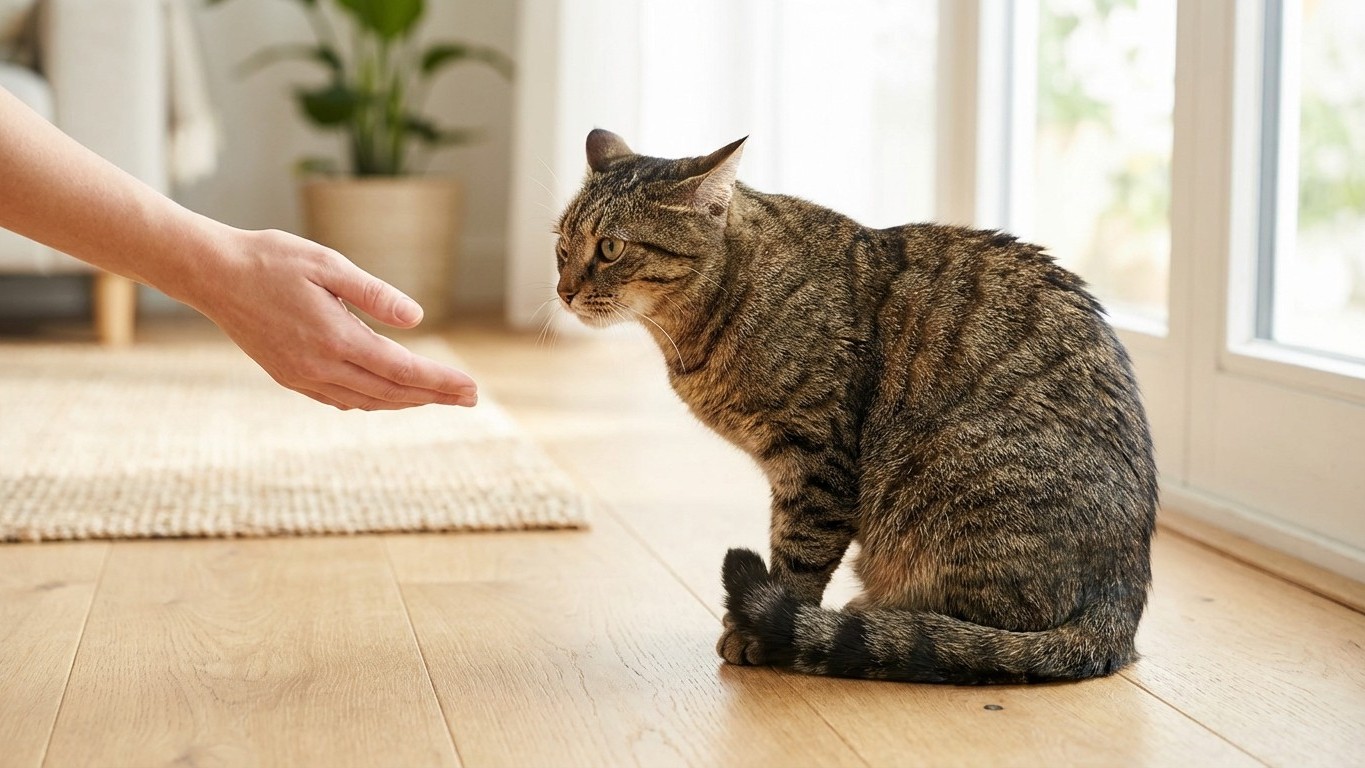
You pick your cat up for a cuddle. She goes rigid, flicks her tail, then bolts under the sofa the moment you put her down. You’re left wondering what you did wrong. The answer, according to feline behaviour specialists, might be hiding in plain sight, in the small, well-intentioned things you do every single day without thinking twice.
Cats are extraordinary communicators. They use the positioning of their ears, the tension in their tail, slow blinks, and the angle of their whiskers to broadcast exactly how they’re feeling. The problem is that most of us aren’t fluent in cat. We project human social norms onto animals whose stress responses are wildly different from our own, and the result is a quietly anxious pet that we genuinely believe is happy.
Key takeaways
- The one daily gesture most cat owners do that triggers your pet’s alarm systems
- Why your loving cuddles might actually feel like a threat to your cat
- The invisible stress signals your cat is sending that you’ve been missing all along
The Eye Contact Trap
Staring at your cat feels natural. You love her, so you look at her. For cats, though, prolonged direct eye contact is not affection, it’s a challenge. In feline social dynamics, holding another cat’s gaze Signals-pain/”>Signals confrontation or threat. When you lock eyes with your cat across the room, you may be triggering a low-level stress response without ever touching her.
The good news is that the fix is almost comically simple. Slow-blink at her instead. Half-close your eyes, look away briefly, then return your gaze softly. This is genuine cat body language for “I’m calm, I trust you.” Cats often return the gesture. It sounds daft, but there is real behavioural science behind it, researchers at the University of Sussex published work in 2020 confirming that the slow blink genuinely influences how cats perceive human interactions. Try it tonight.
Picking Them Up on Your Terms, Not Theirs
This is the big one. The daily gesture that probably stresses your cat more than anything else is being scooped up without warning, held longer than she wants, and put down only when you decide the cuddle is over. From your cat’s perspective, that’s a loss of control, and control is everything to a cat.
Cats are not physiologically wired for the kind of sustained physical contact that dogs tolerate happily. Their ancestors were (and in many cases still are) both predator and prey, and being restrained triggers hardwired alarm systems in the nervous system. A cat who goes stiff, tucks her tail, or pins her ears flat while being held is not being “grumpy.” She is communicating genuine discomfort.
The shift in approach is small but transformative. Let your cat initiate contact whenever possible. Sit on the floor, extend a hand, and wait. If she approaches and rubs her face on your knuckles, she’s marking you as safe territory, that’s her version of a hug. Follow her lead on duration. The moment she shifts her weight, turns her head, or twitches her tail at the base, put her down before she asks you to with her claws.
The Sounds and Smells You’ve Stopped Noticing
Your cat’s hearing range extends well beyond what humans can perceive. She can detect frequencies up to around 65,000 Hz, compare that to the roughly 20,000 Hz upper limit for most adult humans. This means that the ultrasonic hum of certain appliances, the squeal of a poorly-oiled hinge, or even specific phone notification sounds might be registering as genuinely unpleasant noise in rooms you consider perfectly quiet.
Then there’s scent. Cats have an olfactory system that puts ours to shame, with roughly 200 million scent receptors compared to a human’s 5 million. Plug-in air fresheners, scented candles, and heavily fragranced cleaning products can be genuinely overwhelming for a cat living at nose height in a freshly cleaned home. Citrus-based products in particular are aversive to most cats, which is exactly why they’re sometimes used as a deterrent spray.
Worth thinking about: when did you last clean your cat’s litter tray with a strongly scented product? If she’s started going elsewhere in the house, this might be the answer rather than any kind of “spite” (a concept that, for the record, feline behaviour specialists broadly reject as a motivation for cat behaviour).
Routine Disruption and the Invisible Pressure of Change
Cats are creatures of pattern in a way that goes deeper than most owners appreciate. Your cat has probably memorised your daily routine with an accuracy that would embarrass most personal assistants. She knows when you usually get up, when you put the kettle on, and roughly when you open her food. This predictability is not just comfort, it’s security.
Moving furniture, changing feeding times, having workmen in the house, or even switching cat food brands can tip a cat into a chronic low-grade stress state that owners often miss because it doesn’t look dramatic. Instead of yowling or obvious distress, you might see subtle signs: sleeping more than usual, a slight decrease in grooming (or an increase in over-grooming), eating more slowly, or withdrawing from rooms she previously enjoyed.
If you’re planning any significant change at home, giving your cat access to a consistent “safe space”, a room or corner where nothing changes, her bedding smells familiar, and foot traffic is low — can make a significant difference to how she navigates the disruption.
The really striking thing about all of this is how reversible it is. Cats are adaptable animals, and most stress responses linked to human behaviour ease off relatively quickly once the trigger is removed or modified. If you’ve noticed your cat seems tense, withdrawn, or irritable, a conversation with your vet is always the right first step, there can be physical causes behind behavioural changes that no amount of slow-blinking will fix. But if she gets a clean bill of health, it might just be worth asking yourself: whose needs are you really meeting during that daily cuddle?