
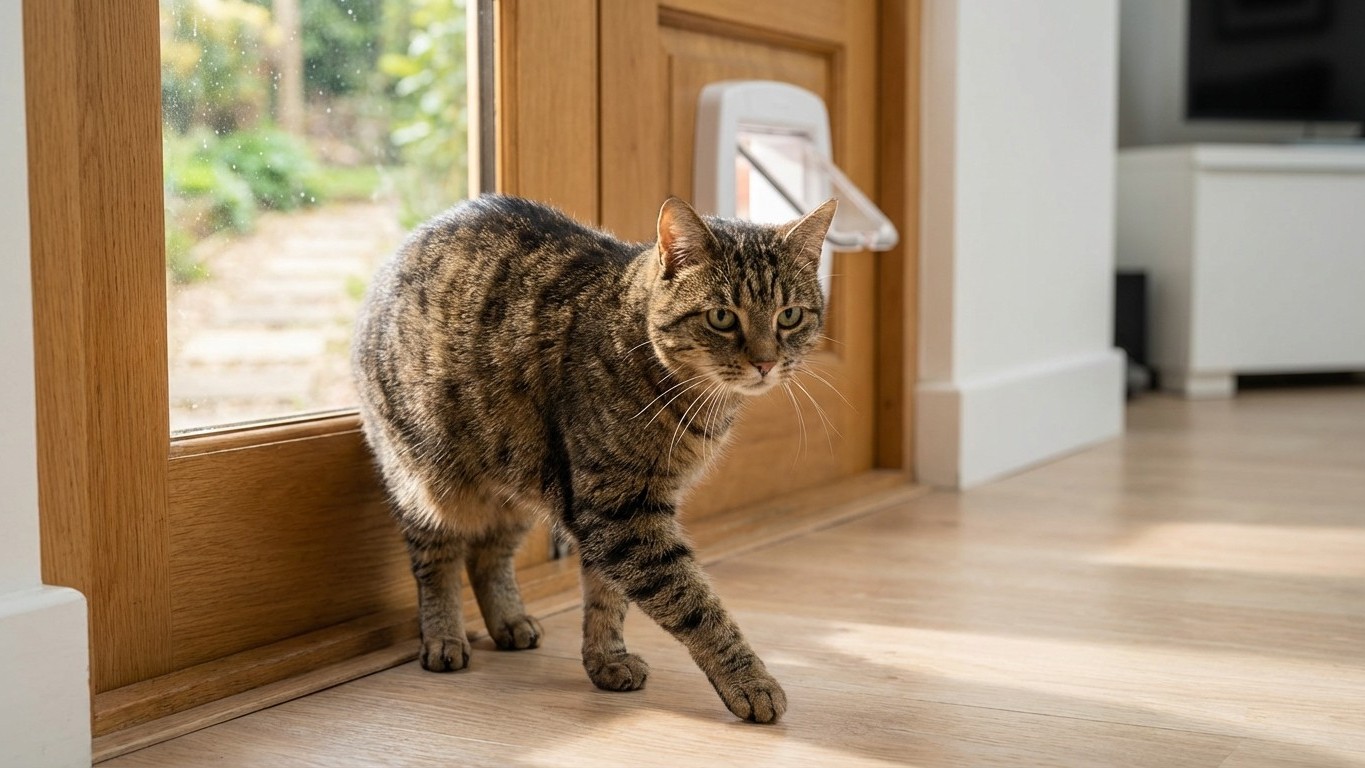
Seven months. That’s how long my cat, Biscuit, sat on the wrong side of the door, yowling at me with the righteous fury of someone who absolutely knew there was a perfectly functional cat flap installed right in front of him. He had sniffed it, batted it gently, and then decided, with the kind of conviction only a cat can muster, that it simply wasn’t for him. The fix, when I finally stumbled upon it, was almost embarrassingly simple, and every cat owner I’ve shared it with has had the same reaction: “Why didn’t anyone tell me this sooner?”
Key takeaways
- A cat’s refusal to use a flap often stems from fear, not stubbornness—but the reasons might surprise you
- One unconventional technique resolved months of frustration in less than 24 hours
- Even after solving it, there are other hidden factors that determine whether your cat will actually use it regularly
The psychology behind a cat flap standoff
Cats are creatures of genuine complexity. Unlike dogs, who tend to charge enthusiastically at any new experience, cats operate on a trust-based system. A cat flap presents a fairly unusual proposition from their perspective: push your head into an unknown space, temporarily losing sight of what’s behind you, and emerge somewhere else. That’s not stubbornness. That’s a prey animal running a risk assessment.
The flap mechanism itself can be the first sticking point. Many standard cat flaps create resistance that requires the cat to push with their head or shoulders. For a cautious animal, that sensation of pressure, especially around the face and neck, triggers an immediate retreat instinct. Kittens introduced early often adapt without much fuss, but adult cats who’ve never used one can find the whole experience deeply suspicious.
There’s also the sound. Even a relatively quiet flap makes a distinct click or thwack when it swings back into place. Cats with any anxiety or noise sensitivity can find that noise aversive enough to avoid the flap entirely, even if they managed to use it once. Biscuit, I’m fairly certain, fell into this camp. After months of observation, I noticed he’d flinch slightly every time it closed, regardless of whether he was near it.
What I actually changed (and why it worked)
The detail that transformed everything? I taped the flap open.
Not permanently, obviously. Just for a few days, using a strip of masking tape to hold the flap in a slightly raised position so Biscuit could see daylight through the opening. No resistance, no swinging, no click. Just a hole in the door. Within 24 hours he had walked through it. By day three, he was trotting in and out with the casual confidence of a cat who had invented the concept.
The principle behind this is solid. Cats Need to Understand the destination before they’ll commit to the journey. With the flap pinned open, Biscuit could see the garden on the other side, smell fresh air, and pass through without any sensory surprise. Once the route was established in his mental map as safe, reintroducing the flap (bit by bit, lowering it over several days) was straightforward. He already knew where he was going. The flap was just a minor inconvenience now, not an unknown threat.
Some owners find that leaving the flap open in stages works well too, propping it at various heights using tape or a small clip, gradually reducing the gap day by day. The goal is always the same: let the cat choose to engage with the space at their own pace, without forcing the physical sensation of the flap until they’re committed to the route itself.
Other factors worth reconsidering if the tape trick alone doesn’t do it
Scent plays a role that often gets overlooked. Cats mark their territory partly by rubbing their face glands on familiar surfaces, and a brand-new plastic cat flap smells of nothing except manufacturing. Rubbing a soft cloth on your cat’s cheeks and then wiping it across the flap can help introduce their own scent to the object, which signals safety. It sounds almost too easy, but feline communication relies heavily on scent in ways we tend to underestimate.
Placement of the flap matters more than many people realise when they’re choosing a door or wall to install one. A flap positioned in a location where the cat feels exposed, directly facing a busy street, or opening onto a spot where neighbourhood cats congregate — may be refused simply because the exit point feels unsafe. Cats prefer to emerge somewhere they can quickly assess their surroundings. If possible, ensure the exit opens into a sheltered area, with nearby cover like a bush or a low fence. That small environmental change can make a nervous cat dramatically more willing to commit.
Microchip-activated flaps, which have become genuinely popular in recent years, add another layer of complexity. Some cats are bothered by the slight delay as the sensor reads their chip before unlocking. If you’ve recently switched to a microchip flap after your cat was used to a standard one, that brief pause can feel unsettling enough to cause a regression. Patience and the same staged re-introduction process usually resolves this, but it’s worth knowing the mechanism is a possible cause.
And if you’ve tried all of this and your cat remains a committed indoor-only resident by personal choice, a conversation with your vet is genuinely worthwhile. Occasionally, an underlying anxiety disorder or a health issue affecting confidence and mobility can make new experiences harder to navigate. A vet can rule out anything physical and discuss whether behavioural support might help.
Biscuit now uses his cat flap with such casual frequency that I sometimes think he’s forgotten the whole saga entirely. Cats have that gift, the ability to act as though the problem was always yours to solve. Watching him slip through at 2am on some mysterious errand, I can’t really argue with the outcome, even if it did take seven months and a strip of masking tape to get there. How many other cat mysteries, I sometimes wonder, are hiding a solution that simple?