
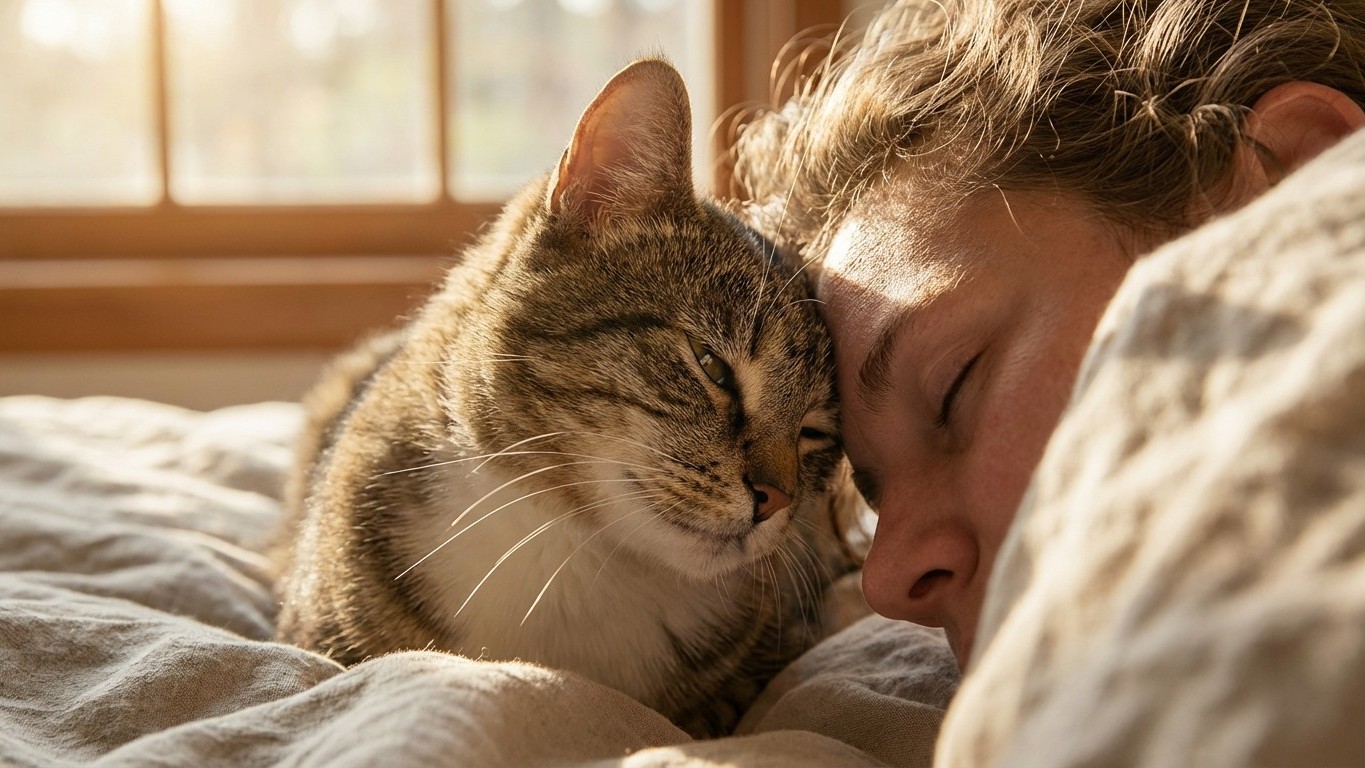
That moment happens somewhere between 5 and 6am. Your cat plants their warm, slightly damp nose directly onto your cheek, or presses their forehead firmly into yours, and stares at you with an intensity that would make a hypnotist jealous. Before you groan and pull the duvet over your head, here’s what’s Actually going on, because this quirky Morning ritual is far more meaningful than a simple demand for breakfast.
Key takeaways
- Your cat’s forehead press is called ‘bunting’—a behavior reserved only for those they truly trust
- That 5am wake-up call combines genuine affection with a perfectly-timed biological alarm clock
- By mixing their scent with yours, your cat is creating a shared group identity that reassures them
The Science Behind the Squish
Cats have scent glands concentrated in several areas of their face, including along the cheeks, chin, and forehead. When your cat presses their face against yours, they are engaging in a behaviour called bunting. It’s a form of scent marking, but not in the territorial, spray-the-sofa sense. Bunting directed at a person (or another cat) is an affiliative behaviour, meaning it signals closeness, familiarity and trust. Your cat is essentially saying “you belong to my group.” In feline social structures, this kind of facial contact is reserved for individuals they genuinely feel safe with.
The forehead-to-forehead press in particular, sometimes called a “head bump,” is one of the more intimate gestures in a cat’s behavioural repertoire. Feral cats and lions both do it within their social groups. The fact that your domestic cat extends this behaviour to a large, strange-smelling primate is, when you think about it, rather touching.
There is also a comfort dimension to this. Cats are creatures of scent, and by mixing their scent with yours, they are creating a shared “group scent” that is reassuring to them. You’ve been out all day, you’ve brought back the smells of the bus, the office, a stranger’s dog. A quick face press at dawn (or dusk, or any hour they choose) resets the olfactory record. You smell like them again. Order is restored.
What Your Cat Is Actually Communicating
The context of the behaviour matters enormously. A slow, gentle forehead press accompanied by half-closed eyes and a rumbling purr is about as pure an expression of feline affection as you’ll ever witness. Those softly blinking eyes, often called a “slow blink,” are themselves a signal of relaxation and goodwill. If your cat does all of this in one go, you can feel genuinely flattered.
The morning version of the face press, though, often comes with a slightly more transactional edge. Cats are crepuscular by nature, meaning they are naturally most active around dawn and dusk. Their internal clock is precise, almost alarmingly so, and it aligns breakfast time with first light. The face press in this context is still affectionate, but it’s affectionate in the way someone might say “I love you, and also, please feed me.” Both things can be true simultaneously. Cats are very good at that.
Some cats take this further with a behaviour called “kneading” on your chest or shoulder immediately after the face press, alternating their paws in a slow, rhythmic push. This stems from kittenhood, when they would knead their mother’s belly to stimulate milk flow. In adult cats, it signals deep contentment and security. If your cat treats your face like a morning check-in and then proceeds to knead you like bread dough, you have achieved something genuinely special in the feline world.
Should You Worry About Anything?
For the vast majority of cats, face pressing is entirely benign. A healthy, affectionate animal engaging in bunting behaviour with their owner is a good sign. That said, there is one scenario worth knowing about: if your cat begins pressing their head against walls, floors or hard surfaces with apparent force or urgency (rather than gently against you), this can signal a neurological issue. Head pressing of this kind is a Veterinary concern. Any sudden change in your cat’s behaviour, whether in how they sleep, eat, interact or move, warrants a call to your vet. It’s always better to check.
On the hygiene question that some owners quietly wonder about, cats’ faces carry bacteria, as all animals do, and they are meticulous groomers, but they also lick areas we’d rather not think about. If you have a compromised immune system, keeping feline-to-face contact minimal is worth discussing with your GP. For the average healthy adult, the occasional nose-to-cheek good morning is unlikely to cause any harm.
How to Respond (and Whether You Should)
Cats read human responses carefully. If you return the gesture by gently pressing your forehead against your cat’s, many cats will accept this warmly and lean in further. A slow blink back, deliberate, unhurried, is one of the best responses you can give, as it mirrors their own signal of calm and safety. Some cats will respond to this by immediately rolling over and going back to sleep, which is somehow both anticlimactic and deeply satisfying.
The question of whether to encourage the 5am alarm call is a different matter entirely. Feeding your cat immediately after they wake you reinforces the behaviour, which is worth Knowing if you’d rather sleep until seven. Many cat behaviourists suggest a timed automatic feeder as a way to decouple your waking up from their breakfast, gradually shifting the dynamic. Whether that actually works depends largely on the specific opinions of your cat.
What strikes me most about this behaviour, having written about animals for years, is how much cats are underestimated as emotional communicators. A species often dismissed as aloof or indifferent has developed a nuanced, physical vocabulary for trust and affection, one that includes pressing the most vulnerable part of their body, their face, against yours while you sleep. That’s not manipulation. That’s intimacy. The real question is whether we’re paying enough attention to notice it.