
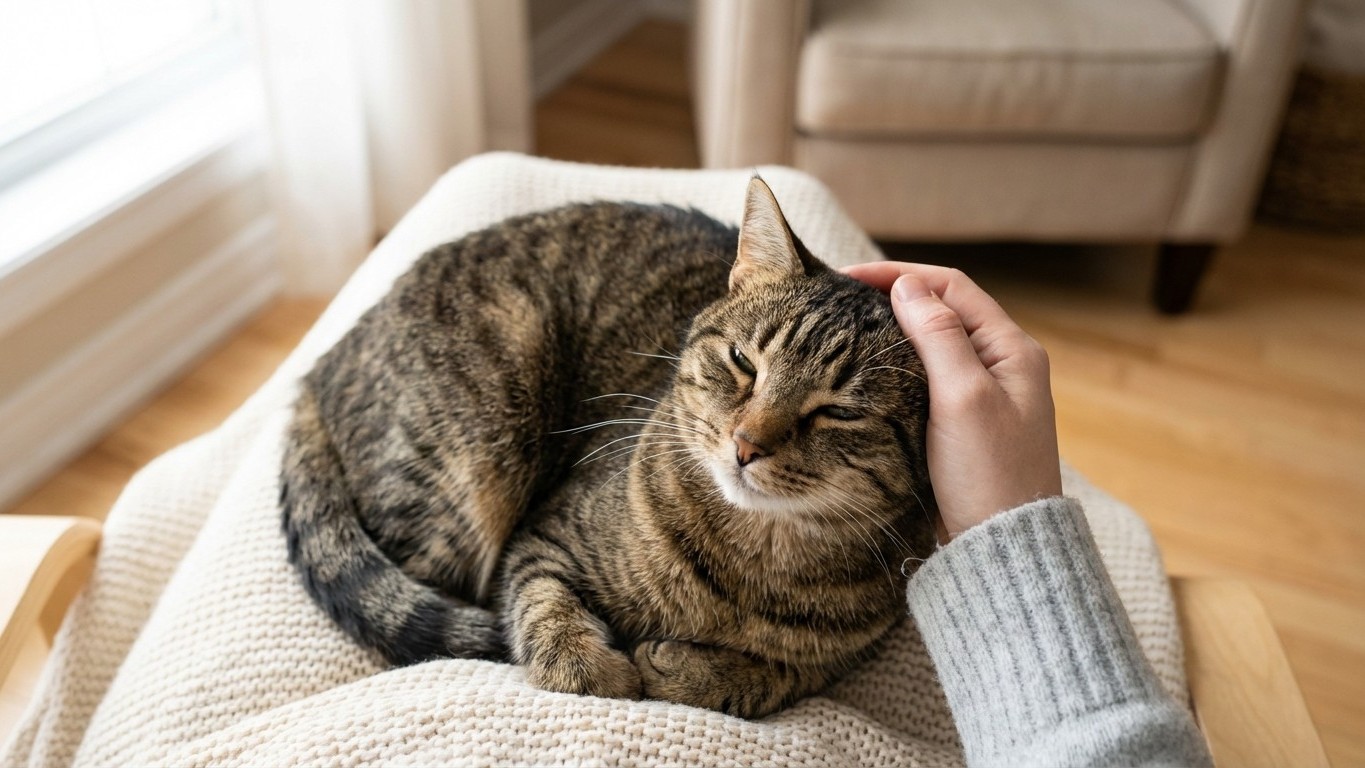
You’ve seen it happen. The cat who greets your partner at the door with slow blinks and head bumps, yet retreats under the sofa the moment your best friend walks in. Or the one who kneads biscuits on your lap every evening but treats every other family member like a mildly irritating background character. Cats forming a deep bond with just one person isn’t a quirk or a phase. There are real, biology-rooted reasons behind it, and understanding them can genuinely change how you interact with your cat.
Key takeaways
- The first weeks of a kitten’s life create a critical window that shapes who they’ll trust forever
- Cats read body language and scent more than personality—some humans naturally ‘speak cat’ better than others
- Your cat’s one-person bond might reveal more about their attachment style than about who they love
The first weeks of a kitten’s life matter more than anything that follows
Cats go through a socialisation window between roughly two and seven weeks of age. During this narrow period, their brains are primed to absorb information about who and what is safe in the world. Kittens who are gently handled by humans during this time, exposed to different voices, smells and environments, tend to grow into cats who are broadly comfortable with people. Those who miss out on that early contact often spend their entire adult lives wary of strangers, even if they adore the one person who eventually earned their trust.
This window closes surprisingly fast. A kitten who has had limited human contact by eight weeks is already playing catch-up. That doesn’t mean they can never bond with people, but it does mean the process requires far more patience, and the resulting attachment often goes to whoever put in that work. In multi-person households, this usually means the person who feeds them, who moves slowly, who reads their body language correctly and backs off when the cat asks them to. Trust, with cats, is a currency you earn.
Why some humans just “speak cat” better than others
Here’s something worth sitting with: your cat may not prefer you because of who you are as a person, but because of how you move through the world. Research into cat-human communication suggests cats are highly attuned to non-verbal cues. Someone who sits quietly, avoids direct prolonged eye contact, lets the cat make the first move, and blinks slowly is sending all the right signals. Someone who leans in too fast, stares, or tries to pick the cat up uninvited is, in cat language, being frankly rude.
Children often struggle for this reason. Not through any fault of their own, but because the enthusiastic, unpredictable energy of a young child conflicts with almost everything a cat finds reassuring. The same cat who sleeps on a calm teenager’s bed might bolt from a boisterous six-year-old, even if both children genuinely adore them. Cats aren’t judging character. They’re reading signals.
There’s also scent to consider. Cats have an olfactory system that makes ours look embarrassingly basic. The person they bond with often becomes a familiar, comforting smell, associated over months and years with safety. A cat who has lived with someone for three years has built up a complex sensory archive of that person. A visitor smells unknown, and unknown, to a cat, means unpredictable.
The role of attachment style (yes, cats have one)
A study published in 2019 by researchers at Oregon State University found that domestic cats form attachment bonds to their owners in ways that parallel infant attachment to caregivers. They categorised cats as secure or insecure attachers, much like developmental psychologists do with children. Securely attached cats use their owner as a safe base to explore from, showing distress when left alone but calming quickly on return. Insecurely attached cats either became clingy and anxious, or appeared indifferent in ways that masked underlying stress.
The study found around 64% of cats displayed a secure attachment style, which challenges the popular narrative that cats are fundamentally aloof and independent. What it also suggests is that the quality of that bond matters as much as its existence. A cat who has bonded with one person in a genuinely secure way is more likely to be confident and sociable overall. A cat whose single attachment is rooted in anxiety may seem devoted but is Actually struggling.
If your cat shadows only you, cries excessively when you leave, or becomes destructive in your absence, that’s worth discussing with a vet or a qualified animal behaviourist. Attachment and anxiety can look identical on the surface.
Can you change who your cat prefers?
Yes, though patience is the only tool that Actually-leave-your-cat-home-alone-veterinary-guidelines-for-2026/”>Actually works. If someone in your household feels ignored by the family cat, the worst thing they can do is try harder in the conventional human sense: seeking the cat out, offering strokes, picking them up. The better strategy is almost counter-intuitive. Sit in the same room. Don’t make eye contact. Let the cat come over on their own terms. Have that person be the one who feeds them, even occasionally. Scent and positive association are powerful.
Some cats do expand their circle over time, particularly if their core attachment person is present and relaxed during introductions. A cat is more likely to accept a new person if their trusted human is visibly at ease around them. You’re essentially vouching for someone in a language your cat understands.
There are cats, though, who will always be a one-person animal. Genetics, early experience, and individual temperament all play a role, and some of that simply isn’t negotiable. Accepting a cat for the social creature they actually are, rather than the one you hoped they’d be, is the most respectful thing you can do for them. And if it happens to be you they’ve chosen? That particular feline endorsement, hard-won and quietly given, is something rather special.