
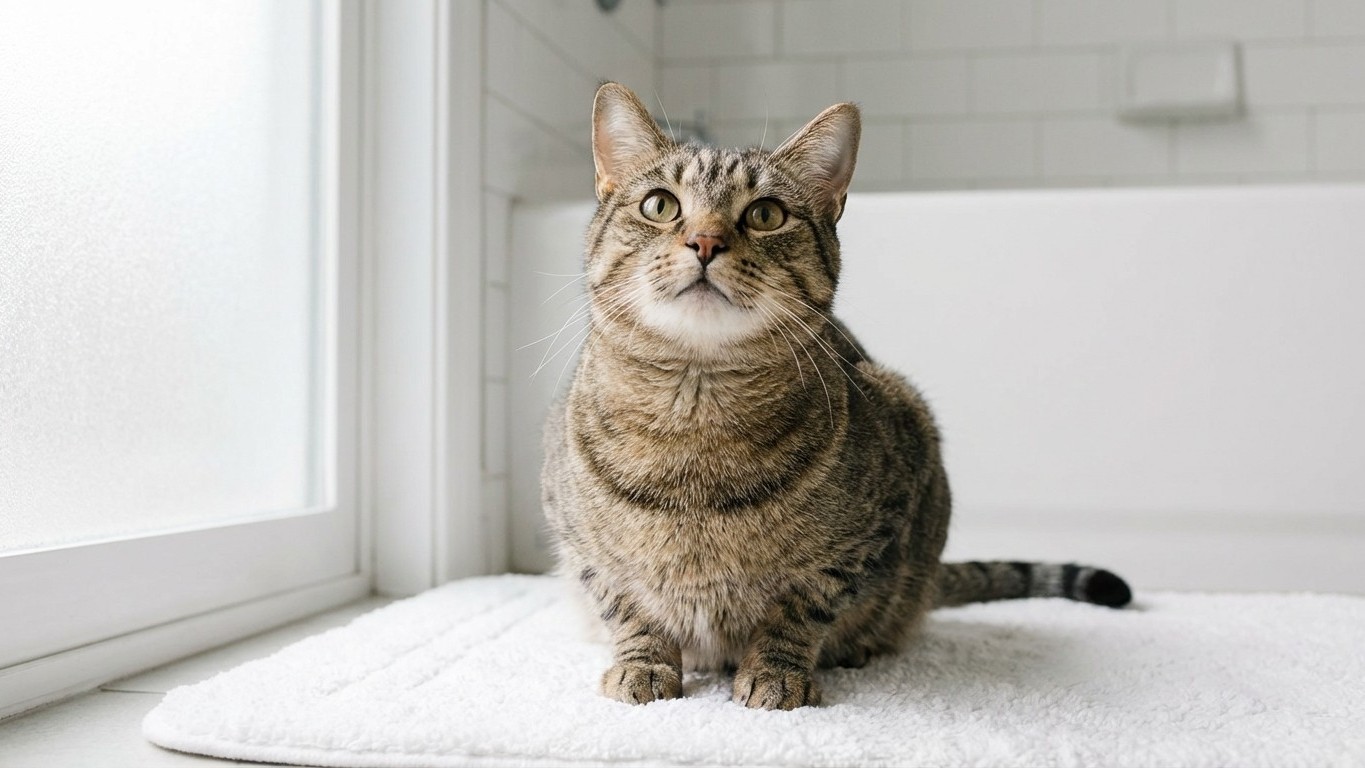
Your cat sits outside the bathroom door, pawing at the gap underneath. You open it for thirty seconds and they march straight in, supervising proceedings with an air of supreme authority. Sound familiar? This behaviour baffles cat owners endlessly, but animal behaviourists have spent years piecing together why it happens, and the answer is far more emotionally layered than most people expect.
Key takeaways
- Cats are obligate social animals who form genuine attachment bonds with their owners—not the aloof creatures we thought
- Your cat sees a closed bathroom door as an anomaly threatening your safety, not a privacy boundary
- Excessive bathroom-following combined with anxiety signs might signal separation anxiety requiring professional intervention
You’re the Most Interesting Thing in the Room
Cats are obligate social animals, which surprises people who’ve spent years believing the myth that cats are fundamentally solitary. Domestic cats, shaped by thousands of years of living alongside humans, have developed genuine attachment bonds with their owners. Research from Oregon State University confirmed that many cats display secure attachment behaviour similar to what you’d see in dogs and even human infants. Your cat following you to the bathroom isn’t random nuisance behaviour. It’s attachment in action.
The bathroom specifically holds an odd appeal. Think about it from a cat’s perspective: you’ve disappeared behind a closed door, which in feline terms is genuinely suspicious. Cats are hardwired to monitor their territory and the beings within it. A shut door doesn’t read as “privacy please” to a cat. It reads as an anomaly. You’ve voluntarily separated yourself from them, and their instinct is to fix that immediately. There’s also something almost comedic about the power dynamics at play here. Your cat spends the day largely ignoring you, and the moment you attempt a quiet five minutes alone, suddenly you’re the most compelling creature on earth.
Safety in Numbers (Even in the Bathroom)
Wild cat ancestors were both predators and prey. That dual status left a deep behavioural legacy. In the wild, a cat attending to bodily needs is momentarily vulnerable, and staying close to a trusted companion during vulnerable moments is an instinct that hasn’t been fully domesticated away. Your cat may actually be offering you a form of companionship during what their Ancient-instinct-that-changes-everything/”>Ancient wiring reads as your vulnerable moment. It’s oddly touching when you frame it that way.
Behaviourists also point to the concept of allogrooming and social bonding time. Cats within a bonded group groom each other, sleep near each other, and generally maintain proximity throughout the day. Your cat has inducted you into their social group. Following you everywhere, including the bathroom, is their version of staying connected. The closed door isn’t just an inconvenience; from their perspective, it’s a small social rupture they want to mend.
There’s a practical dimension too. Cats are notoriously clever about routine exploitation. If following you to the bathroom has ever resulted in extra fuss, a treat, or even just attention (even being told off counts as attention to a cat), they’ve logged that information carefully. Cats learn fast what behaviours produce responses from their humans, and they repeat them. You may have accidentally trained your cat to follow you without ever meaning to.
When It Becomes More Than Cute
Most of the time, bathroom-following is harmless and even endearing. A cat who trots in, sniffs around, and settles on the bath mat while you shower is simply a sociable creature doing sociable things. The behaviour becomes worth examining more carefully when it’s accompanied by other signs of anxiety: excessive vocalisation when you’re out of sight, destructive behaviour when left alone, over-grooming, or toileting outside the litter box. These can point to separation anxiety, which is more common in cats than historically recognised.
If your cat’s clinginess seems frantic rather than casual, a conversation with your vet is genuinely worthwhile. There are behavioural interventions and, in some cases, medical considerations that can help. Never assume anxious behaviour is “just the cat being dramatic.” Chronic stress in cats has real physical consequences, affecting everything from immune function to digestive health. A vet can help distinguish between a cheerfully nosy cat and one who’s genuinely struggling with separation.
For cats who follow due to genuine anxiety, environmental enrichment makes a real difference. Puzzle feeders, window perches, and dedicated play sessions help create a cat who feels confident in their territory rather than dependent on your constant proximity. Feliway diffusers, which release synthetic feline facial pheromones, have a reasonable evidence base for reducing stress-related behaviour in some cats, though results vary between individuals.
What Your Response Should (and Shouldn’t) Be
The temptation is to shut the bathroom door firmly and ignore the performance outside. That works for some cats. Others will simply escalate, scratching at the door and yowling until you emerge, at which point they’ll stare at you with the expression of someone who won a minor battle and knows it. The worst thing you can do is open the door specifically to quiet them down. That teaches precisely the wrong lesson.
A gentler approach is to occasionally leave the door open when you don’t mind the company, and gradually make your bathroom exits unremarkable. Step out, offer no fanfare, go about your day. The more neutral your departures and arrivals, the less charged the whole situation becomes. Cats find predictability genuinely calming, and routine that includes easy access to you is usually enough to satisfy most bathroom-followers without reinforcing anxious behaviour.
The real question worth sitting with is this: what does it say about the bond between humans and cats that an animal capable of ignoring you spectacularly for hours will paw through a closed door just to sit near you in an unremarkable room? There’s something quietly profound in that. Your cat, for all their theatrical indifference, has decided that where you are is simply where they want to be. Even if where you are is the bathroom.
Sources : sciencedirect.com | drbillspetnutrition.com