
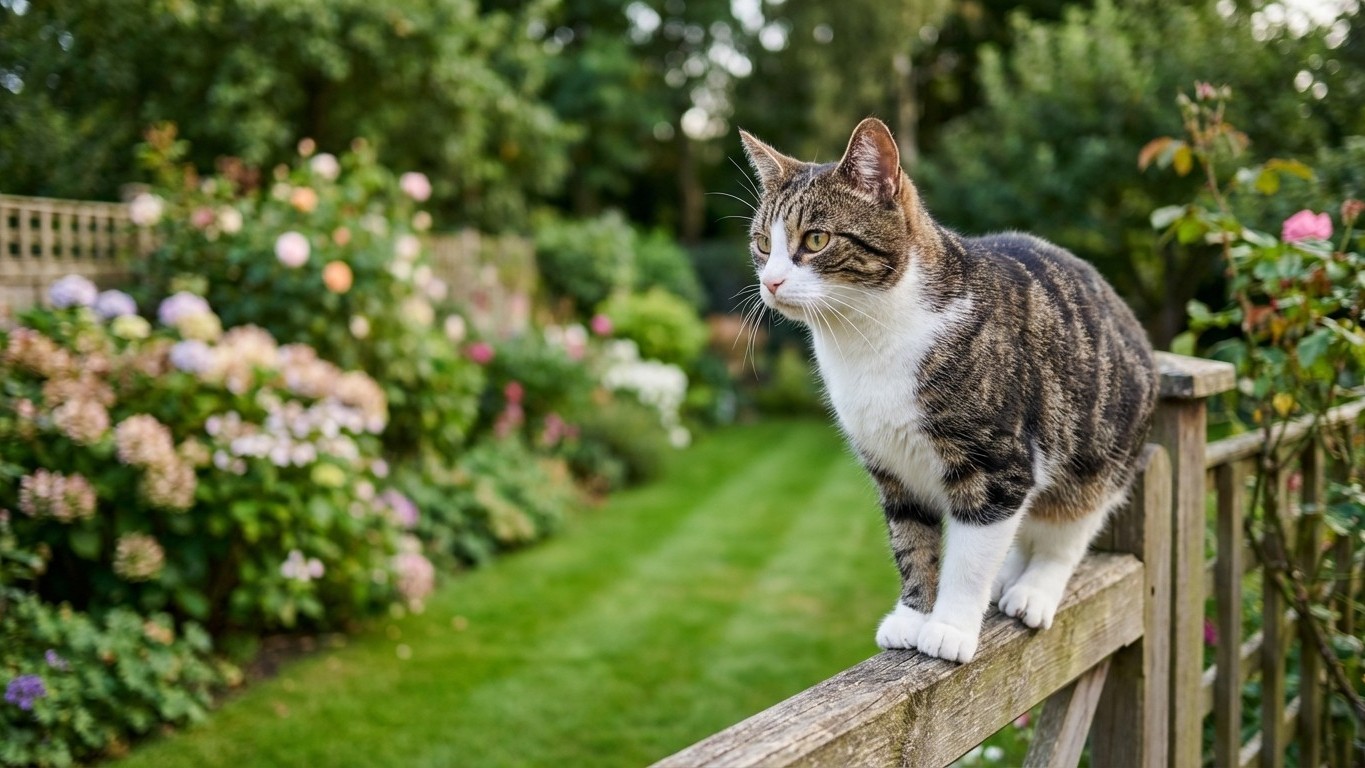
“I Thought my garden was safe enough.” Those words echo in countless cat owners’ minds after an unexpected escape, mishap or, in far too many cases, heartbreak. The simple act of letting your cat explore your carefully fenced, flower-filled patch seems harmless, even responsible. Yet, one overlooked detail repeatedly catches devoted owners out, year after year.
Key takeaways
- How cats exploit overlooked garden gaps and features to escape.
- The hidden toxic plants and poisons threatening your cat’s health.
- Innovative solutions to keep adventurous felines safely entertained.
The Invisible Dangers Lurking in ‘Safe’ Gardens
With British gardens resembling miniature Edens, complete with blossoming beds and neat lawns, it’s easy to believe these spaces double as sanctuaries for cats. You might glance at your boundaries, nod, and assume your feline can’t possibly wander off. But here’s the snag: cats are evolutionary escape artists. What defeats a fox or dog is little trouble for these clever climbers and contortionists. A six-foot fence? Merely an interesting obstacle. A hedge? Camouflage. Even narrow gaps at the base of fences or around sheds are often exploited with mind-boggling ingenuity.
What surprises most cat owners isn’t just how determined some cats can be to break free, but how quickly they spot new escape routes. One recent survey found nearly half of British cat owners believed their garden “fully secure”, yet reported at least one unexpected feline disappearing act in the past twelve months. The most common culprits? Overlooked gaps behind wheelie bins, dangling branches acting as launchpads, or even the tempting scaffolding next door during home renovations. That one time you leave the garden gate ajar for a second might be all it takes for a whiskered Houdini to vanish.
Minimising the Risks: What Really Works?
Once you accept that gardens are never quite as foolproof as we’d like, the conversation quickly turns to solutions. High fences and sturdy gates are a start but rarely solve the problem entirely. Cats jump vertically with astonishing power, some easily scaling two-metre barriers from a standing start. Beyond the barrier lies a world of stimulation: birds, insects, neighbourhood scents, curious neighbours, and, of course, rival moggies strutting their stuff. Few cats resist the urge forever.
Some owners turn to purpose-built cat fencing systems. These ingenious contraptions, launched widely across the UK since 2020, use angled toppers to make outbound climbing tricky (though nothing, really, is impossible where motivated cats are concerned). Catios, enclosed patios for cats, have found a growing following. The best versions let cats sunbathe, play, and bask in garden sights, all with robust mesh protection. Well-constructed catios offer more peace of mind than almost any other approach, with the added bonus that even the laziest feline gets a break from staring at four walls.
Still, for many households, a full-scale catio isn’t practical. If that’s you, think like a cat and walk your boundaries daily. Inspect for recent digging (from foxes or badgers), holes by compost bins or under sheds, or newly overgrown plants providing accidental cover. Remove climbing aids: trellis panels, decorative or practical, are irresistible. Those charming stacked flowerpots? Steps to the top, as far as your cat’s concerned. Can you add netting at boisterous corners? A strip of smooth, shed roof material along fences also helps deter persistent paws.
Never underestimate how a new garden feature may alter the security equation. A full wheelbarrow, left leaning against a fence, can be the difference between “safe” and a quick farewell. Even a summer paddling pool, covered or uncovered, carries hidden hazards for curious cats. Remember: what’s safe one week can change in an instant, especially after a gale collapses that old fence panel you’d meant to replace.
Wildlife, Poisons, and the Perennial Garden Hazards
Physical escape isn’t the whole story. The real kicker is this: even if your garden boasts cat-proof fencing, what lurks within those borders might threaten your cat’s health. Lilies, so common they seem innocent, contain toxins fatal to felines even in tiny quantities. One nibble, even just brushing pollen onto fur then grooming, can trigger acute kidney failure. The RSPCA received an uptick in emergency calls after the warm spring of 2025, largely connected to cats encountering unexpected garden hazards. It’s not just lilies. Azaleas, foxglove, and yew, among others, are best kept far from any green space cats inhabit.
Slugs and snails bring their own issues. The pellets sold across many UK garden centres might seem like a quick fix, but ingesting even a few can prove lethal for cats. Recent campaigns are urging gardeners towards wildlife-friendly, toxin-free alternatives. And let’s not forget curious kittens and rodenticide baits, or the risk of an encounter with a hedgehog or toad, potentially resulting in bites, stings, or episodes of curiosity-gone-wrong. If you ever believe your cat has ingested something potentially harmful, contact a vet as soon as possible.
Leaving bowls of food outside, hoping to attract a passing hedgehog or squirrel? You might find local foxes, rats, or other less welcome guests turn up instead, causing unexpected conflicts and disease risks for both your cat and local wildlife. The garden ecosystem, so rich and varied, needs thoughtful management wherever cats mingle.
Is the Adventure Worth the Risk?
Cats exist in that peculiar space between independence and domesticity. A garden can add texture, movement, and sheer joy to their lives. Yet the “one mistake”, assuming perfect safety — brings risks that can’t be ignored. One friend confessed his tabby learned to open the back gate latch with a mere flick of a paw, the sort of plot twist you can’t predict until you see those wide green eyes on the wrong side of the garden wall.
The reality? There’s no single answer, just a spectrum of better and worse options. Thorough inspection, adaptation to your cat’s talents, and ongoing vigilance help more than grand plans alone. Every garden tells its own story with every season, but if you care for a cat, that story is always being rewritten, one leap and tumble at a time. How might our gardens evolve, not for security, but for true shared enjoyment — feline and human alike?