
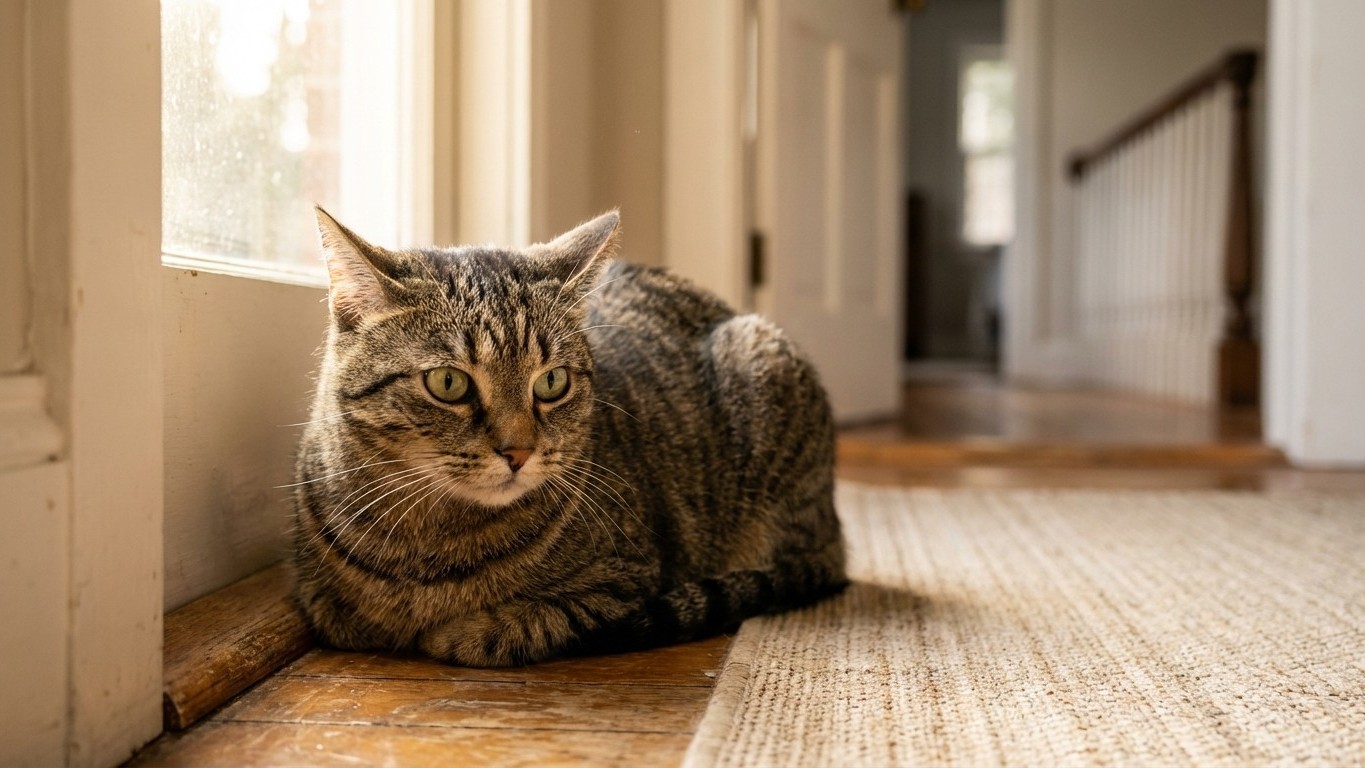
Separations and divorces are hard enough on the humans involved. But spare a thought for the cat sitting in its carrier, heading towards a second address it can barely map yet, while its carefully memorised territory starts to feel like shifting sand. The number that matters here isn’t the floor plan, the distance between the two homes, or even the quality of the sofa. It’s three. Three days, three weeks, three months: the window within which a cat will either settle or start to shut down.
Key takeaways
- A mysterious three-day threshold separates cats that cope from those that crack under the strain of split custody
- Territory isn’t sentimental for cats—it’s pure biology, and disrupting it triggers stress responses that damage health
- One simple consistency strategy works better than most owners realize, but not all cats can be saved from this arrangement
Why territory means everything to a cat
Cats are deeply territorial creatures who form strong attachments to their physical environment, building mental maps of their space, establishing scent-marked boundaries, and developing routines based on familiar surroundings. That’s not sentimentality. It is biology. Domestic cats are descended from solitary, territorial hunters, and while they can form social groups under the right conditions, their natural survival strategy relies heavily on territorial control.
When a cat’s brain interprets a threat, whether that threat is a territorial conflict, a sudden change in scent, or an unpredictable routine, it activates the sympathetic nervous system. During this activation, stress hormones like cortisol and adrenaline are released. A new address qualifies as a threat, full stop. When cats are removed from familiar territory and placed in an unknown environment, their stress response systems activate in ways that can be measured through elevated cortisol levels, changes in immune function, and alterations in behaviour patterns. The cat shuttling between two homes is not merely adapting to different sofas. It is being asked to rebuild its entire psychological map from scratch, repeatedly.
The stakes are real. Research in feline medicine links chronic stress to changes in bladder health, gastrointestinal function, immune regulation, and skin integrity. Cats experiencing prolonged stress are more prone to conditions such as idiopathic cystitis, digestive upset, and excessive grooming. A cat that stops using the litter box, starts over-grooming, or refuses food isn’t simply being difficult. It’s telling you something is physiologically wrong.
The 3-3-3 rule: the number that decides everything
The 3-3-3 rule is a helpful guide: it takes cats about three days to decompress, three weeks to get the household routine down, and three months to bond and fully relax. In a single-home scenario, this progression is manageable. For a cat moving between two homes on a weekly or fortnightly schedule, the maths become more complicated, and this is where the arrangement can either work beautifully or unravel entirely.
The first three days are the crunch point. This guideline offers a general timeline for how long it may take a cat to feel Comfortable in a new environment. Three days to decompress: in the first few days, your cat may hide, avoid contact, or seem unsure about their new surroundings. Research shows that single cats that had been in a shelter less than four days demonstrated higher stress levels than those who had been given longer to settle. For a cat being moved weekly, that first four-day window is essentially reset every time it arrives at a new address. The cat never fully leaves the decompression phase.
By the three-week mark, something shifts. By the end of the third week, a cat will start feeling more comfortable in their new environment, begin exploring more, and may even start to develop a routine. This is why longer custody intervals often work better. If Your Dog or Cat is new to one or both of the households, try splitting up your custody arrangements into longer periods, weeks or even months if possible, so your pet will have more time to adjust to each location. A three-week minimum at each address gives the cat a genuine chance to map the territory, embed familiar scents, and build behavioural confidence before the next switch.
Which cats cope and which ones crack
Not all cats are created equal when it comes to environmental upheaval. Adjustment timelines vary widely depending on a cat’s personality, history, and environment. Bold, social cats may acclimate within three to seven days, exploring confidently and resuming normal eating habits. Shy, anxious, or previously traumatised cats often require two to six weeks to feel secure. A confident, adaptable cat that has been accustomed to travel or regular visitors from kittenhood stands a far better chance of handling dual-home life than a timid, elderly, or intensely territorial animal.
Many families successfully maintain shared custody of cats by creating near-identical setups and keeping moves predictable; cats become accustomed to the routine and display minimal stress. Some cats initially show mild stress, such as hiding or decreased appetite, for one to three weeks and then normalise. A minority of cats develop chronic stress or litter-box problems; in those cases, reducing moves or designating one primary home often resolves issues.
There is also an important practical consideration. The key to managing a two-home arrangement is not to introduce cats to a “third-party” cat when they change locations, and to keep their items, such as food, litter, and toys, in the same location when they get there. Consistency of layout across both homes may sound fussy, but for a cat that navigates by scent and spatial memory, finding the litter tray in the same relative position is not a small detail. It is a signal that says: you are safe here.
What actually helps a two-home cat thrive
The single most protective factor is predictability. In the domestic environment, both changes in the husbandry routine and inconsistency in the owner’s reaction to the cat’s behaviour may cause chronic stress. Feeding at the same times, using the same food, and maintaining the same rules across both homes removes a significant source of anxiety. The American Association of Feline Practitioners cites consistent routines as a stress-management strategy that can help prevent health issues.
Environmental enrichment matters more than most owners realise. Research found that cats from a more enriched environment have almost half the level of cortisol in their hair than cats from an environment with fewer resources. Each home needs vertical space (a cat tree or high shelf), dedicated hiding spots, and familiar-smelling bedding. Sending the same blanket with the cat between homes is one of the simplest things you can do. The scent travels; the security travels with it.
Synthetic feline facial pheromones, available as plug-in diffusers, are worth considering for anxious cats. The F3 feline facial pheromone is believed to calm cats in stressful situations or new environments by mimicking territorial markings. The evidence on their effectiveness varies by individual animal, but they are safe, widely available in UK pet shops, and worth trying at both addresses during the initial transition period.
There is also the question of what to watch for if things are not going well. High levels of stress in cats can cause changes in food intake, grooming, general activity, exploratory behaviour, facial marking, and interactions with other cats and humans, as well as increased vocalisation, anxiety, urine spraying, and aggressive behaviour. If these signs persist beyond three weeks at either home, take that seriously. Any new or persistent physical symptom, including changes in toileting, eating, or weight, warrants a conversation with your vet, who can rule out a medical cause before assuming the problem is purely behavioural.
The honest answer, uncomfortable as it may be, is that some cats will never fully accept the two-home arrangement. Cats can experience stress reactions like dogs, but they are even more likely to become distressed. Almost all cats handle stressful situations poorly. They are particularly susceptible to social stresses, so it is wise to monitor them closely. For those individuals, one settled home with supervised visits from the other person may be the kinder option. The hardest part of loving a cat is accepting that their comfort does not always align with our own.
Sources : quora.com | mountainguardians.org