
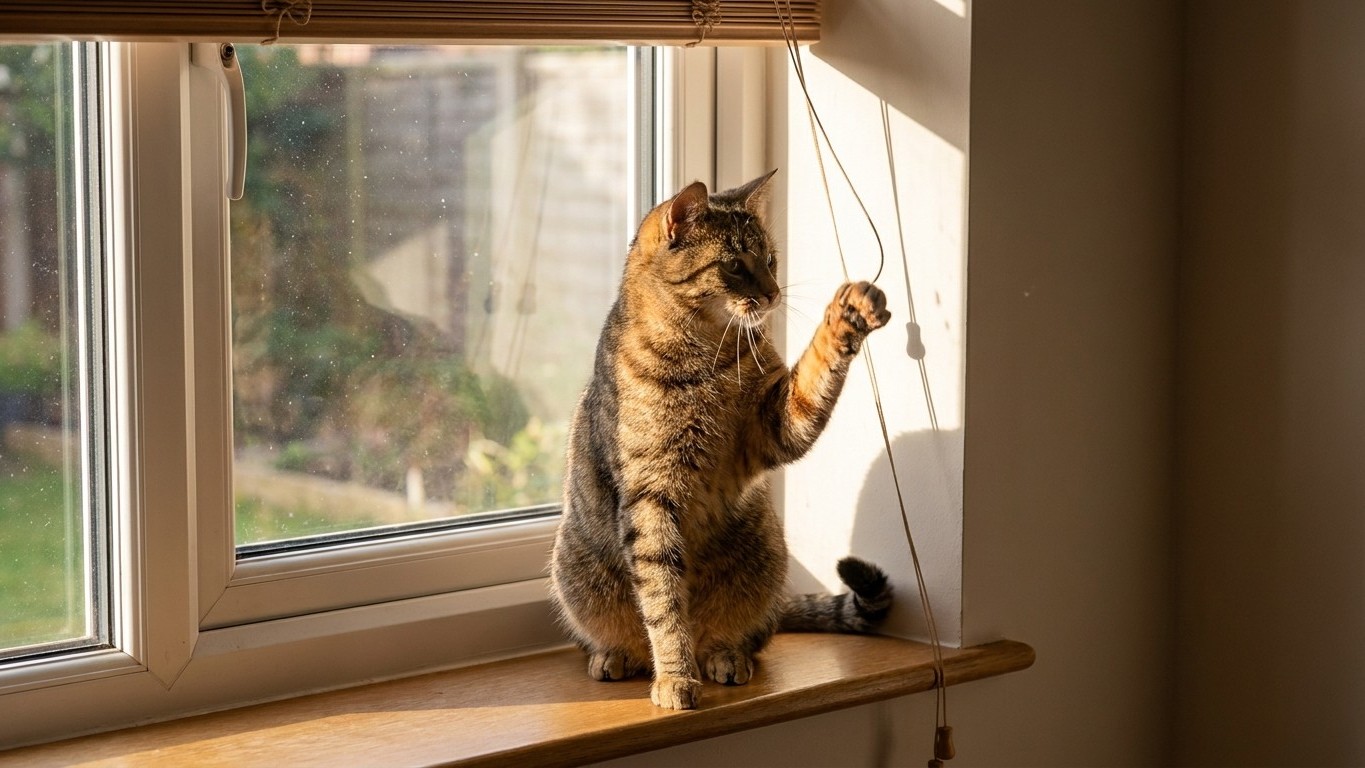
Every afternoon in May, the same window. The same cat, paw raised, batting rhythmically at something just out of sight behind the blind. For most of us, it reads as standard feline eccentricity, a bit of afternoon entertainment, the kind of behaviour we film and post rather than worry about. But the moment you time how quickly a blind cord can become a noose, the whole thing shifts completely.
Key takeaways
- A cat can become fatally entangled in window blind cords in less than a second—with no warning sound
- Blinds installed before February 2014 may lack safety features that prevent cord strangulation
- Cordless alternatives and interim fixes exist, but removing the risk entirely is the only truly safe option
Why Your Cat Is So Obsessed With That Window
Cats seek out sunshine to feel warm and relaxed, but they’re also hardwired to prefer warmer environments, as they chase those rays around your home, it isn’t just a cosy habit, it’s something instinctual. In May particularly, the afternoon sun hits living room windows at a low, golden angle in Britain, casting moving shadows and flickering light patches across the floor. Moving light patterns mimic the erratic movements of potential prey. To a cat, a dancing dot on the wall isn’t abstract — it registers as something alive, unpredictable, and worth pursuing, with the sudden start-stop motion and changes in direction mirroring the behaviour of real prey, triggering an automatic hunting sequence.
Cats have a strong natural urge to climb and perch in high places, an instinct that can lead them to seek out window sills and blinds as ideal vantage points to observe their surroundings and look for potential prey. Pair that with the blind cord itself, which, dangling and swaying, is essentially a purpose-built cat toy fitted to your wall — and you have a recipe for daily ritual. Kittens especially like to play with dangling things and eventually end up becoming entangled in them, unable to release themselves, at which point they are in danger of being strangled. The problem is that what looks like harmless batting can, in a single unlucky movement, become a life-threatening entanglement.
The Danger Nobody Thinks About Until It’s Too Late
The internet is full of stories of cats being found dangling in the window blinds by a single hind leg, or with a paw, tail, or other body part entangled in a tourniquet of blind cords. In some extreme cases, cats have lost their lives to this seemingly harmless bit of home décor. The mechanism is grimly simple: any time a window-blind cord features a cord or tassels that dangle, there is a possibility that over time they will intertwine and twist, forming a loop, and a child or pet may put their head through the intertwined loop and strangle.
Even if your cat is smart enough to keep the blind cords out of his mouth, he might not be smart enough to keep them from becoming entangled around a body part. It’s easy enough to slip partway through some window blinds, but it’s less easy to back out again, especially as the blinds start moving and making funny noises, the angled slats make it almost impossible for a cat to simply reverse course. The more the cat struggles, the tighter the cords can become. A cord wrapped too tightly around a limb, tail, paw or toe can cut off circulation or breathing and cause cell death. A cord around a neck can choke a cat.
The speed at which disaster strikes is the part that genuinely shocks people. It only took a fraction of a second for one eight-month-old kitten to jump off the windowsill and get her neck caught, and then dangle from the cord, she struggled briefly, and if the owner wasn’t in the same room and three steps away, she could have died. This isn’t a slow-building risk. It’s a matter of seconds, in a room you’re not in, with a cat who makes no sound at all.
What the UK Law Says, and Why Your Old Blinds Are the Real Problem
All blinds produced and sold after February 2014 must comply with specific child safety requirements under BS EN 13120. Some existing blinds installed before February 2014 may have cords or chains that could pose a serious hazard to babies and young children, and, by extension, to pets. In February 2014, new UK regulations were introduced following a number of blinds-related fatalities, establishing the British safety standard for internal blinds. Every set of blinds must now comply with these rules, regardless of whether children are present in the home.
According to the BS EN 13120 regulations, blinds must have no accessible cords, if they do, they must be fitted with appropriate child safety devices. For all blinds with pull cords, there must be a 150cm distance between the bottom of the cord and the floor, reduced to 60cm if a breakaway device is fitted. A breakaway device is a safety feature whereby the chain compartments separate from the rail if pressure of more than 6kg is applied, ensuring that should a child become entangled, the cord will fall to the floor. The same breakaway mechanism protects a cat, though the physics of a panicking feline are somewhat less predictable than a specification document might suggest.
The critical word here is old. If you have an older blind that doesn’t have a breakaway in the cord or a P-clip fixing to keep it secured to the wall, this could potentially make it a hanging risk for your cat, and replacing it as soon as possible is strongly advisable. Renting? Trading Standards guidance makes clear that landlords are responsible for ensuring their rental properties are free from health hazards, and this includes potentially dangerous blind cords.
What to Replace Them With, and What to Do Right Now
The straightforward answer is cordless. Plantation shutters are often the safest and most durable option for homes with cats, because they are fixed within a full frame and do not swing or flap, they eliminate many of the risks associated with traditional blinds. They’re also, frankly, very good-looking, which softens the financial sting considerably. Flat blinds won’t have a way for a cat to get through and could prove enough of a barrier. Vertical blinds allow you to keep some space between the slats so the cat can see out, and cordless blinds are ideal for felines only interested in the swinging cord.
If replacing every blind in the house immediately isn’t realistic, there are interim steps. Try putting a hook on the wall next to the blinds, then wrapping the cord around it, this gets the cord out of the way, and hopefully it’s a case of out of sight, out of mind for the cat. Chain tensioners are another popular safety device. Roller blinds use looped chains to lower and raise the blind, which can be risky for children and pets — but by using a tensioning device, you can ensure the chain is tight enough that it no longer poses a risk. Cord cleats, available cheaply from any DIY shop, can secure excess cord to the wall. None of these are as reliable as removing the cord entirely, but they are better than doing nothing while you save up for new blinds.
Consider replacing the blinds one room at a time, starting with those that pose the biggest potential risk or the rooms where your pet spends most of their time. For most cats, that means wherever the afternoon sun falls in May, which is probably where the problem started in the first place.
One thing worth knowing: unlike humans, cats cannot produce vitamin D through skin exposure to sunlight, they rely almost entirely on vitamin D intake through their diet. So while your cat’s window obsession looks like purposeful sunbathing, the actual nutritional benefit comes from their food, not the rays themselves. The window is a theatre, not a pharmacy. Which means you can, without any guilt, redirect them to a safer spot — a perch away from cords, facing a bird feeder, on the other side of a room with cordless blinds, and give them all the afternoon entertainment they could want.
Sources : burghblindsnshutters.co.uk | wefixblinds.com