
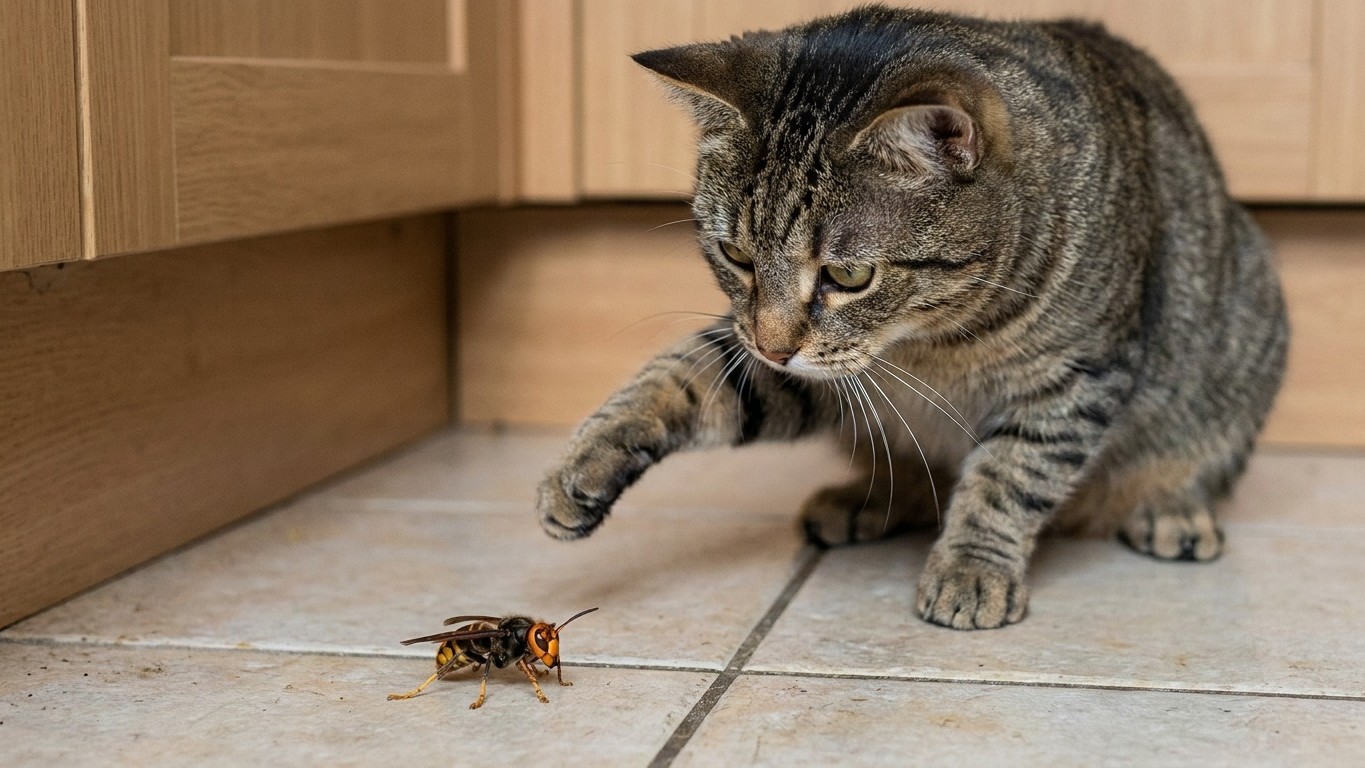
The Asian hornet has been steadily colonising the British Isles since its first confirmed sighting in Gloucestershire in 2016, and with it has come a seasonal hazard Most Cat Owners haven’t yet considered: their beloved pet treating this highly venomous insect as a toy. Cats are natural swatters. A large, buzzing insect drifting within paw’s reach is practically an invitation. The problem is that the Asian hornet (Vespa velutina) does not play along.
Key takeaways
- Cats have no instinct to fear Asian hornets and will swat at them like any other prey—but these insects can sting repeatedly
- A single hornet sting can trigger an allergic reaction within minutes, and multiple stings can escalate into life-threatening anaphylaxis
- Even if your cat survives a first sting, sensitization makes a second encounter far more dangerous
A New Arrival That Keeps Spreading
Throughout 2025, 163 nests were found and 544 credible sightings were recorded throughout the UK. That is a dramatic escalation. The first UK detection occurred in Tetbury, Gloucestershire, in 2016, and low numbers of sightings were reported each year until 2023. Numbers have since increased dramatically, with the National Bee Unit reporting hundreds of credible sightings and over 150 nests destroyed in 2025 alone. Sightings are now reaching into Wales, the north of England, and, as of October 2025, Northern Ireland.
You can identify Asian hornets by their yellow legs, orange face, and dark abdomen with a single yellow stripe. Unlike our native European hornet, Asian hornets are smaller and darker, and are much more aggressive, especially when protecting their nest. Smaller and darker does not mean less dangerous. Vespa velutina venom contains a greater proportion of toxins than venoms from other Hymenoptera species, and its sting can cause severe allergic and/or toxic reactions. For a curious cat who hasn’t read the memo, batting one across the kitchen floor is a very bad idea.
Why Cats Are Especially Vulnerable
To a cat or dog, a small flying buzzing object will seem like a great thing to play with, and they just can’t help but swat at it. The paw and the face are the two most common sting sites, because those are the parts cats use to investigate and prod their prey. In most cases, a cat will experience a localised reaction, which results in mild swelling and tenderness at the site of the sting, most often on the face, typically near the nose, or on a paw.
That is the best-case scenario. The far more serious concern is what happens next, especially with a hornet capable of stinging multiple times in a single encounter. Individual hornets can sting repeatedly. Unlike honey bees, hornets do not die after stinging because their stingers are very finely barbed and can easily be withdrawn. A cat in full predatory mode, batting, biting, trapping the insect under its paws, could easily provoke several consecutive stings.
Multiple insect stings, stings in areas where swelling could obstruct breathing such as the mouth or throat, or stings that cause an allergic reaction can be more serious and may require prompt veterinary attention. A sting inside the mouth, entirely possible if a cat tries to bite a hornet, is a genuine emergency. Take your cat to the veterinary emergency clinic at the first sign of severe swelling around the head and neck that could compromise respiration; swelling in these areas may occur even if the bite occurred elsewhere.
The venom itself is a complex cocktail. Besides the substantial amount of transcripts encoding for allergens usually regarded as the major lethal factor of wasp sting, a greater abundance of hemostasis-impairing toxins and neurotoxins in the venom of V. velutina were identified. Venom can cause pain, redness, swelling, and systemic symptoms including vomiting, diarrhoea, headache, and low blood pressure, which intensify with more stings. In a small animal receiving multiple stings, those systemic effects can escalate quickly.
Recognising a Serious Reaction
Cats are very good at hiding symptoms of pain, so if you weren’t around when your cat got stung, it may not be immediately obvious. Look out for your cat suddenly pawing, licking or nibbling at a particular part of their body, yowling or vocalising more than usual, or showing signs of localised swelling or reddening.
Allergic reactions usually occur within 20 minutes of the bite but may be delayed for hours, so close monitoring is critical. Severe reactions (anaphylaxis) can be fatal, so quick action is vital. the Warning Signs demanding immediate veterinary attention are: visible swelling of the face, throat, or neck; difficulty breathing or panting (unusual in cats); excessive drooling; vomiting; disorientation; seizures; and collapse. If your cat’s mucous membranes turn blue (cyanosis), this is a sign that it cannot breathe, this is an acute emergency and can prove fatal.
One thing worth knowing: unlike bees, hornets do not leave a stinger behind. A hornet’s sting usually causes a rash that may be itchy for a day or so. The stinger isn’t left in the skin, so there’s nothing to remove as there would be with a bee sting. So the first aid step of scraping out a stinger does not apply. For a hornet sting, apply a cold compress to reduce swelling and contact your vet. Do not treat your pet with over-the-counter human medications without speaking to your vet first, as they may contain ingredients that are toxic to dogs and cats. Antihistamine formulations safe for humans can be lethal to cats, always call the vet before reaching for the medicine cabinet.
In an emergency, the vet will give your cat adrenaline (epinephrine), which constricts the blood vessels and thus leads to a life-saving increase in blood pressure and dilation of the bronchial tubes. They may also give your cat oxygen and intravenous fluids to maintain blood pressure and help them breathe.
Keeping Your Cat Safe as Sightings Rise
Prevention is straightforward in principle, less so in practice with a cat. Keeping windows and doors screened during warm months is a reasonable starting point : Asian hornets are most active when temperatures are above 13°C, and peak activity runs from July through to November. Confirmed sightings increased dramatically in 2024 and 2025, prompting serious concern among environmental agencies, bee conservationists and managers of outdoor spaces. If you live in the south-east of England, Kent, or East Sussex, currently the front line, vigilance around garden areas is sensible. Predominantly it is Kent and East Sussex on the front line but there have been sightings elsewhere, and the Asian hornet could turn up anywhere in the country.
If you spot an Asian hornet in your garden, do not attempt to deal with the nest yourself. Report it using the free Asian Hornet Watch app (available on iOS and Android) or via the online form managed by the UK Centre for Ecology and Hydrology. During the summer, a single yellow-legged hornet colony can produce an average of 6,000 individuals in one season. A nest near the garden is not a problem to approach with a rolled-up magazine.
One detail that surprises many people: Asian hornets use sting venom as an alarm pheromone, and sting venom volatiles are strongly attractive to other hornet workers and trigger attacks. In plain English, if a cat stings or crushes a foraging hornet, the chemical signal released can draw other workers to the scene. A single hornet pawed through the cat flap could become several within seconds if the colony is nearby. That is a scenario that moves from nuisance to emergency very rapidly.
Most stings will result in pain and local swelling that resolves within a day. But a cat that has been stung once is now sensitised. If a wasp or hornet has stung your cat for the first time, this initial contact is usually asymptomatic. Nevertheless, your cat’s immune system does react to the toxin and forms certain protective proteins (IgE antibodies) against the toxin’s allergens, a process specialists call sensitisation. If the insect stings again after some time, your cat’s immune system will initiate a type I hypersensitivity reaction. The second encounter, carries a meaningfully higher risk than the first. It is always worth calling your vet after any hornet sting, even if your cat appears fine — not because a crisis is guaranteed, but because knowing what to watch for in the hours that follow can make all the difference.
Sources : researchgate.net | pubmed.ncbi.nlm.nih.gov