
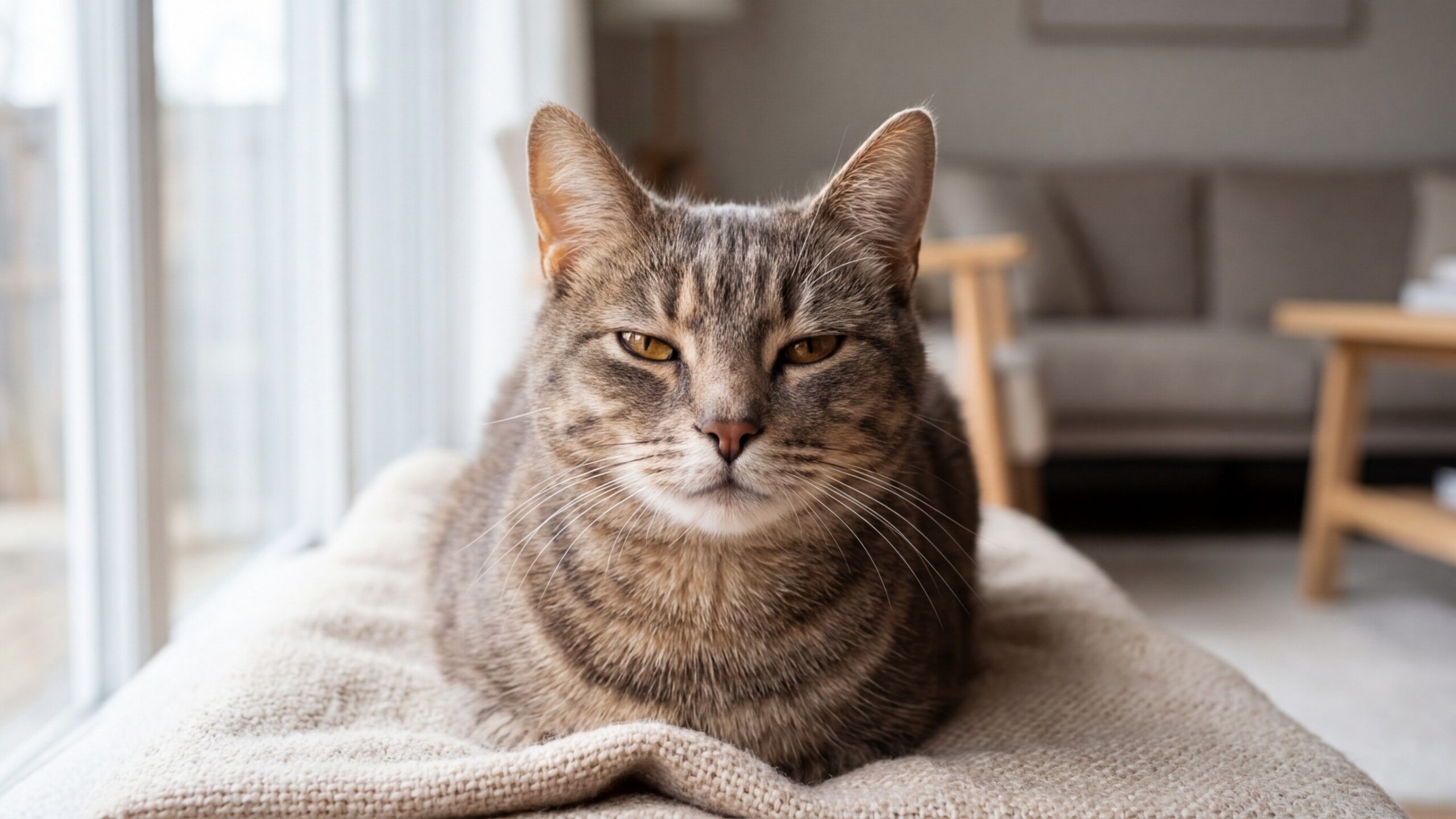
Your cat is sitting across the room, completely still, eyes fixed on you. No meow, no tail swish, just that steady, unblinking gaze. Most people feel vaguely judged. Some feel a little unnerved. But that look almost certainly isn’t what you think it is, and somewhere in the middle of it, there’s a tiny Gesture That Changes Everything: the slow blink. The eyes are important in signalling emotions, and the act of narrowing them appears to be associated with positive emotional communication across a range of species — which is exactly what the slow blink sequence is all about in cats.
Key takeaways
- Most cat stares aren’t confrontational—they’re your cat gathering information about you and their surroundings
- The slow blink is a cat’s way of signaling trust and vulnerability, and research proves it strengthens human-cat bonds
- You can initiate slow-blink communication yourself, and it works with unfamiliar cats too
The Stare Is the Starting Point, Not the Message
Cats staring at you is perfectly normal, staring is one of their primary ways of communicating with humans, observing their surroundings, and expressing themselves, and most of the time it’s simply a natural part of how they interact with us. Think of it less like a confrontation and more like attention. Cats evolved as observant hunters and cautious survivors, using their eyes to track motion, judge distance, and evaluate safety — and when they stare at a person, they’re using that same instinctive focus to gather information, reading our movements, tone, and behaviour.
There’s also a rather mundane Biological explanation for why that stare looks so intense. Cats blink much less than we do, and they also have a third eyelid that keeps their eyes moisturised without visible blinking. So the unblinking quality isn’t rudeness or a challenge, it’s just anatomy. These third eyelids, called nictitating membranes, can extend across the eyeball to provide moisture and protection without you ever seeing it happen, which means your cat can maintain that focused gaze on you while their eyes remain perfectly comfortable.
Context, as ever, is Everything. Cats stare to communicate needs, emotions, or intentions, common reasons include attention-seeking, play solicitation, hunger, affection, fear, or aggression. A cat parked by their empty bowl, fixing you with a meaningful look, is almost certainly doing arithmetic about their next meal. Cats are naturally observant animals — they may stare simply because they’re taking in what you’re doing, or even trying to anticipate whether what you’re doing will affect them, like walking near the treat drawer or getting ready to leave the house. They know your routines better than you realise.
When the Stare Softens: The Slow Blink and What It Means
Here’s where things get genuinely moving. Amid a relaxed gaze, you might notice your cat’s eyelids begin to droop, close slowly, and reopen, unhurried, deliberate, almost sleepy. The slow blink is a subtle feature that has been observed in cats for some time and is thought to indicate a sense of calm and a positive emotional state; it involves the partial or complete closure of the eyelids, performed slowly and lasting for longer than half a second.
When your cat narrows their eyes around you, they’re doing the opposite of threatening, they’re signalling vulnerability. Closed eyes mean “I don’t need to watch you for threats,” in the same way that cats expose their belly to trusted humans to demonstrate they feel safe. For an animal whose survival instincts are never fully switched off, that is an extraordinary gift to offer.
The science backs this up compellingly. A study conducted by the University of Sussex found that cats are more likely to slow-blink at their owners when their owners slow-blink at them, and were more likely to approach an experimenter who had slowly blinked at them, findings that support the idea that slow blinking serves as a form of positive emotional communication between cats and humans, helping to build trust and strengthen the bond between the two species. The research, published in Scientific Reports, was the first of its kind to test this experimentally rather than relying on the long-held assumptions of cat owners (who, for the record, were right all along).
The slow blink is similar to how human eyes narrow when smiling and usually occurs when a cat is relaxed and content; it’s been interpreted as a means of signalling benign intentions, since cats are thought to interpret unbroken staring as threatening. breaking the hard stare with a gentle eye closure is the feline equivalent of putting your hands up in peace.
How to Slow-Blink Back (and Why You Should)
The genuinely delightful thing is that this works both ways. You can initiate it. Scientists confirmed that slow-blinking makes cats, both familiar and strange, more likely to approach and be receptive to humans. That means it works not just with your own cat, but potentially with any cat you meet who seems a bit wary of you. Think of it as a universal password.
The method is straightforward. Wait until your cat is relaxed and looking in your direction without forcing eye contact, then narrow your eyes slowly, keeping them half-closed for a moment, think “sleepy” not “squinting”, and close your eyes fully for a second or two, then open them softly. Research showed that cat half-blinks and eye narrowing occurred more frequently in response to owners’ slow-blink stimuli, and in a further experiment cats had a higher propensity to approach an experimenter after a slow-blink interaction than when the experimenter had adopted a neutral expression.
There’s a small but important nuance worth noting. While communicating through slow blinking requires eye contact between humans and cats, direct eye contact in the form of a prolonged stare can itself be perceived negatively and as threatening behaviour by cats, so slow blinking needs to be used in a subtle, non-confrontational way. Soften your expression, relax your face, and let your gaze be gentle rather than fixed. The difference is immediately readable to your cat, even if it’s hard to describe in words.
There’s also a shelter cat angle to this that I find rather beautiful. Research demonstrated for the first time that cats who responded to human slow blinking by using eye closures were rehomed quicker than cats that closed their eyes less, suggesting that the use of slow blinking may have given cats a selective advantage during the domestication process. Thousands of years of living alongside humans may have, quite literally, shaped this behaviour into cats’ social toolkit.
When to Worry: Reading the Hard Stare
Not every stare carries warmth, and it’s worth knowing the difference. A cat staring with dilated pupils and stiff body language may indicate fear or aggression, in cases like these, the stare is more of a “back off” signal than a hint of affection. A happy cat will display a relaxed posture, their tail moving slowly from side to side, ears perked up, possibly purring and blinking slowly or kneading their paws — with steady, undilated pupils. An agitated cat looks entirely different.
In rarer cases, excessive staring, glassy or unfocused eyes, or a lack of blinking could be linked to vision problems, seizures, or neurological issues, and cats are notorious for hiding their pain, so subtle changes in demeanour and body language can often be the first clues that something is wrong. If your cat’s staring feels different from their usual behaviour, particularly in older cats, it’s always worth a conversation with your vet. Older cats can develop feline cognitive dysfunction, similar to dementia in humans, with symptoms including disoriented staring, pacing, and changes in sleep patterns — and if your senior cat stares more often and seems confused, a vet visit is warranted.
The slow blink, though, remains one of those small, extraordinary details that reminds you why sharing a home with a cat is unlike anything else. An animal descended from a largely solitary wild species, one that took thousands of years to warm to the idea of us, and the most intimate thing it can say is simply this: it closes its eyes. What other creature expresses love by making itself briefly blind?