
Every dog deserves a grooming routine built around its actual coat, not a one-size-fits-all approach copied from a neighbour’s spaniel or a YouTube video made for American poodles. The breed your dog belongs to, the structure of its fur, whether it has a double coat or a single one, whether it sheds or barely moults at all, all of this shapes what you should be doing with your brush, your clippers, and your hands. Get it wrong, and you risk matting, skin irritation, damaged guard hairs, or a very unhappy dog. Get it right, and grooming becomes a bonding ritual your dog might actually look forward to.
The main coat types and what they mean for care
Dogs come in a surprisingly wide variety of coat textures and structures, and understanding which category your dog falls into is the first practical step. No two coat types respond the same way to grooming, a technique that works beautifully on a Border Collie will leave a Wire Fox Terrier looking (and feeling) wrong.
Short coats: low maintenance, but not zero maintenance
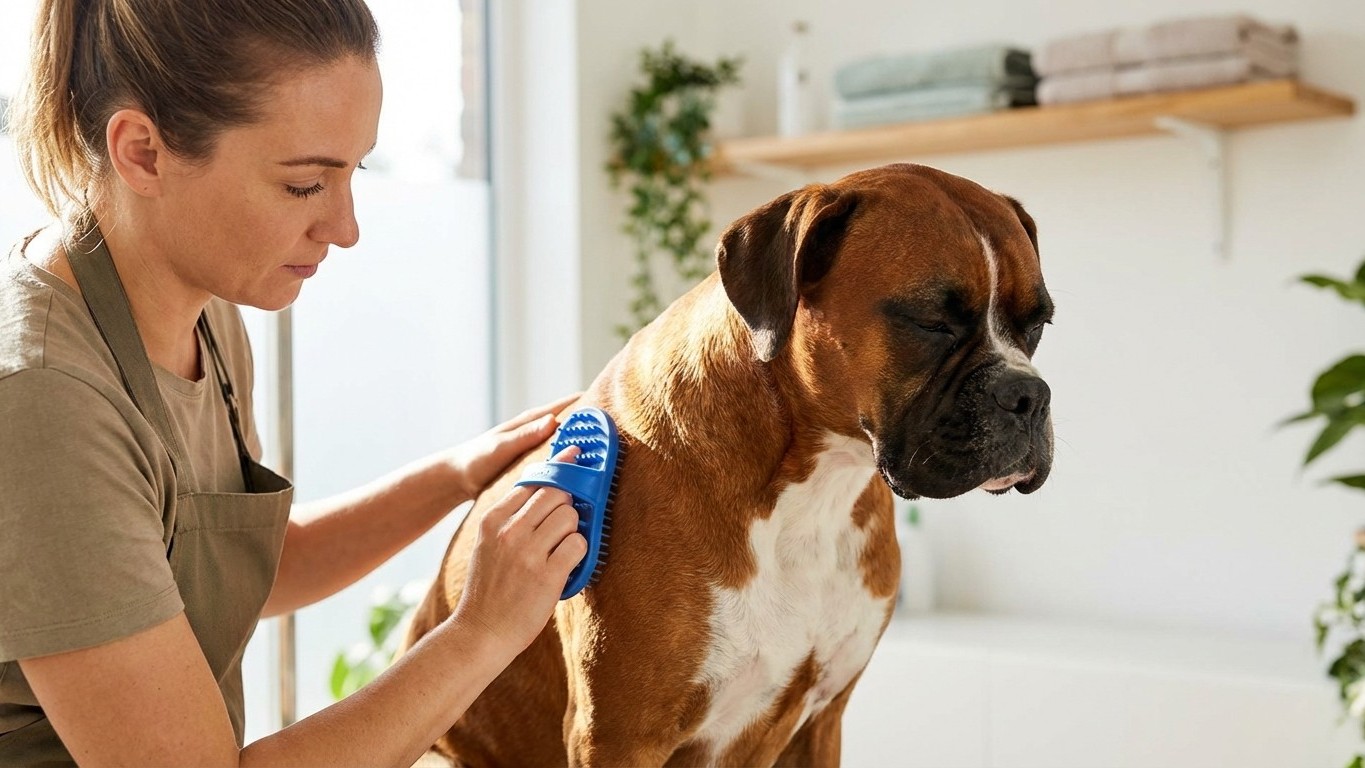
Breeds like the Boxer, the Weimaraner, the Staffordshire Bull Terrier, and the Beagle all carry short, close-lying coats that are deceptively low-effort. Weekly brushing with a rubber curry comb or a soft bristle brush removes dead hair, stimulates circulation, and distributes natural oils across the skin, which gives that characteristic healthy sheen. Short-coated dogs still shed, sometimes quite heavily depending on the season, so a de-shedding glove during moulting periods can make a real difference to your sofa’s survival. These breeds rarely need clipping, and shampooing every four to six weeks is usually sufficient unless your dog has a talent for rolling in something unpleasant.
Long coats: beautiful, but demanding
The Afghan Hound, the Yorkshire Terrier, the Maltese, the Rough Collie, long-coated breeds are visually striking and notoriously high-maintenance. Without regular brushing (several times a week, or daily for the finest coats), the fur tangles and mats form close to the skin. These mats trap moisture and debris, creating warm, airless pockets where skin infections, parasites, and hotspots thrive. A wide-toothed comb followed by a slicker brush is the standard toolkit here. Start from the ends and work your way inward to avoid ripping through knots. Long-coated breeds may also need professional trimming around the eyes, ears, paws, and sanitary areas, even if the main coat is left in its full glory.
Curly and woolly coats: the no-shed illusion
Poodles, Bichon Frises, Lagotto Romagnolos, and Portuguese Water Dogs fall into this category. Their coats grow continuously, shed very little, and felt readily if left unattended. That last point catches a lot of new owners off guard, because these dogs don’t scatter hair around the house, people assume they need less grooming. The opposite is true. Curly coats require thorough brushing every two to three days at minimum, and professional clipping every six to eight weeks. These are the dogs most often brought into the grooming salon with pelts so matted they need to be shaved entirely off, which is distressing for the dog and hard to avoid once it reaches that stage. If you’re drawn to low-shedding dogs, the low shedding dog breeds guide offers a thorough breakdown of what really separates minimal shedding from genuine coat-free living.
Wire and broken coats: trimming territory
The Cairn Terrier, the Airedale, the German Wirehaired Pointer, the Border Terrier, and many other terrier and gundog breeds carry a coarse, wiry topcoat over a softer undercoat. This texture exists for a reason, it repels mud and water, offers protection in the field, and insulates effectively. Clipping a wire coat softens and dulls it over time, which is why hand-stripping (or trimming, as it’s commonly known) is the traditional and technically correct method. This involves pulling dead hairs out by hand or with a stripping knife, allowing new guard hairs to grow through with their proper texture intact. It’s time-intensive and requires some skill, but for show dogs or working breeds, it preserves the coat’s function.
Double coats: managing seasonal shedding
The Siberian Husky, the Golden Retriever, the Labrador, the German Shepherd, the Samoyed, double-coated breeds carry a dense, insulating undercoat beneath a layer of protective guard hairs. Twice a year, typically in spring and autumn, they blow their undercoat in a moulting event that can feel like your dog is dissolving. An undercoat rake or a de-shedding tool used regularly during this period prevents the dead undercoat from compacting against the skin and forming mats. One thing worth knowing: shaving a double-coated dog is generally considered harmful. Removing the guard hairs disrupts the coat’s ability to regulate temperature in both heat and cold, and regrowth is often uneven. The breed’s natural insulation is sophisticated; a pair of clippers is not smarter than thousands of years of selective evolution.
Brushing, clipping, and trimming: choosing the right technique
Brushing: the non-negotiable foundation
Whatever coat type your dog has, brushing is the baseline. The tools differ enormously, though. A rubber curry brush suits short coats. A slicker brush handles medium and long coats. A wide-toothed metal comb works through the layers of curly or double coats. An undercoat rake targets the dense undercoat of double-coated breeds. Using the wrong brush, say, a fine slicker on a wire coat, or a paddle brush on a dense double coat — either misses the problem entirely or irritates the skin. One common mistake is brushing only the top layer and leaving the undercoat untouched, which allows mats to form invisibly close to the skin while the surface looks fine. Always brush down to the skin, gently.
Clipping: when it helps and when it harms
Clipping is appropriate for continuously growing coats : Poodles, Bichons, Cocker Spaniels, Shih Tzus, and similar breeds. For these dogs, regular clipping every six to eight weeks keeps the coat at a manageable length, prevents matting, and keeps the dog comfortable in warmer months. Electric clippers come in a range of blade lengths, and choosing the right grade matters for the finished result and the dog’s comfort. For a nervous first-timer, a professional groomer for the first session makes sense — watching the process and asking questions is infinitely more useful than guessing from a tutorial.
Clipping should generally be avoided on double-coated breeds and wire-coated breeds (where stripping is preferred). There are nuanced exceptions, a heavily matted rescue dog, for instance, may need to be clipped regardless of coat type as a welfare measure — but as a routine practice, it’s not appropriate for these coat types.
Hand-stripping and trimming: the specialist approach
Hand-stripping is the process of removing dead outer coat hairs by pulling them out at the root, either with a stripping knife, a thumb and forefinger, or a serrated stripping stone. It sounds more alarming than it is, when done correctly on a coat that’s ready to be stripped, the hairs come out easily because they’ve already loosened from the follicle. The result is a coat that retains its correct texture, colour, and weather resistance. Many terrier owners learn to do basic maintenance stripping at home between professional appointments. The timing varies by breed and season, but every three to four months is a rough guide for most wire-coated dogs.
Recommended grooming routines by coat type
Here’s a practical summary of what each coat type typically needs:
- Short coat (Boxer, Beagle): Weekly brush with rubber curry or bristle brush; bathe every 4–6 weeks; no clipping needed.
- Long coat (Yorkshire Terrier, Afghan): Daily to three-times-weekly brushing with comb and slicker; professional trim every 8–12 weeks; bathe every 3–4 weeks.
- Curly/woolly coat (Poodle, Bichon): Brush every 2–3 days; professional clip every 6–8 weeks; bathe every 3–4 weeks.
- Wire/broken coat (Border Terrier, Airedale): Hand-strip every 3–4 months; weekly brush; avoid clipping if preserving coat texture.
- Double coat (Husky, Golden Retriever): Weekly brush; daily during moulting with undercoat rake; bathe every 6–8 weeks; no shaving.
Grooming mistakes that cause real problems
Shaving a Husky in summer because it “looks hot” is probably the most repeated grooming mistake in the UK. The double coat actually shields against heat as much as cold, removing it disrupts thermoregulation and exposes the skin to UV. Similarly, neglecting a Poodle’s curly coat between salon visits until it has to be shaved off entirely is avoidable with a ten-minute brush three times a week. Wire-coated terriers clipped instead of stripped gradually lose their characteristic wiry texture, ending up with a soft, fluffy coat that loses its weather-resistant properties entirely.
Products matter too. Human shampoos are too acidic for canine skin. Dog-specific shampoos are formulated for a skin pH between 6.5 and 7.5, compared to human skin’s 4.5 to 5.5. Using the wrong product repeatedly can strip natural oils and cause dry, flaky skin or itching. If your dog has a skin condition, your vet may recommend a medicated shampoo, and this is genuinely a case where professional advice is worth seeking before experimenting with over-the-counter options.
Choosing the right tools and products
The grooming tool market is large and confusing, full of claims that a single brush will suit all coat types. It won’t. For most owners, a practical starter kit includes a metal comb with both wide and narrow tines, a slicker brush with flexible pins, and a rubber curry or grooming glove for the moulting season. Wire-coated breeds will need a stripping knife. Double-coated breeds benefit from an undercoat rake. Beyond that, less is often more, four well-chosen tools used correctly outperform a drawer full of gadgets.
For shampoos, choose a formula appropriate to your dog’s coat type and any skin sensitivities. Moisturising formulas suit dry or long coats. Volumising ones work well on soft, fine coats. Medicated varieties should be used only when recommended. Always rinse thoroughly, shampoo residue left against the skin is a common cause of post-bath itching that owners often mistake for a product reaction.
Frequently asked grooming questions
One of the most common questions is how to tell whether a dog needs clipping, stripping, or just brushing. The answer starts with coat type. If your dog has a wire coat, stripping is likely the right approach. If it has a continuously growing soft or curly coat, clipping applies. If it has a natural double coat or a short single coat, brushing and de-shedding are the primary tools, and clipping rarely comes into the picture.
People also ask whether it’s risky to clip their own dog at home. For short-coated breeds, grooming at home is straightforward. For curly or long-coated breeds, home clipping is possible with practice and patience, but the first few attempts often result in uneven cuts or accidental nicks, particularly around the face and paws. Starting with a professional session and watching carefully before attempting it yourself is sensible advice.
Frequency questions are also constant. As a general guide, short coats need weekly brushing; long and curly coats need brushing every two to three days at minimum; double coats need weekly attention ramping up to daily during seasonal moults. These aren’t rigid rules, a dog that spends all day outdoors in brambles needs more frequent attention than a city dog with a sofa-based lifestyle.
Taking the next step
Grooming is not a cosmetic concern. It’s a welfare one. A dog with a matted, neglected coat is uncomfortable, sometimes in pain, and often hiding skin problems that have gone unnoticed for weeks. Building a routine suited to your dog’s specific coat type makes every session quicker, easier, and far less stressful for both of you.
If you’re still in the process of choosing your breed, your coat-care commitment is part of the equation. The dog breeds guide offers a comprehensive look at matching lifestyle to breed, coat included. If you’re specifically drawn to minimal-shedding dogs, the hypoallergenic dog breeds guide clarifies what the term actually means in practice, while our hypoallergenic dog breeds guide digs into the shedding and coat-care side of the story in more detail. Grooming is ultimately a conversation between you and your dog, and knowing your dog’s coat is how that conversation begins.