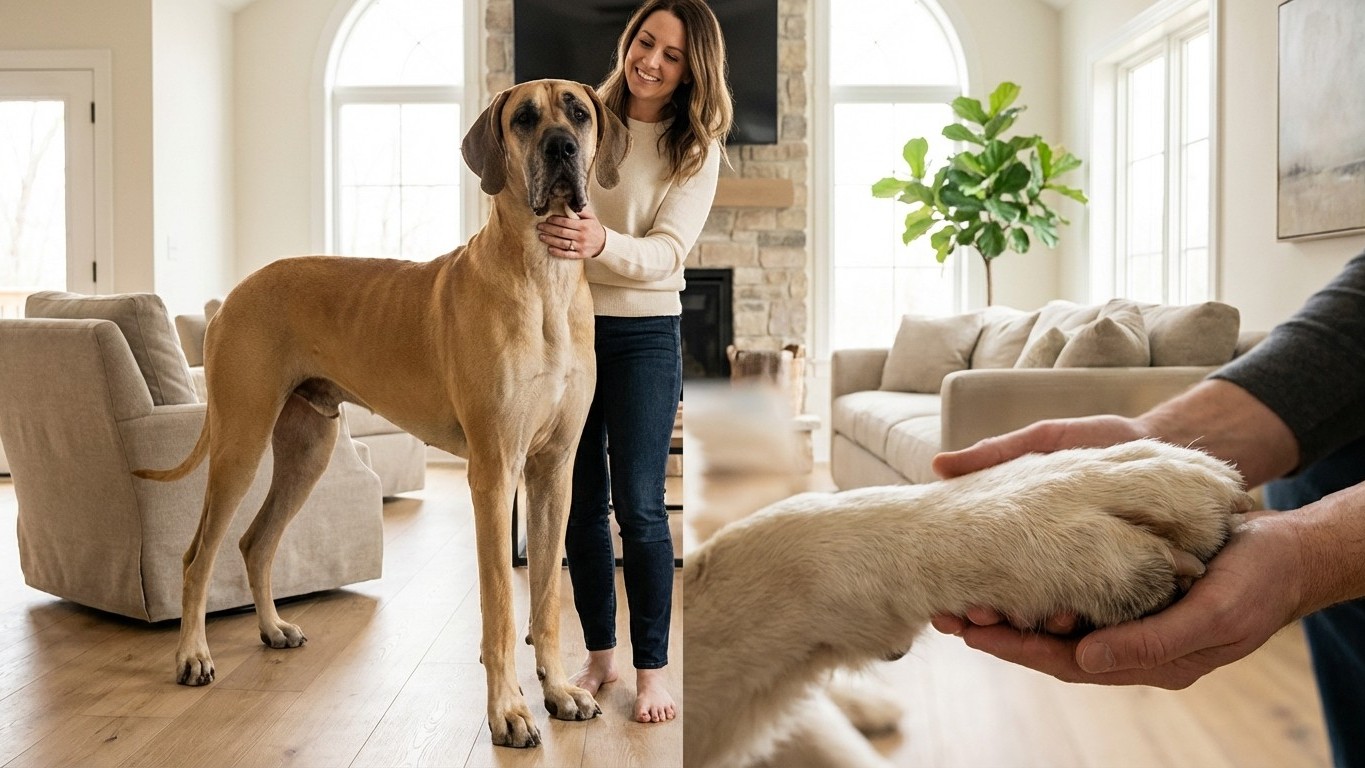
A Great Dane can weigh more than most adult humans. A Saint Bernard’s paw is roughly the size of a grown man’s hand. These aren’t curiosities at a country fair, they’re the daily reality of life with a giant dog breed, and if you’re seriously considering bringing one home, the gap between expectation and reality can be genuinely enormous. This guide exists to close that gap.
What actually counts as a giant dog breed?
The term “giant” gets thrown around loosely in casual conversation, but there’s a meaningful distinction between a large dog and a truly giant one. Generally speaking, breeds are considered giant when adult males consistently exceed 45 kg (roughly 100 lbs), with many reaching 60–90 kg or beyond. Height matters too: most giant breeds stand above 65 cm at the shoulder. The Great Dane, for instance, can reach 80 cm, taller than many six-year-old children.
Where the line falls between large and giant
A German Shepherd or Labrador Retriever is a large dog. Impressive, yes. Giant, no. The distinction isn’t purely about numbers, it’s about an entirely different set of physiological and logistical realities. Giant breeds have skeletal structures, metabolisms, and health profiles that differ from large breeds in ways that directly affect how you feed them, exercise them, house them, and care for them medically. If you’re exploring the broader landscape of breed sizes, the dog breeds guide offers useful context for placing giant breeds within the full spectrum.
Classic examples of giant breeds
The most recognised giant breeds in the UK include the Great Dane, Saint Bernard, Newfoundland, Irish Wolfhound, Tibetan Mastiff, Leonberger, Anatolian Shepherd, and the Neapolitan Mastiff. Each carries its own personality and purpose, but all share that defining characteristic: sheer, substantial mass that shapes every aspect of their care.
Why people choose giant breeds, and what they don’t always anticipate
Temperament: the gentle giant cliché is mostly true
Ask anyone who has owned a Newfoundland or a Saint Bernard and they’ll likely describe an animal of surprising emotional intelligence and warmth. Many giant breeds were developed for work alongside humans, hauling carts, guarding flocks, water rescue, and that history has produced dogs with a deep attachment to their families. The Irish Wolfhound, once bred to hunt wolves, is famously gentle with children. The Great Dane, despite its intimidating size, is routinely described by owners as a lap dog that simply hasn’t registered its own dimensions.
That said, gentle doesn’t mean effortless. A 70 kg dog that hasn’t been properly socialised or trained is a safety risk, full stop. Strength on this scale requires consistent, patient, reward-based training from puppyhood. Pulling on the lead, jumping up, or resource-guarding behaviours that might be manageable in a medium-sized dog become genuinely dangerous in a giant one. This isn’t a reason to avoid these breeds, it’s a reason to prepare seriously.
The practical realities: space, budget, and logistics
Here’s where the romance of owning a giant dog meets the spreadsheet. Food bills alone can be substantial: giant breeds consume significantly more than smaller dogs, and many require breed-appropriate large-breed formulas that tend to cost more per kilogram. Veterinary costs scale with body weight for medications, anaesthesia, and procedures, a routine dental clean or neutering operation will cost considerably more than for a Spaniel. Pet insurance premiums reflect this reality too, so comparing policies carefully before adopting is wise.
Transport is another consideration people routinely underestimate. Standard car boots may not accommodate a fully grown Great Dane comfortably. Dog crates for giant breeds are large enough to dominate a room. Even boarding kennels may have limited spaces for very large dogs, and daily rates are typically higher. None of this should be a dealbreaker, but it should be a line item in your planning.
Profiles of the most popular giant breeds
Rather than an exhaustive list, a handful of breeds represent the diversity within the giant category well.
The Great Dane is perhaps the most architecturally striking of all giant breeds. Despite the name, the breed has German origins and was historically used to hunt boar. Today’s Great Danes are affectionate, relatively low-energy indoors, and surprisingly adaptable to urban living provided they get adequate daily exercise. Their short coat makes grooming simple, though their drool output is considerable.
The Saint Bernard originated in the Swiss Alps, developed by monks at the Great St Bernard Hospice to locate and rescue travellers lost in snowdrifts. The breed’s legendary tracking ability and calm temperament made it ideal for the work. Modern Saint Bernards retain that steady, patient character, they’re famously good with children, but they shed heavily and require regular grooming, particularly the long-coated variety.
The Newfoundland is essentially a water rescue dog built into a bear-shaped frame. They’re strong swimmers with webbed feet and a dense double coat that sheds prolifically. Newfoundlands are among the most gentle-natured of all giant breeds and are often described as “nanny dogs” for their patience with children. That coat, however, demands serious grooming commitment and their love of water means a muddy walk is likely to result in a muddy home.
The Irish Wolfhound holds the distinction of being the tallest dog breed in the world. A gentle, dignified animal, the Wolfhound has a wiry coat and a surprisingly quiet disposition indoors. They’re sighthounds at heart, which means they have a strong prey drive and need secure outdoor spaces, a tall fence is non-negotiable.
The Tibetan Mastiff is perhaps the most independent of the group, a breed developed to guard livestock in the Himalayas with minimal human direction. That independence translates to a more challenging training experience, and Tibetan Mastiffs are generally not recommended for first-time dog owners.
Daily life with a giant dog
Exercise, stimulation, and space
A common misconception is that giant breeds need enormous amounts of exercise. The reality is more nuanced. Great Danes and Saint Bernards are actually lower-energy breeds that can be content with moderate daily walks, while Irish Wolfhounds need more space to stretch their legs at speed. What all giant breeds share is a need for mental stimulation, puzzle feeders, training sessions, and social interaction, to prevent boredom from turning into destructive behaviour. A bored giant dog can demolish furniture with impressive efficiency.
Apartment living is possible for some giant breeds, but it requires honest self-assessment. If your flat has a lift and you’re committed to multiple daily walks, a low-energy giant breed might adapt. If you’re regularly away for long hours, the answer is likely no. These dogs crave company.
Feeding, costs, and health maintenance
Giant breed puppies require specific nutrition to support controlled bone and joint development, standard puppy food is not appropriate. Feeding too rich a diet during the growth phase can accelerate skeletal development in ways that increase the risk of joint problems later. A vet’s guidance on feeding protocols for giant breed puppies is worth taking seriously from day one.
Bloat (gastric dilatation-volvulus, or GDV) is a serious and life-threatening condition disproportionately common in giant breeds with deep chests. Symptoms include restlessness, unproductive retching, and a distended abdomen. This is a veterinary emergency requiring immediate treatment. Knowing the signs can save a life.
Health risks and lifespan
The trade-off for that magnificent size is a shorter lifespan than smaller breeds. While a Miniature Dachshund might live 14 to 16 years, many giant breeds average 7 to 10 years, with some like the Irish Wolfhound having an average closer to 6 to 8 years. This is simply biology, larger bodies age faster, and the cardiovascular system works harder throughout life.
Hip and elbow dysplasia are among the most common structural conditions in giant breeds, arising from abnormal joint development. Responsible breeders screen breeding stock for these conditions, so requesting health certificates when adopting from a breeder is non-negotiable. Heart conditions, particularly dilated cardiomyopathy, affect several giant breeds including Great Danes and Irish Wolfhounds. Regular veterinary check-ups, at least annually, more frequently in older dogs, are the baseline, not a luxury. Always consult your vet promptly if you notice changes in your dog’s mobility, appetite, or energy levels.
Who should actually adopt a giant breed?
The honest answer is: people who’ve genuinely thought it through. Giant breeds thrive with owners who have stable home environments, adequate physical space (a house with a garden is ideal for most), the financial resilience to absorb higher-than-average vet bills, and the time to invest in proper training and socialisation. Families with children can do brilliantly with breeds like the Newfoundland or Saint Bernard, provided the children are old enough to understand how to interact safely with a very large dog.
First-time dog owners aren’t automatically excluded, but some giant breeds (the Tibetan Mastiff, for instance) are better suited to experienced handlers. If you’re new to dogs and drawn to a giant breed, choosing one of the more trainable, people-oriented breeds and committing to professional training classes from the start will make a significant difference.
How giant breeds compare to large and medium breeds
Placing giant breeds in context alongside their smaller counterparts helps clarify the decision. If the scale of a giant dog feels daunting but you still want a substantial companion, the medium dog breeds guide explores breeds that offer a compelling balance of energy, trainability, and manageable size. For those weighing up the full range of options, the small dog breeds guide covers the other end of the spectrum, and the small dog breeds guide provides a comparative size overview that puts everything in perspective side by side.
Giant breeds ask more of you financially and logistically than large or medium breeds. What they offer in return, that unique combination of imposing presence and profound gentleness — is something their owners tend to describe as unlike any other experience. The question worth sitting with isn’t “can I handle a giant dog?” but rather “am I ready to build my life around one?” Because that, more than anything, is what these animals quietly require.
If you’re still in the early stages of working out which type of dog fits your life, the dog breeds guide is a useful starting point before narrowing your focus to the giant category.