
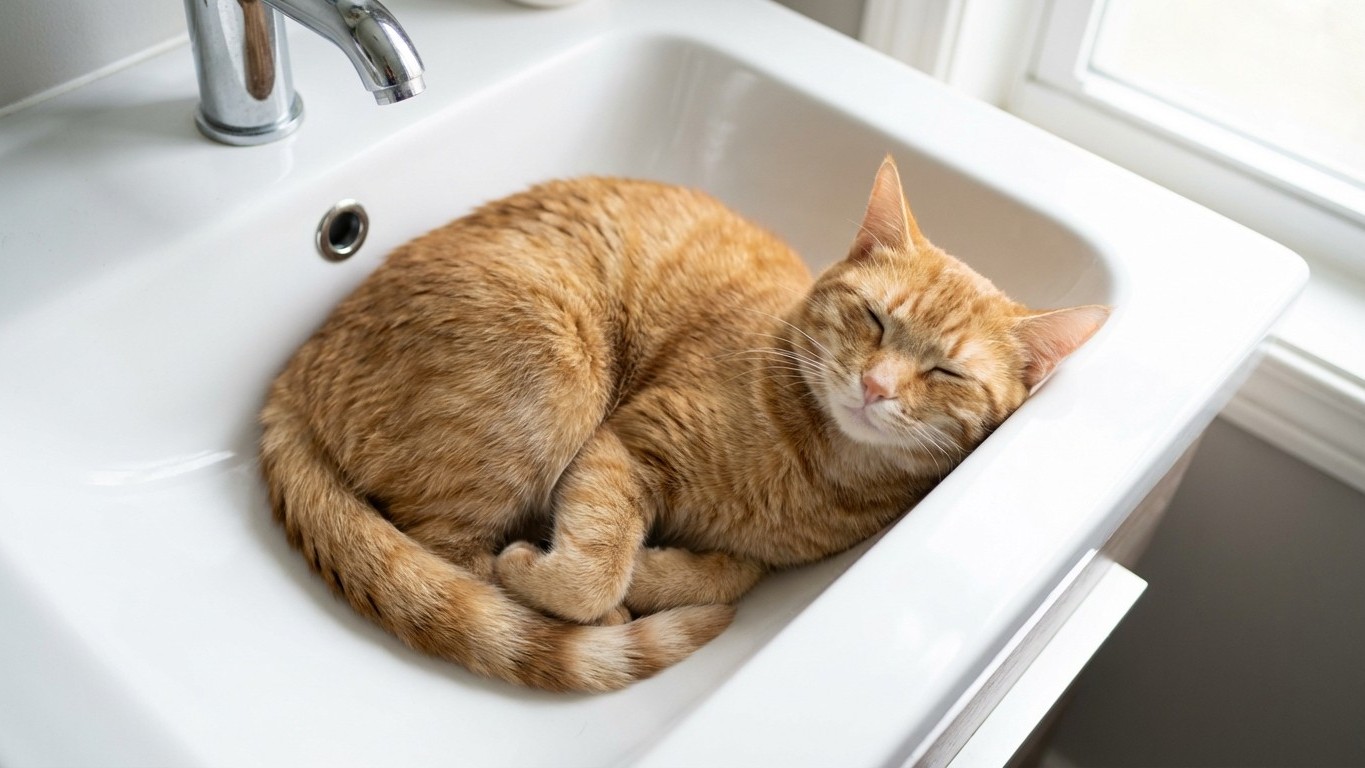
Your cat has commandeered the bathroom sink. Every single night, without fail, you find them curled up in that cold porcelain bowl like they own the place, which, let’s be honest, they believe they do. Before you chalk it up to feline eccentricity and move on, there’s Actually quite a lot going on behind this behaviour. A conversation with a veterinary behaviourist shed some light on what’s really happening, and the answers are more layered than you might expect.
Key takeaways
- Your cat’s sink obsession involves more than just being quirky—there’s real science behind it
- The bathroom transforms into the perfect sleep environment after dark, but not for reasons you’d expect
- When sink-sleeping becomes a red flag versus when it’s just your cat having excellent taste
The sink is not just a bed, it’s a strategy
Cats are extraordinarily deliberate creatures. Every sleeping spot they choose tells you something about their internal world: their stress levels, their sense of security, their temperature needs. The bathroom sink, strange as it seems to us, ticks several boxes simultaneously.
Temperature regulation is the first thing to consider. Cats have a higher core body temperature than humans (ranging roughly between 38°C and 39.2°C), and they are masters at finding microclimates that suit them. A porcelain or ceramic sink retains cool temperatures beautifully, making it genuinely refreshing to lie against, especially during warmer months. This is the same reason cats drape themselves across tiled floors or press their bellies against cold radiator covers. The sink just happens to be the most conveniently shaped cool surface in the house, curved, enclosed, perfectly cat-sized.
Then there’s the shape itself. The bowl of a sink mimics something cats have sought out instinctively for thousands of years: a contained, slightly elevated space with defined edges. In the wild, felines sleep in hollows, between rocks, or in tree cavities. The sink provides that same sense of being held. Your cat isn’t being weird, they’re being deeply, ancestrally logical.
Why nighttime, specifically?
This is where the behaviour becomes genuinely interesting. If your cat only does this at night, the bathroom dynamic shifts considerably. Cats are crepuscular by nature, meaning their activity peaks at dawn and dusk, but domestic cats often adapt their rhythms to mirror their owners’ schedules. At night, the bathroom transforms: it’s quiet, the house is still, human foot traffic has stopped, and the room retains a particular ambient warmth from the day’s hot water use while the surfaces themselves stay cool. That combination is, apparently, irresistible.
There’s also a territorial element that’s easy to overlook. The bathroom carries your scent intensely, think towels, clothing left on the floor, the shower. For a cat, sleeping in a room saturated with your smell is a form of comfort and connection, even if they’re technically choosing to be apart from you. It’s the feline equivalent of wearing a partner’s jumper. They want your scent, just on their own terms.
Some cats, particularly those who can be a little anxious or overstimulated by household activity, use the bathroom as a decompression zone. The closed door (when they choose it), the echo-y silence, the single window, it all creates a predictable, low-stimulation environment that helps certain cats wind down. If your cat seems particularly drawn to the sink after busy or noisy evenings, that’s worth noting.
Should you be worried, or just amused?
Honestly, in most cases: mostly amused. A cat choosing the sink as a sleeping spot is not, in itself, a red flag. It becomes worth paying closer attention to when the behaviour changes Suddenly or seems compulsive. A cat who has never shown interest in the sink and abruptly begins sleeping there exclusively, especially if paired with drinking from the tap, increased thirst, or lethargy, deserves a vet check. Excessive water-seeking behaviour can sometimes indicate kidney issues, hyperthyroidism, or diabetes, all conditions that are very manageable when caught early. Any sudden shift in a cat’s habits is reason enough to book a veterinary appointment.
If, however, your cat has been doing this for months or years with no other Changes in behaviour, appetite, or energy levels, you’re almost certainly just sharing your home with a cat who has excellent taste in sleeping arrangements. Some cats settle into routines that are so specific and so consistent they become almost ceremonial. The sink is their spot. That’s it. That’s the whole explanation.
What you can actually do about it (if you want to)
You have a few options here, ranging from full acceptance to gentle redirection.
Full acceptance is, frankly, the path of least resistance and the one most cat owners eventually arrive at. Put a small folded towel in the sink for comfort and warmth. Your cat gets their sacred spot, you get a slightly less bewildered feeling about the whole thing.
If you’d prefer to encourage them elsewhere, the key is to replicate what the sink offers rather than simply blocking access to it. A small, enclosed cat bed, the kind with raised sides or a hood, placed in the bathroom will often appeal to the same instincts. Keep it on the cool side if possible, perhaps away from a radiator, and try rubbing it with one of your worn T-shirts to transfer your scent. Give it a few weeks. Some cats will take the bait; others will pointedly ignore your alternative and return to the sink with visible disdain.
The one thing that genuinely won’t work is simply closing the bathroom door and hoping the impulse disappears. Cats don’t tend to abandon preferences, they escalate them. You’ll hear about it.
What strikes me most about this whole phenomenon is how perfectly it illustrates the way cats navigate their domestic lives: using our spaces, our scents, and our routines to build something that works entirely for them. Your bathroom sink has become, in your cat’s mind, a precision-engineered sleep environment. The fact that it took a veterinary conversation to fully unpack that feels about right. Cats have always been a little more complex than we give them credit for, and considerably more Comfortable in a sink than any of us have a right to be.