
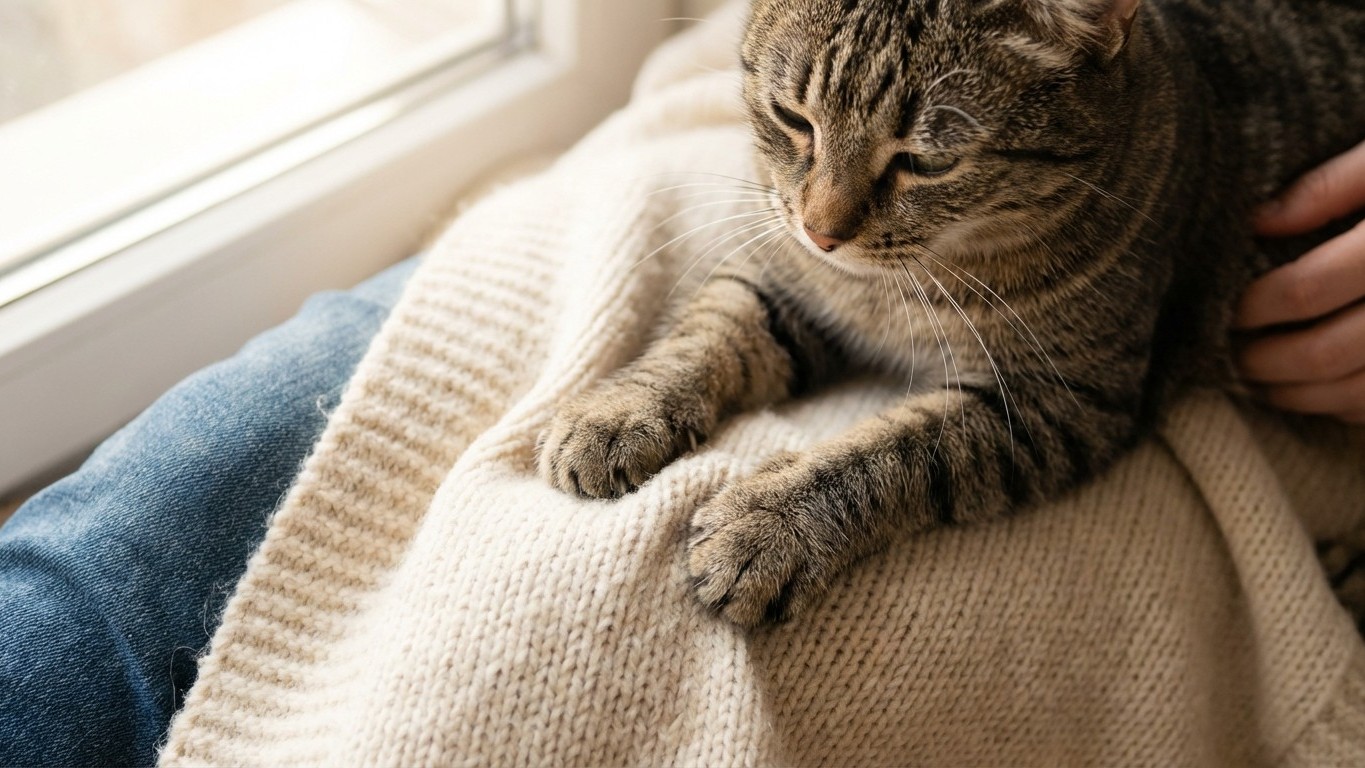
Your cat climbs onto your lap, settles into that familiar loaf position, and then starts it: the slow, rhythmic push-and-pull of their front paws, eyes half-closed, purring like a small engine. It’s one of the most endearing things a cat does, and yet most owners chalk it up to simple contentment. The truth, as it turns out, is considerably more layered, a behaviour rooted in ancient instinct, neurochemistry, scent communication and a relationship with you that goes deeper than a warm lap and a cosy spot on the sofa.
Key takeaways
- Kittens knead their mothers to trigger milk production—but why do adult cats still do it?
- Your cat has scent glands in their paws and is literally marking you as territory when they knead
- Wild big cats like lions perform this same behavior—your pet is channeling thousands of years of feline evolution
Where it all begins: a reflex born in the nest
Kittens use a kneading action to stimulate milk production from their mother cat when nursing. Those tiny paws pressing rhythmically against their mother’s belly are not just adorable; they’re a survival mechanism. Using kneading and purring together, kittens are asking their mums, also known as queens, to remain still so they can continue suckling. The two behaviours are so tightly paired that even in adult cats, many cats purr while kneading, as they also purr when newborn or feeding, and the common association between the two behaviours may indicate the origin of kneading as a remnant instinct.
Because nursing and being around a mother cat’s calming pheromones encourages a sense of contentment in young kittens, many cats will continue to knead into adulthood to create a similar sense of calm and relaxation. Think of it as the feline equivalent of a comfort blanket, a deeply wired response that, once associated with safety and warmth, doesn’t simply switch off when kittenhood ends. Kittens who are taken away from their mothers before they are fully weaned may also develop a habit of kneading a human whom they have adopted as a maternal figure. That says quite a lot about how cats process attachment.
It’s not just comfort, your cat is marking you as theirs
Here’s where kneading gets genuinely interesting. Dr Lauren Finka, a cat behavioural expert from Cats Protection, notes that “kneading is a really interesting behaviour in that it hasn’t been researched in-depth scientifically.” Despite this, one key theory is that it could simply be another way for cats to spread their scent, creating comforting familiarity : “there are quite a lot of scent glands around cats’ paws, so it may be that they knead us to deposit their scent.”
Cats have scent glands located in the smooth pads of their paws, and by kneading, they release pheromones onto the surface they’re pressing against. These pheromones function as an aroma marker, letting other cats know that the area is claimed and helping create a sense of familiarity and security for the kneading cat. So when your cat kneads your thighs with that blissful expression, they are, in the most literal sense, branding you. You are theirs. By pushing their paws in and out they activate these scent glands, so they could be doing this on your lap to mark you as their own and warning other cats to back off. Flattering, if slightly territorial.
There’s also something worth knowing about the neuroscience at play. Kneading in cats triggers the release of dopamine, a neurotransmitter associated with pleasure and reward, this behaviour, often beginning in kittenhood, is instinctive and tied to the Comfort of nursing. This release of dopamine also motivates your cat to continue kneading to receive additional bursts of the hormone, so excessive kneading can be a sign of a compulsive behavioural disorder. Worth keeping an eye on, then.
The wild ancestor hiding in your living room
Kneading isn’t just about kittenhood: wild feline species will sometimes knead soft grasses and other bedding materials in their natural habitats as they prepare for rest. Wild cats will paw at piles of leaves or tall grass to create a nest for themselves and their young to relax and sleep in. By doing this to the ground they’re not only creating a soft nest, but they’re also Checking for predators, prey or dangerous things hidden in the foliage. Lions, it turns out, do it too. Another widely held belief is that kneading is a remnant of domestic cats’ wild ancestry, after all, lions and other big cats have been spotted kneading in the wild. The furry little one in your home may not have grass or a nest to push her paws against, but that doesn’t mean the wild instinct isn’t within.
In gardens where cats are present, sheltered areas can often reveal the “wild” results of kneading: round, cat-sized nests trodden into long grass. Domestic cats also make “nests” out of cardboard boxes and other items. The next time your cat circles and kneads your duvet before lying down, they are essentially performing a behaviour encoded over thousands of years of feline evolution, right there on your £60 throw from John Lewis.
There’s also a physical dimension that often gets overlooked. Kneading gives cats a chance to stretch their muscles and maintain agility. The rhythmic movement engages their shoulder, leg, and back muscles, encouraging good circulation and easing any stiffness. For indoor cats especially, this gentle self-directed Exercise is no small thing.
What it means when your cat kneads you specifically
Cats are a little more subtle than dogs in their ways of telling a person, “I like you”, kneading is one of those clues. When directed toward humans, kneading signifies trust, love, and the desire to strengthen the human-cat bond. It is, in cat terms, a profound gesture. Many cat experts believe that a cat kneading on you, or close to you, is actually a huge compliment — the cat is instinctively showing the same behaviour it did with its mother when it was a kitten, meaning they are showing you that they feel safe and happy around you.
One particularly thought-provoking dimension comes from the field of animal behaviour. Free-living domestic cats that aren’t socialised towards humans don’t tend to perform kneading behaviours when they leave the nest, to them, these behaviours are something they mostly only do when they’re around their littermates and their mother, not as independent adult cats. the fact that your cat kneads you at all places you firmly in the category of “family.” That’s not nothing.
Of course, if the claws come out during a kneading session, it can be rather less enjoyable. It’s important that you never punish a cat for kneading, as it’s an instinctive behaviour, but if your cat is sinking their claws in a little too much, try putting a soft barrier between you both like a cushion or a blanket. Regular nail trims also help enormously. And if kneading suddenly becomes obsessive or appears paired with signs of stress, consult with your cat’s primary veterinarian to address any underlying medical or behavioural concerns — it’s always better to rule out anxiety or physical discomfort early.
What strikes me most about kneading is how it collapses time. In that slow, trance-like rhythm, your very modern, sofa-dwelling cat is doing exactly what its wild ancestors did in the tall grass Thousands of years ago, and what it did as a blind, helpless newborn pressed against its mother. The question of whether cats experience something like nostalgia is one scientists haven’t fully cracked. But watching a cat knead with that faraway look in their eyes, it’s hard not to wonder.