
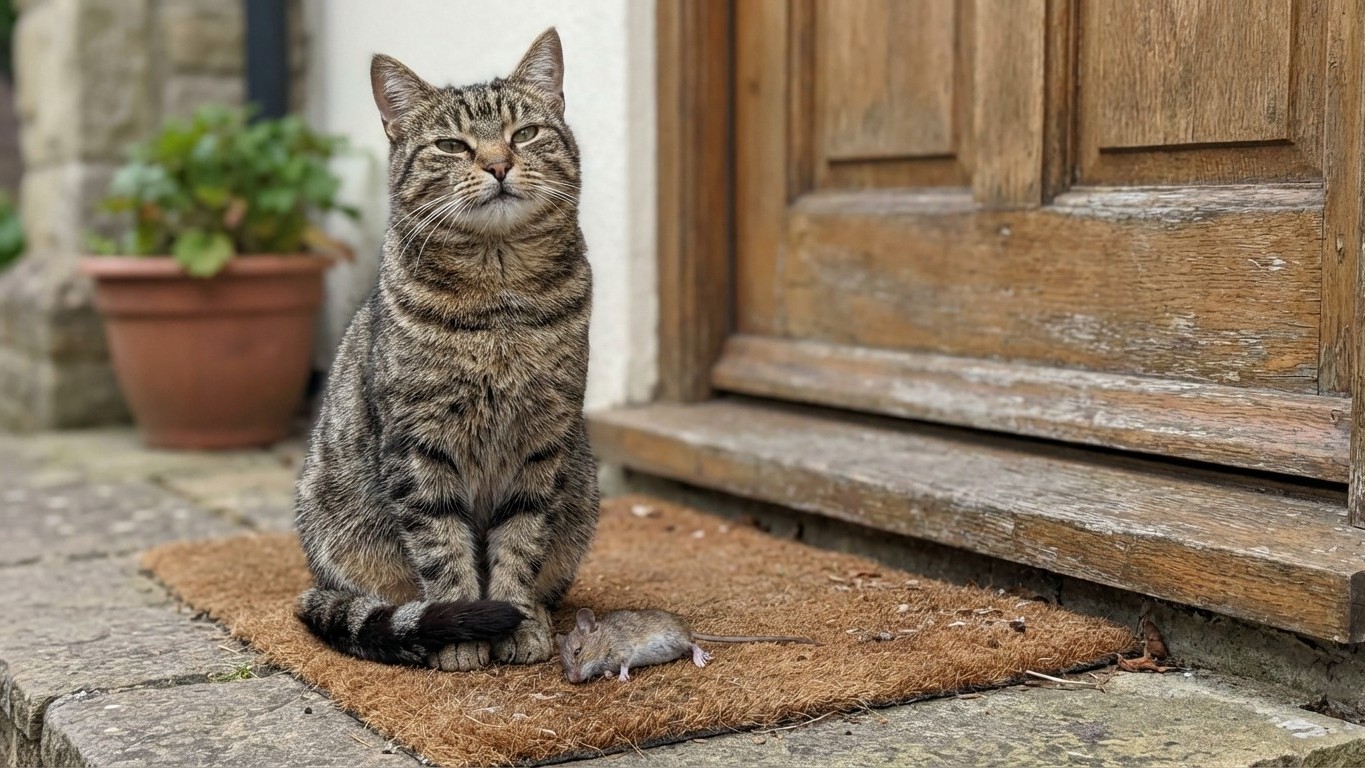
There’s a mouse on your doormat. Again. Your cat is sitting beside it, tail curled with quiet satisfaction, and the bowl of kibble in the kitchen is still half full. Most owners just sigh, grab a carrier bag and bin it, but that small, limp offering is actually a rather pointed message about what your cat thinks of their diet, and the science behind it is more compelling than you might expect.
Key takeaways
- A major study found premium meat-based cat food reduced hunting by 36%—but what’s actually missing from standard kibble?
- Cats are obligate carnivores with specific nutrient needs plant-based proteins can’t satisfy—and their bodies know it
- One cat went from catching 22 animals to just 2 after a diet change, then reverted when the owner switched back
Hunting isn’t hunger, or is it?
Research suggests that predatory instinct, rather than hunger, is probably the main reason why some domestic cats regularly hunt wild prey. That much most cat owners already sense. But the story doesn’t end there. The simple answer to Why Your Cat Brings You Dead animals is because it is their natural instinct to do so, even though they have no need to hunt for food. Cats quite simply prefer to bring their prey back to their core territory where it is safer to eat it, and that core territory is the house, often in the space they share with you.
The deeper question, though, is why the instinct fires at all when a full bowl is waiting at home. It has been proposed that some cats may hunt more because they are stimulated to seek additional or diverse food items to compensate for some aspects of Deficiency in the food they are provided within the household. That is not a fringe theory. It sits at the centre of one of the most significant pieces of feline research published in recent years.
A study by the University of Exeter found that introducing a premium commercial food where proteins came from meat reduced the number of prey animals cats brought home by 36%, and that five to ten minutes of daily play with an owner resulted in a 25% reduction. The trial involved 355 cats in 219 households in south-west England over 12 weeks. Those are substantial numbers, and a 36% drop in kills is not a rounding error.
The problem with “complete” food that isn’t quite complete enough
Here is where it gets genuinely uncomfortable for anyone staring at a supermarket own-brand bag of kibble. “It is not clear what elements of the meaty food led to the reduction in hunting. Some cat foods contain protein from plant sources such as soy, and it is possible that despite forming a ‘complete diet’ these foods leave some cats deficient in one or more micronutrients, prompting them to hunt,” said Martina Cecchetti, the researcher who conducted the experiments.
As obligate carnivores, cats require animal-based proteins for essential nutrients such as taurine and arginine, which they cannot synthesise from plant-based sources. This isn’t a dietary preference, it is biology. De novo synthesis of arginine and taurine is very limited in cats, and concentrations of both taurine and arginine in feline milk are the greatest among domestic mammals — a sign of just how dependent the species is on these nutrients from external sources.
The consequences of getting this wrong are serious. Three syndromes have been identified related strictly to taurine Deficiency: feline central retinal degeneration, reproductive failure and impaired fetal development, and feline dilated cardiomyopathy. Arginine is so essential in a cat’s diet that signs of deficiency can be acutely observed within a short time after consuming an arginine-free diet. Carnivorous diets supply abundant taurine, but cereals and grains supply only marginal or inadequate levels for cats, so diets based on these protein sources may be lacking in taurine.
Research found that cats who ate 100%-meat foods responded by reducing their hunting, but when the food contained grain fillers or plant-based proteins, the cats did not change their behaviour. The team suggests that there are micronutrients or amino acids in meat that satisfy some biological needs of the cat. A bag labelled “complete and balanced” can legally meet minimum standards while still leaving a gap between what your cat gets and what evolution actually wired them to need.
What the dead mouse is actually telling you
Cats would kill around 12 small animals (rodents mostly) on average in order to meet their daily energy and nutrient requirements in the wild. This instinctive behaviour is probably inherited from their ancestors and helps explain the habit of eating frequent small meals observed in domesticated cats today. A mouse, nutritionally speaking, is a near-perfect meal for a cat: high protein, moderate fat, almost no carbohydrate, and packed with the amino acids their metabolism depends on. The body recognises what it needs even when the conscious brain doesn’t know it’s missing anything.
Research has also found that cats scoring high for extraversion or low for neuroticism are more likely to hunt and bring home wild prey, compared to cats that do not. Personality, it turns out, shapes how intensely the hunter inside any given cat expresses itself. So your cat’s doorstep offering may also be as much about temperament as it is about nutrition. Both factors matter, and they interact.
One detail from the Exeter study deserves a mention. Minnie, a cat who was in the high-meat group, brought back only two animals during the trial, compared with 22 in the seven weeks before it. Her owner had previously been feeding a supermarket own-brand food. The switch to a meat-based diet made a dramatic difference, until cost became an issue and she reverted. The point stands: food quality changed behaviour measurably and quickly.
What you can actually do about it
Reading the ingredient list on your cat food is a reasonable starting point. Look for a named meat source as the first (and ideally second) ingredient. Commercial foods have high and variable carbohydrate content, and dry foods in particular contain high proportions of plant sugars and starches, including from distinctive C4 plants, much of which may be indigestible to cats. The presence of soy, maize, or wheat high up on the ingredient list should prompt questions about whether the food is genuinely meeting a cat’s carnivorous requirements.
Play also matters, perhaps more than owners realise. iCatCare has noted that predatory-like play is an activity owners can easily introduce at no or little cost, takes little time, and is very cat-friendly. The mental and physical stimulation of this kind of play is likely to help keep a cat in top condition and provide an appropriate behavioural outlet for its predatory behaviours. Five to ten minutes per evening with a wand toy isn’t a huge commitment, especially given that it cuts wildlife casualties by a quarter.
If your cat hunts regularly, there is also a health angle worth considering. If your cat still goes outside and catches and kills animals, it is important to keep on top of their flea and worm treatments. Hunting is one of the most common ways for a cat to catch worms, and fleas will often hop from the deceased animal onto your pet. Always speak to your vet about the right parasite prevention schedule if your cat has outdoor access, it’s one of those conversations that’s easy to delay and easy to regret.
There is one final nuance that often gets lost in the discussion. Domestic cats living as companion animals rely almost exclusively on provisioned cat foods, even when they regularly kill wild prey. If provisioned cats hunt to address some nutritional deficiency, what they kill is unlikely to substantially alter macronutrient intake. The mouse on your doormat, is probably a symptom rather than a solution, your cat’s body prompting a behaviour that the bowl at home should be doing a better job of satisfying in the first place. Always consult your vet before making significant dietary changes, particularly if your cat has any existing health conditions.
Sources : esajournals.onlinelibrary.wiley.com | sciencedirect.com