
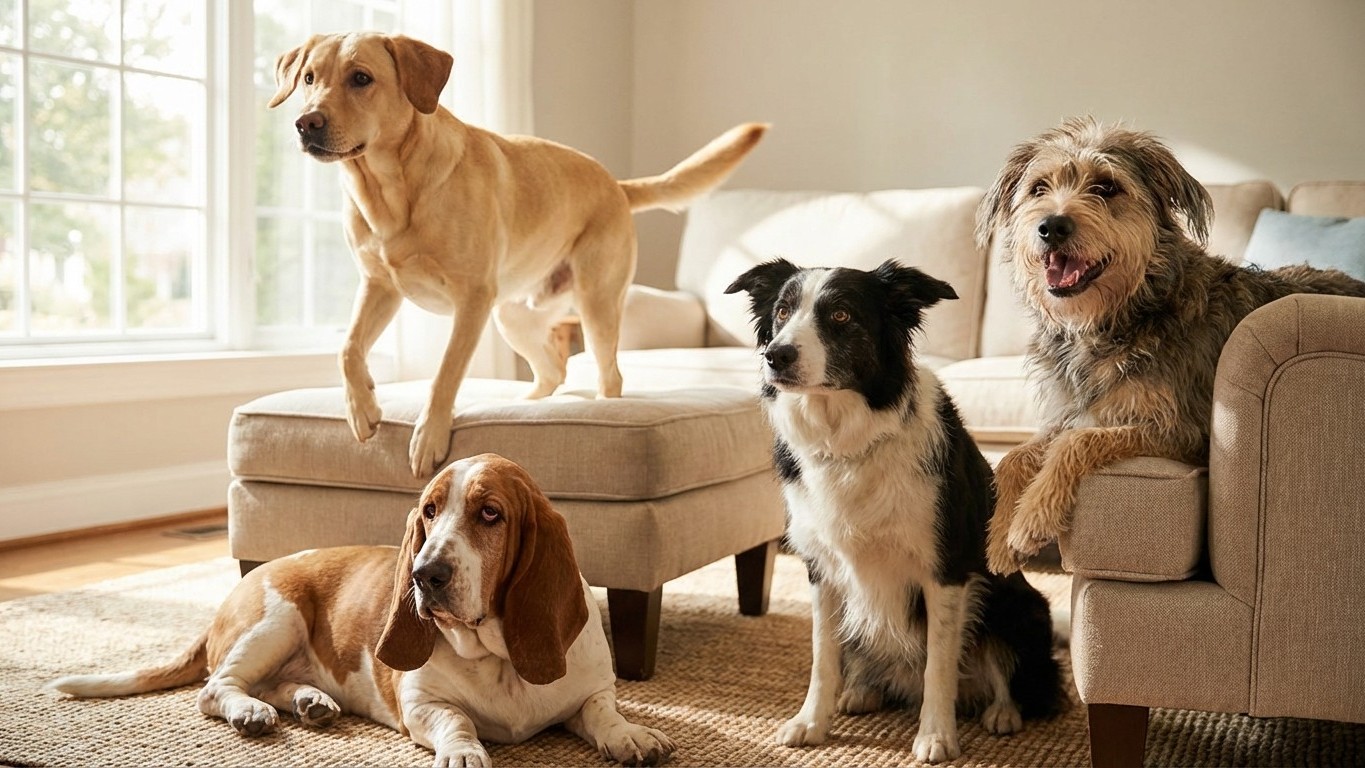
Every dog is an individual, yes, but the breed behind that individual tells you an enormous amount about what you’re signing up for. The Labrador who bounces off the walls at 7am, the Basset Hound who regards the morning walk as a personal insult, the Border Collie who’s already three steps ahead of you before you’ve finished the command, these aren’t random personality quirks. They’re temperament. And understanding that temperament, really understanding it, is what separates a joyful lifelong partnership from a chaotic mismatch that ends in heartbreak for both species. For those considering breeds with particularly demanding exercise requirements, consulting a high energy dog breeds guide can be invaluable in setting realistic expectations.
This dog breeds temperament guide breaks down the three axes that matter most when assessing any breed: energy level, sociability, and trainability. These three dimensions, taken together, paint a far more honest picture than any single label like “family dog” or “working dog” ever could.
Understanding Dog Breed Temperament: Why It Matters More Than You Think
Defining Canine Temperament
Temperament, in the canine context, refers to the constellation of inherited behavioural tendencies that a dog carries from birth. Think of it as the factory settings, the baseline from which every individual dog operates before training, socialisation, or life experience adds its own layer. It encompasses things like reactivity, prey drive, confidence, sociability with strangers, and tolerance for novelty. These traits have been selectively amplified or muted over centuries of breeding for specific functions, which is why a Malinois and a Maltese can share 99% of their DNA and yet feel like entirely different species to live with. For those seeking breeds with strong learning capabilities and cooperative tendencies, consulting an easy to train dog breeds guide can help identify breeds with naturally compliant temperaments. Similarly, for those prioritising peace and quiet in their home environment, a quiet dog breeds guide (low barking) can help identify breeds with naturally calm vocal tendencies, or consider exploring a calm dog breeds guide for breeds with naturally relaxed temperaments overall.
The Fédération Cynologique Internationale (FCI) groups breeds into ten categories based largely on original function, and that function is the single most reliable predictor of temperament. A breed designed to herd sheep will have an innate need to control movement. A breed designed to flush game will be perpetually alert to sound and scent. Understanding why a breed was created tells you, almost immediately, what living with one will feel like. For those particularly interested in breeds known for their cognitive abilities, this intelligent dog breeds guide provides valuable insights into their specific temperament traits.
Temperament vs Individual Behaviour: A Critical Distinction
Here’s where many owners, and even some breeders, muddy the waters. Temperament is heritable and breed-typical. Behaviour is the expression of temperament filtered through experience. A Golden Retriever with excellent breed temperament but zero socialisation as a puppy may still grow into an anxious adult. Conversely, an independent breed like the Shiba Inu, properly raised and consistently trained, can be a surprisingly manageable companion, just don’t expect the same biddability you’d get from a Golden.
This distinction matters practically because it shifts some responsibility back to the owner. Temperament sets the parameters; you work within them. Choosing a breed whose temperament parameters suit your lifestyle gives you the best possible starting point.
The Three Key Axes: Energy, Sociability, and Trainability
Energy Level: The Spectrum from Calm to Relentless
Energy level is the temperament trait with the most immediate daily impact. A high-energy dog in a low-activity household isn’t just inconvenient, it’s a welfare issue. Border Collies who don’t work develop stereotypies. Huskies left without outlets for their endurance can be destructive on a scale that would impress a small demolition crew.
Energy needs don’t just mean physical exercise either. Mental stimulation is the often-overlooked half of the equation. A working breed that’s had a two-hour walk but no cognitive challenge is still a working breed looking for a job. Puzzle feeders, scent work, training sessions, these count. For a detailed breakdown of which breeds sit at the high end of this spectrum, the high energy dog breeds guide is an excellent next step. For those leaning toward a more relaxed companion, the calm dog breeds guide covers breeds whose factory settings include a natural “off” switch.
Sociability: How Dogs Relate to Humans and Other Animals
Sociability encompasses two distinct but related qualities: how a dog relates to humans (familiar and unfamiliar), and how it relates to other animals. These don’t always correlate. The Greyhound, for instance, tends to be gentle and affectionate with people but may have a strong prey drive that makes small animals a liability. The Chow Chow can be deeply bonded to its family while remaining aloof to the point of suspicion with strangers.
For families with children, understanding the breed’s tolerance for unpredictable movement and noise is critical. For multi-pet households, prey drive, resource guarding tendencies, and same-sex aggression levels all need factoring in. Sociability is not a fixed quantity either, early and appropriate socialisation during the puppy’s sensitive window (roughly 3 to 14 weeks) can widen the social comfort zone considerably, though it cannot override the fundamental temperament.
Trainability: Intelligence, Motivation, and the Independence Question
Trainability is frequently misunderstood. People conflate it with intelligence, but some of the most intelligent dogs are among the hardest to train, because they’re intelligent enough to have their own agenda. Trainability is really about motivation and biddability: how much does this dog want to work with you, and what does it find rewarding?
Herding breeds and gun dogs typically top trainability charts because they were bred to take direction from a human handler. Terriers and scent hounds, bred to work independently, often prioritise their own judgement over yours. That’s not stupidity; it’s the job they were designed for. The easy to train dog breeds guide explores this in depth, including why some “easy” breeds may still challenge novice owners in unexpected ways.
Temperament Across Breed Groups
Herding Dogs: Stimulated by Work, Loyal but Demanding
Border Collies, Australian Shepherds, German Shepherds, Belgian Malinois, the herding group produces some of the most capable dogs on the planet. They’re also some of the most demanding to own. Bred to make decisions independently while still responding to a shepherd’s commands, these dogs need both mental and physical engagement at a level that catches many owners off-guard. The loyalty is extraordinary. The intensity, if not properly channelled, can be exhausting.
German Shepherds sit at a slightly more moderate point on the energy-intensity spectrum compared to Collies, which is one reason they remain the world’s most popular working dog. Their trainability is exceptional, their protective instinct strong, and their sociability, when well-socialised, genuinely warm.
Hunting Dogs: Instinct, Stamina, and That Independent Streak
Spaniels, Retrievers, Pointers, Beagles, Dachshunds, the hunting group is vast and internally diverse. Retrievers (Labradors, Goldens) were bred to work closely with a handler and have a sociability and trainability profile that makes them forgiving for novice owners. Beagles and other scent hounds are a different proposition: once their nose engages, recall becomes theoretical rather than practical. Terriers, technically their own FCI group, bring a terrier-specific ferocity of spirit that can be enormous fun or a persistent headache, depending on how well it’s understood from the outset.
Hunting breeds generally need more off-lead time and olfactory stimulation than owners anticipate. A Cocker Spaniel who never gets to use its nose is a Cocker Spaniel looking for mischief.
Companion Breeds: Attached, Adaptable, and People-Focused
Bichons, Cavalier King Charles Spaniels, French Bulldogs, Pugs, companion breeds were designed from the ground up for human company. Their sociability with people is typically high, their energy levels generally moderate to low, and their trainability often solid if somewhat treat-motivated. The flip side of that deep human attachment is a vulnerability to separation anxiety. A breed that exists to be with people can struggle profoundly when left alone.
It’s worth noting (in a non-mechanical way) that many companion breeds also come with significant health considerations related to their physical conformation, something any prospective owner should research thoroughly alongside temperament. The broader dog breeds guide covers this intersection of temperament and health in more detail.
Giant vs Small Breeds: Energy and Training Dynamics
Size introduces its own temperament nuances. Giant breeds like the Great Dane, Saint Bernard, or Newfoundland often have surprisingly calm temperaments, they were bred for endurance and steadiness rather than speed and reactivity. That said, a calm temperament in a 70kg dog requires just as much training investment as an energetic temperament in a smaller one, because the consequences of inadequate training scale with body weight.
Small breeds, conversely, are sometimes indulged in behaviours that would never be tolerated in a large dog, leading to what Behaviourists sometimes call “small dog syndrome”, a cluster of anxious or pushy behaviours that stem from inconsistent handling rather than breed temperament itself.
Which Temperament Suits Which Owner?
Active and Sporty Owners
If your weekends involve trail running, cycling, or long country walks, a high-energy working breed can be a genuine companion. Vizslas, Weimaraners, Border Collies, Australian Shepherds, Siberian Huskies, these breeds thrive alongside active owners and often struggle without them. The key question isn’t just energy, though: it’s also trainability and sociability, because a dog that’s physically tired but emotionally demanding can still be hard work.
Families with Children and Other Pets
For families, the headline traits to look for are patience, low-to-moderate prey drive, and resilience under unpredictable stimuli. Labrador Retrievers, Golden Retrievers, Boxers, and Bernese Mountain Dogs tend to score well here. Breeds with strong herding instincts may try to corral children (which can alarm small ones), and breeds with high prey drive need very careful management around smaller pets.
Socialisation from puppyhood remains the single most powerful tool for any family dog, regardless of breed. No breed is born family-ready; that takes time, consistency, and early positive experiences.
Seniors and City Dwellers
Basset Hounds, Cavalier King Charles Spaniels, Greyhounds (yes, genuinely, retired racers are often remarkably lazy indoors), Shih Tzus, and French Bulldogs tend to suit lower-activity lifestyles. For urban environments, adaptability and noise tolerance matter as much as energy level. A small, energetic terrier in a flat may be more manageable than a calm but large breed with space requirements that a city home simply cannot meet.
Temperament and Training: What to Watch For
Easy to Train vs Stubborn: What the Distinction Actually Means
A breed that’s described as “stubborn” usually means one that wasn’t bred to defer to human direction. Chow Chows, Basenjis, Afghan Hounds, Akitas, these breeds are often independent thinkers with a deep sense of self-preservation that doesn’t naturally include “do what the human says.” They can absolutely be trained, but the approach needs to respect that independence. Harsh, repetitive methods tend to shut these dogs down. Patience, reward-based training, and accepting that your Basenji may never have perfect recall are the realistic frameworks here.
The Case for Early Socialisation
Whatever breed you choose, socialisation in the early weeks of life is the most cost-effective investment you’ll ever make in your dog’s welfare. Puppies who experience a wide range of people, animals, sounds, and environments between 3 and 14 weeks of age develop into more confident, adaptable adults. This doesn’t override temperament, but it works with it, expanding the dog’s comfort zone within its natural parameters. A well-socialised confident breed is a joy. An under-socialised anxious one is a daily management challenge, whatever its genetic background.
Temperament Snapshot: 10 Popular Breeds at a Glance
The table below gives a simplified overview of energy, sociability, and trainability for ten popular breeds. These are generalisations across the breed standard, individual dogs vary, and a reputable breeder or rescue organisation will be able to tell you about specific dogs within those parameters.
- Labrador Retriever — Energy: high; Sociability: very high; Trainability: very high
- Border Collie — Energy: very high; Sociability: moderate; Trainability: very high
- French Bulldog — Energy: low-moderate; Sociability: high; Trainability: moderate
- German Shepherd — Energy: high; Sociability: high (with socialisation); Trainability: very high
- Greyhound — Energy: moderate (bursts); Sociability: high with people, variable with animals; Trainability: moderate
- Beagle — Energy: high; Sociability: high; Trainability: moderate (scent-distracted)
- Cavalier King Charles Spaniel — Energy: low-moderate; Sociability: very high; Trainability: high
- Shiba Inu — Energy: moderate-high; Sociability: selective; Trainability: low-moderate
- Golden Retriever — Energy: high; Sociability: very high; Trainability: very high
- Chow Chow — Energy: low-moderate; Sociability: reserved; Trainability: low
Refining Your Choice: Temperament, Lifestyle, and the Bigger Picture
Connecting Temperament to Your Whole Lifestyle
Temperament doesn’t exist in isolation from other breed characteristics. A breed’s grooming requirements, size, health predispositions, and lifespan all interact with its temperament to create the full picture of what ownership looks like. A high-energy breed that also requires daily grooming and is prone to costly health conditions demands a specific kind of commitment that’s worth identifying honestly before falling for a pair of soulful eyes at a rescue centre.
The best choices come from sitting with all these variables together. How much time can you genuinely give, seven days a week, fifty-two weeks a year? How does your home environment suit the breed’s sensory needs? Do your social habits, travel, long working hours, a busy house, align with what this breed was built for?
For anyone at the beginning of this process, starting with the comprehensive dog breeds guide gives a solid foundation across all these dimensions, before narrowing down by temperament type.
Frequently Asked Questions About Dog Breed Temperament
How do I know if a breed’s temperament is compatible with my lifestyle?
The most honest approach is to research the breed’s original function and ask yourself whether you can meet those functional needs in a modern domestic context. A breed created to run 50 miles a day pulling a sled needs that outlet replicated somehow. Beyond research, spending time with adult dogs of the breed, not just puppies, gives you a far more realistic impression. Breed clubs and reputable rescue organisations are invaluable here.
Which breeds are easiest for first-time owners?
Breeds that combine moderate energy, high sociability, and strong trainability tend to be most forgiving. Labrador Retrievers, Golden Retrievers, and Cavalier King Charles Spaniels regularly appear at the top of these lists for good reason. That said, “easy” is relative, even a biddable breed needs consistent training, appropriate socialisation, and realistic expectations from its owner.
Can a high-energy dog adapt to flat living?
Physically, some can manage with sufficient exercise and mental stimulation, but the honest answer is that most high-energy breeds are stressed by the confinement of city flat life, regardless of how much walking they get. The dog’s daily life involves a great deal of time inside four walls, and for a breed with strong working instincts, that time needs to be richly structured to prevent anxiety and problem behaviours. Some breeds adapt better than others, a Whippet, for instance, is energetic but also genuinely comfortable spending long stretches resting indoors.
Does temperament affect how easy a dog is to train?
Directly and profoundly. Breeds with high biddability, the desire to work with a human handler, take to training more readily and forgive inconsistency more graciously. Independent breeds require cleaner, more consistent technique because they’re less inclined to keep trying when the communication isn’t clear. Motivation also varies: food-motivated dogs are generally easier to train than dogs who find environmental rewards (smells, movement, other animals) more compelling than anything you’re offering.
Whatever breed you’re considering, if questions arise about behaviour, anxiety, or health, always consult a qualified vet or accredited canine behaviourist, breed temperament guides give the frame, but your individual dog deserves individual professional attention when needed.
The relationship between a person and their dog is one of the oldest partnerships in human history. Getting the temperament match right from the start doesn’t guarantee perfection, but it does give that partnership the best possible foundation. And perhaps the most honest thing any guide can tell you is this: the dog who fits your life may not be the dog you first imagined, and that dog might turn out to be the better story.