
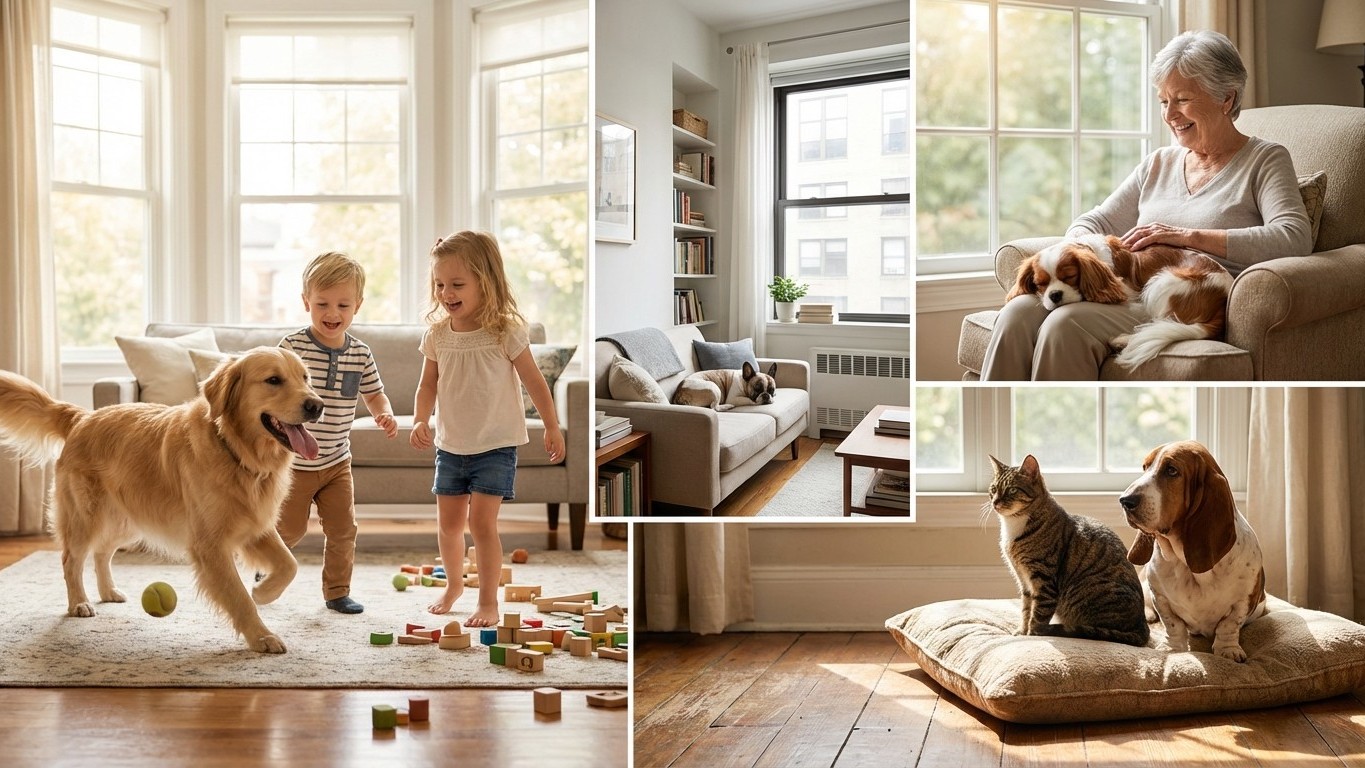
Choosing a dog is one of the most significant decisions a household can make, and the stakes are higher than most people initially realise. Not because dogs are difficult (many aren’t), but because the wrong match between breed and lifestyle is one of the leading reasons dogs end up in rescue centres. Temperament clashes, energy mismatches, unexpected grooming demands, these are entirely avoidable when you approach the decision with honest self-reflection and solid information. This guide maps the best breeds across four distinct life situations: families with children, seniors (for whom we have a dedicated dog breeds guide for seniors), homes with cats (detailed in our comprehensive dog breeds guide good with cats), and households dealing with specific constraints like allergies, limited space, or busy schedules.
Why matching a breed to your profile actually matters
There’s a persistent myth that any dog, properly trained, will adapt to any household. That’s partly true, socialisation and training do an enormous amount of heavy lifting. But breed characteristics are real. Thousands of years of selective breeding have shaped instincts, energy levels, pain tolerance, and social wiring that don’t simply disappear with a few obedience classes. A Border Collie in a sedentary flat will find its own entertainment (usually destructive). A Greyhound with young children who want to roughhouse may become anxious rather than playful.
The good news is that understanding these tendencies makes matching much more straightforward than people expect. Our broader dog breeds guide covers the foundational principles of choosing by lifestyle, think of this page as the applied, profile-specific version of that framework.
Factors to consider before adopting
Before you look at any breed list, sit with a few honest questions. How active is your household on an average Tuesday, not a holiday weekend? Do you have very young children, elderly family members, or a resident cat? How much time can you genuinely dedicate to grooming each week? And crucially, is anyone in the home prone to allergies or anxiety? If you’re dealing with anxiety or prefer low-maintenance options, our dog breeds guide for anxious owners (low maintenance) offers targeted recommendations. For households juggling both children and allergies, our detailed dog breeds guide for allergies and kids addresses these dual concerns specifically. Your answers will immediately narrow the field considerably, and they’ll save you from the heartbreak of a return adoption.
Dogs and children: getting the breed right from the start
Families with children need a dog that combines patience with resilience. Children are unpredictable, they move suddenly, make loud noises, grab at tails, and can’t yet read canine body language. A dog that thrives in this environment isn’t simply “friendly”; it has a genuinely high stimulus threshold and a forgiving temperament toward clumsy handling. For detailed breed recommendations and specific considerations, check out our comprehensive best dog breeds guide for families with children.
What actually makes a breed child-friendly
Trainability matters enormously here. A dog that responds readily to commands gives parents the ability to manage interactions before they escalate. Equally important is size and physicality, a very large, bouncy breed can accidentally knock over a toddler, while a very small breed may be accidentally hurt by an enthusiastic five-year-old. The sweet spot tends to be medium-to-large dogs with gentle, sociable personalities and lower prey drives.
Pain tolerance is a factor rarely discussed openly but genuinely relevant. Some breeds will snap when startled or hurt; others will simply move away. Breeds historically selected for work alongside humans tend to have better bite inhibition and more tolerance for the kind of unintentional provocation that children produce. This doesn’t mean any dog should be left unsupervised with young children, it absolutely shouldn’t be, but it does affect the margin for error.
Seven breeds that tend to thrive in family homes
The Labrador Retriever consistently appears at the top of family breed recommendations, and there are solid reasons for this beyond its popularity. Labs have a famously gentle mouth (originally bred to retrieve game without damaging it), a strong desire to please, and a buoyant temperament that tolerates noise and chaos remarkably well. Golden Retrievers share many of these qualities, with perhaps an even softer, more sensitive disposition, ideal for calmer family environments.
The Beagle brings a compact, sturdy build and an affectionate, curious nature that children tend to find irresistible. Their pack-oriented instincts mean they genuinely enjoy company. Cavalier King Charles Spaniels are excellent for slightly older children who understand gentler handling, these dogs are loving, calm, and quite low-energy indoors. The Boxer, despite its imposing appearance, is well-known for being clownish and patient with children, and its short coat requires minimal grooming.
Staffordshire Bull Terriers deserve a particular mention here. Despite their unfortunate media reputation, Staffies were historically nicknamed “the nanny dog” in the UK, and their strong attachment to children and high pain tolerance make them genuinely excellent family pets when responsibly owned. The Poodle (particularly the Standard or Miniature) rounds out this list with intelligence, low shedding, and a playful, adaptable nature that works well across many household types.
For a far more detailed breakdown of criteria and breed comparisons, the best dog breeds guide for families with children goes considerably deeper into this specific profile.
Making the child-dog relationship work day to day
Even with the most patient breed, the responsibility lies with the adults. Teaching children to read basic canine signals (a stiff body, a tucked tail, a whale eye) before the dog even arrives is worth more than any breed characteristic. Give the dog its own space, a crate or bed that children know is off-limits, so it has a genuine retreat. Supervised mealtimes, where the dog eats undisturbed, prevent food-guarding situations before they begin. And involve children in training from an early age: a dog that takes commands from a seven-year-old is a dog that respects the household hierarchy.
Dogs for seniors: calm companions, manageable routines
The dog-senior pairing is, when done well, one of the most genuinely beneficial relationships in pet ownership. Companion animals are well-documented in supporting mental health, reducing loneliness, and encouraging gentle physical activity. But a mismatch here can be exhausting or even hazardous, a strong, pulling dog can cause falls; a high-energy breed can generate stress rather than comfort.
What to prioritise for older owners
Physical manageability is the first consideration. A dog that can be comfortably walked, lifted if necessary, and handled at the vet without a wrestling match is a practical priority. Temperament tends toward calm, affectionate breeds that are content with moderate exercise and thrive on companionship rather than stimulation. Grooming requirements matter too, a breed that needs professional grooming every six weeks is a recurring commitment in cost and logistics.
Health robustness is worth factoring in. Some breeds, charming as they are, carry significant health risks that translate to frequent, expensive vet visits. For older owners on fixed incomes, a breed with a solid health track record and reasonable longevity offers more predictable companionship.
Five breeds worth considering for seniors
The Shih Tzu is a natural fit: small, low-exercise, deeply affectionate, and perfectly happy spending a day indoors in good company. The Bichon Frisé shares these qualities and has the added advantage of very low shedding, useful for seniors with mild allergies or who prefer a tidy home. The Cavalier King Charles Spaniel appears here too, for similar reasons: gentle, adaptable, and content with gentle walks rather than athletic adventures.
The Whippet is a less obvious choice but a genuinely excellent one. These dogs are calm indoors, require relatively brief bursts of exercise rather than long daily walks, and are affectionate without being overwhelming. Their short coat is simple to maintain. The French Bulldog, popular for good reason, brings a steady, low-key temperament and manageable size, though prospective owners should be aware of the breed’s known respiratory issues, which warrants honest conversations with a vet before committing.
The dog breeds guide for seniors offers an expanded look at health considerations, daily routines, and what to ask breeders or rescue organisations when choosing a companion for later life.
Dogs and cats: breeds that genuinely get along
Anyone who’s ever tried to introduce a terrier to a resident cat already knows this can go spectacularly wrong. The good news is that breed selection, combined with a careful introduction process, makes peaceful multi-species households entirely achievable. The key is understanding which dogs have been bred in ways that make cat-chasing a deep instinct versus those for whom other small creatures are simply… neighbours.
Which breeds actually work with cats
High-prey-drive breeds, most terriers, sighthounds like Greyhounds and Whippets (off-lead), many hounds — carry a greater risk simply because the urge to chase small, fast-moving animals is genuinely hardwired. This doesn’t make cohabitation impossible, but it requires more management and careful monitoring.
Breeds that tend to fare better with cats include Golden Retrievers and Labradors (sociable and generally uninterested in chasing), Cavalier King Charles Spaniels (gentle, low prey drive), Pugs and Bulldogs (physically not built for fast pursuit, and temperamentally laid-back), and Poodles (adaptable, intelligent, responsive to training). Some mixed breeds, particularly those without obvious terrier or hound characteristics, can also settle well alongside cats when introduced properly.
For a thorough guide to cross-species introductions, including room-by-room protocols and what to do when first meetings go poorly, the dog breeds guide good with cats is the dedicated resource.
How to introduce a dog and cat successfully
The single most common mistake is rushing the introduction. Letting them “sort it out” in the same room on day one is almost always counterproductive. A staged approach, where the animals spend time on opposite sides of a door, sharing scent through bedding, before any visual or physical contact, dramatically increases the chances of a positive outcome. The cat should always have vertical escape routes, shelves, cat trees, high furniture, where the dog simply cannot follow. Feeding both animals at a distance from each other, gradually closing that distance over days, builds positive associations without pressure.
Specific constraints: allergies, small spaces, and busy lives
Life doesn’t always accommodate a dog’s needs neatly, and acknowledging this honestly is more responsible than pretending otherwise. Three constraints come up repeatedly: allergies, limited space, and limited time.
Hypoallergenic breeds and shedding
The word “hypoallergenic” deserves a small caveat: no dog is entirely allergen-free, because the primary allergen is a protein found in dog saliva, urine, and skin dander, not the fur itself. That said, breeds that shed minimally (and therefore distribute less dander around the home) do tend to provoke fewer reactions in allergy sufferers. Poodles, Bichons Frises, Maltese, Portuguese Water Dogs, and the various Doodle crosses are commonly recommended for this reason. If allergies are a concern in your household, spending time with the specific breed before adoption is the most sensible test.
Breeds for flats and smaller homes
Contrary to popular assumption, a small flat doesn’t automatically mean you need a small dog. Many large breeds are surprisingly sedentary indoors : Greyhounds and Great Danes are often described as “sofa dogs” by their owners. What matters more is whether the dog can get sufficient outdoor exercise each day. Breeds genuinely well-suited to smaller living spaces tend to be low-energy indoors, quiet (important for neighbours in blocks of flats), and not prone to separation anxiety. Cavalier King Charles Spaniels, Basset Hounds, Bulldogs, and Shih Tzus all tick many of these boxes.
Dogs for owners with demanding schedules
Some breeds handle alone time better than others. Independent breeds, Basenjis, Basset Hounds, certain sighthounds, are less likely to develop problematic separation anxiety than highly bonded, people-focused breeds like Border Collies or Vizslas. That said, no dog should be left alone for very long stretches routinely; it’s worth considering doggy daycare, dog walkers, or neighbours as part of the practical plan. If ease of care and predictability is a priority, the dog breeds guide for anxious owners (low maintenance) addresses this specifically, covering breeds that forgive irregular routines and don’t require constant stimulation.
Quick reference: matching breed traits to your situation
Rather than an exhaustive table, a few patterns emerge clearly from everything above. Families with young children benefit most from medium-to-large, trainable, patient breeds with low prey drives. Seniors are best matched with small-to-medium, calm, affectionate dogs with manageable grooming and health profiles. Multi-cat households should look toward sociable, low-prey-drive breeds and invest seriously in the introduction process. Allergy sufferers should prioritise low-shedding breeds and, where possible, trial contact before committing. And owners with limited space or time need dogs whose indoor energy levels and independence allow for a more flexible daily rhythm.
Every profile can find its dog, with the right starting point
One of the most common things people say after a successful adoption is that they wish they’d thought about it more carefully the first time. Not because they made disastrous mistakes, but because the right breed really does make the relationship feel almost effortless by comparison. The dog fits. It’s not a battle of wills or a constant negotiation with incompatible energy levels.
Can a family with children, a resident cat, a small flat, and mild allergies find a suitable dog? Genuinely, yes, though the shortlist gets short. Can a senior living alone find a breed that provides companionship without physical or financial strain? Absolutely. The starting point is always the same: honest self-assessment before breed research, not the other way around.
If you’re still building your understanding of how breed characteristics interact with lifestyle, the dog breeds guide provides the broader framework that underpins all of these specific recommendations. From there, diving into the profile-specific guides gives you the detail you need to make a choice you, and your dog, will be grateful for.