
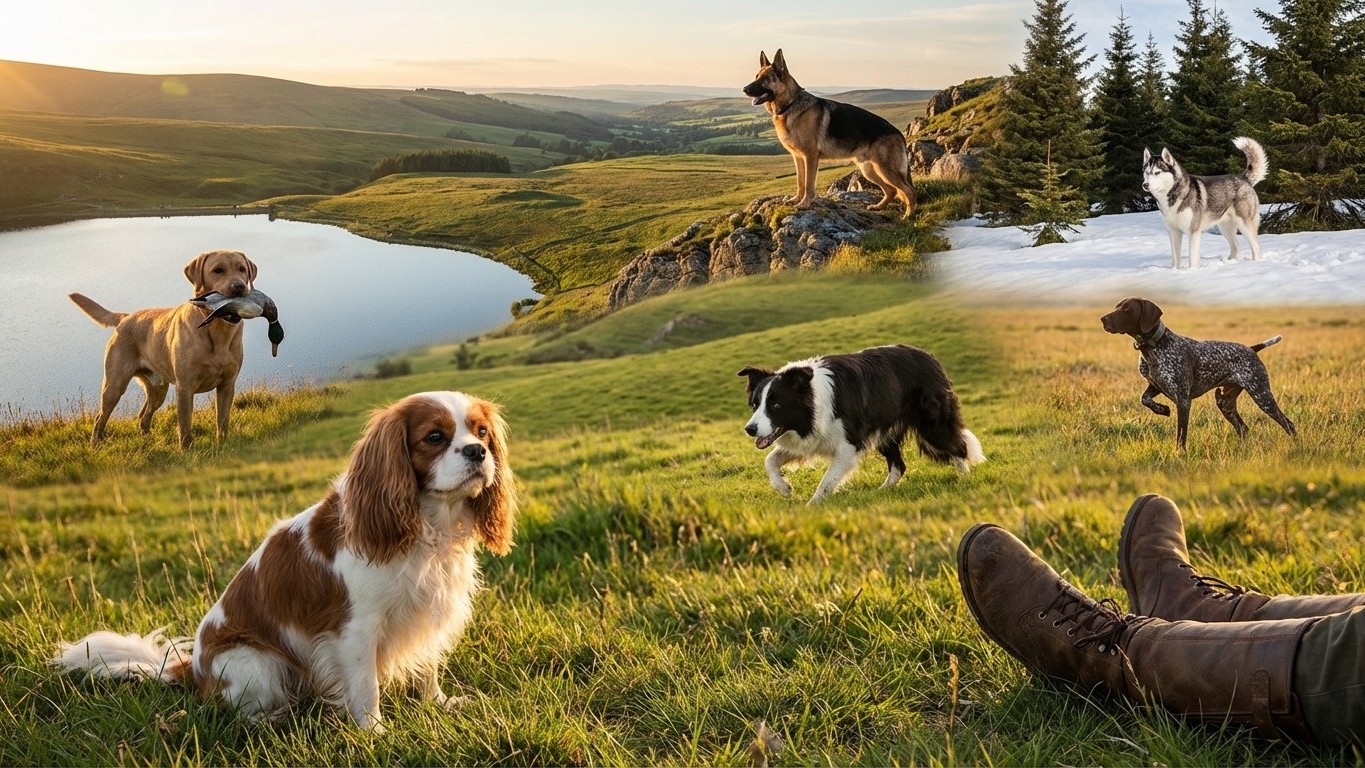
Every dog breed alive today was shaped by a job. Not by accident, not by aesthetics alone, but by centuries of deliberate selection for specific tasks: driving cattle through the Scottish Highlands, retrieving pheasants from icy water, pulling sledges across Arctic tundra, or simply sitting quietly beside a grieving human who needed company. Understanding a dog’s working heritage isn’t just interesting trivia. It’s the single most reliable predictor of whether that dog will thrive in your home or make both your lives miserable.
This guide maps the full landscape of canine purpose, from traditional working roles to modern sport, protection, hunting, and companionship. For those specifically interested in dogs bred for human companionship, our companion dog breeds guide provides detailed insights, while our gun dog breeds guide covers the hunting specialists in depth. Those seeking dogs for protection should explore our guard dog breeds guide. If you’re navigating our broader dog breeds guide, think of this page as the compass that orients everything else.
Why a Dog’s Historical Purpose Still Matters Today
Somewhere along the way, a lot of people began choosing dogs the way they choose sofas: by looks. A Border Collie because it’s beautiful, a Husky because of its wolf-like eyes, a Malinois because it looks impressive on Instagram. The results, as any rescue centre worker will tell you, are often heartbreaking. Dogs surrendered at six months because they’re “too energetic”, “too destructive”, “impossible to manage”. None of those dogs failed. Their owners simply didn’t understand what centuries of breeding had wired into them.
A working dog breed isn’t just a dog that happens to be clever. It’s an animal whose entire nervous system was optimised for a specific kind of sustained, purposeful activity. Strip away that purpose and you don’t get a relaxed pet. You get anxiety, destruction, and a dog that’s genuinely suffering from under-stimulation. The good news is that understanding these instincts makes everything easier: training, exercise planning, even choosing the right flat versus house.
For a deeper exploration of the dedicated working category, our comprehensive working dog breeds guide covers training approaches, daily needs, and the realities of living with these high-demand breeds in detail.
Herding and Traditional Working Breeds: Centuries of Co-evolution
Shepherds, Drovers, and the Dogs That Built Farming
Long before fences existed, herding dogs were the technology that made large-scale livestock farming possible. Border Collies, Australian Shepherds, German Shepherds, Belgian Malinois, and many others developed highly specialized skills that our herding dog breeds guide explores in detail. Briards, and dozens of regional variants were bred to move animals across vast distances using precise, controlled pressure. What looks like play when a Border Collie circles children at a party is Actually a deep-wired herding Instinct. The “eye” (that intense, low-crouching stare the Border Collie uses to hold sheep in place) is so ingrained it activates whether there’s livestock around or not.
These breeds require mental stimulation at least as much as physical exercise. A Border Collie that runs five miles but has nothing to think about is still a frustrated dog. Puzzle feeders, obedience work, agility, and scent games address this in modern households. The herding dog breeds guide goes much further into the specific stimulation needs of these breeds and why mental challenge is non-negotiable for their welfare.
Sled Dogs, Water Rescuers, and Draft Breeds
A different category of working dog was built for raw physical output over long durations. Siberian Huskies and Alaskan Malamutes were bred to haul weight across frozen ground for hours, running on minimal food, in temperatures that would kill most other breeds. They are extraordinarily healthy and athletic, but they also have an independent streak that makes traditional obedience training an exercise in patience. These are not dogs that naturally defer to human authority the way a Labrador does.
The Newfoundland and the Saint Bernard occupy a slightly different niche: both were developed partly for water rescue and mountain rescue respectively, combining enormous physical strength with a calm, biddable temperament. The Newfoundland in particular has webbed feet and a water-resistant double coat that makes it a genuinely competent open-water swimmer. Families often underestimate just how large these dogs become (a male Newfoundland regularly reaches 70kg) and how much they cost to feed, insure, and provide veterinary care for.
Assistance and Service Dogs
Guide dogs, medical alert dogs, hearing dogs, psychiatric support animals: this is working dog culture at its most emotionally compelling. Labradors and Golden Retrievers dominate the assistance sector for good reasons. They combine high trainability with a calm, sociable temperament and low reactivity to environmental stress. A guide dog working in Central London needs to be completely unfazed by buses, crowds, pigeons, and unpredictable surfaces simultaneously. That combination of traits doesn’t appear by accident.
Border Collies are increasingly used in search-and-rescue and scent detection work, where their obsessive drive and problem-solving ability outweigh their higher-strung temperament. Choosing the right dog for assistance work involves far more than picking an intelligent breed. Temperament testing, health screening, and months of specialist training are required before any dog reliably performs a safety-critical task.
Sport Dogs: The Canine Athletes
Agility, flyball, canicross, IPO (Internationale Prüfungs-Ordnung), dock diving, disc dog: the world of canine sport has expanded enormously over the past two decades, and specific breeds have risen to the top of competitive rankings with startling consistency. The Border Collie is almost comically dominant in agility. The Belgian Malinois is the breed of choice across protection sports. The Jack Russell Terrier punches far above its weight in terrier races and earthdog trials.
What these breeds share is an exceptionally high “prey drive” combined with the trainability to channel that drive precisely. A Malinois with no job doesn’t just get bored. It gets dangerous. Destructive behaviour, barrier frustration, redirected biting: these are not signs of a bad dog but of a high-octane working machine that’s been left idling. If you’re an active person who runs, cycles, or hikes regularly and wants a dog to join you, these breeds can be extraordinary companions. If your idea of exercise is a twenty-minute stroll around the park twice a day, they will genuinely struggle.
Matching your actual lifestyle (not your aspirational one) to a dog’s energy profile is the single most important decision in breed selection. Be honest with yourself.
Guard and Protection Breeds: Security, Responsibility, and Socialisation
The guard dog category splits into two quite different functions that often get confused. Alarm dogs (breeds that bark loudly to alert owners to intruders) include everything from a Chihuahua to a Dobermann. Protection dogs (breeds that will physically intervene to defend territory or handlers) are a much smaller, more specialised group requiring significant professional training. Conflating the two leads to both bad outcomes and, in some cases, legal liability.
Breeds historically selected for guarding include the German Shepherd, Rottweiler, Cane Corso, Bullmastiff, Dogue de Bordeaux, and the Belgian Malinois. What they share is territorial instinct, physical confidence, and a lower threshold for perceiving threats. These are powerful traits in the right hands. In the wrong ones, they create dogs that are genuinely dangerous to other people and animals.
Socialisation from the earliest possible age (ideally from the breeder, before eight weeks) is not optional for these breeds. It’s the difference between a balanced, confident dog that Ignores strangers appropriately and an anxious, reactive one that threatens everyone it encounters. For a thorough look at the responsibilities involved, the guard dog breeds guide covers protection levels, socialisation protocols, and the legal framework around owning protection breeds in the UK.
One often-asked question is whether a single breed can serve as both a guard dog and a family companion. The honest answer is yes, but not automatically. A well-bred, well-socialised Rottweiler or German Shepherd can be a deeply affectionate family dog that also provides a meaningful deterrent to intruders. The “and” in that sentence requires consistent training, appropriate boundaries, and an owner who understands the breed’s communication signals.
Hunting Dogs: Scent, Speed, and Specialist Skills
Hunting breeds form one of the most diverse categories in the canine world, because hunting itself encompasses an enormous range of activities. Flushing birds from undergrowth is a completely different task from tracking a wounded deer across two miles of forest, which is different again from sitting in a hide waiting for wildfowl and then retrieving from cold water.
The broad categories are worth understanding. Spaniels (Cocker, Springer, Clumber) were developed to flush game from dense cover, working close to the gun. Retrievers (Labrador, Golden, Flat-Coated) bring shot game back to the handler with a “soft mouth” that doesn’t damage the bird. Pointers and setters locate game by scent and freeze in position to indicate its presence. Scent hounds (Beagles, Bloodhounds, Foxhounds) follow a trail by nose, often over long distances at sustained pace. Each group has distinct energy profiles, trainability quirks, and exercise needs.
For British readers particularly, the Cocker Spaniel and Labrador Retriever remain the backbone of working gun dog culture. Both breeds have diverged significantly between working lines (leaner, higher-drive, field-ready) and show lines (heavier, calmer, bred for conformation). If you want a working Spaniel, get one from working parents. A show-line Cocker is a very different animal. The gun dog breeds guide explores these distinctions in detail, including what to look for when sourcing a genuine working dog from a responsible breeder.
The ethical dimension of hunting with dogs is genuinely complex in the UK post-Hunting Act 2004, and anyone considering a working gun dog should be familiar with current legislation and best practice around animal welfare in the field.
Companion Breeds: More Than Just Lap Dogs
There’s a tendency to treat companion breeds as somehow less than working dogs, as if being bred for emotional connection rather than physical labour makes a dog less purposeful. This badly misunderstands what companion dogs were selected for. A Cavalier King Charles Spaniel was bred to be acutely attuned to human emotional states, to seek proximity, to be calm in variable environments, and to provide comfort. That’s a sophisticated suite of traits requiring just as deliberate a selection process as any herding breed.
The companion category spans an enormous range: from the Chihuahua (one of the oldest breeds, originally kept warm under robes by Aztec nobility) to the Standard Poodle (a working retriever that became a sophisticated urban companion), to the French Bulldog (which has become the UK’s most registered breed despite significant health concerns related to brachycephaly). Companion breeds generally have lower exercise needs than working breeds, but “lower” doesn’t mean none. A Pug still needs daily walks and mental stimulation. A Bichon Frisé still needs socialisation, training, and appropriate challenge.
The distinction between a companion dog and an assistance dog is worth noting. Assistance dogs are working animals with specific trained tasks. Emotional support animals (a less formally recognised category in the UK than in the US) are companion animals whose presence provides therapeutic benefit without task-specific training. Both are legitimate, but they carry different legal statuses and different practical implications for owners.
Comparing Breeds Across Uses: A Practical Overview
Choosing a breed ultimately means matching a dog’s genetic predispositions to your actual life, not the life you’d like to have. Below is a quick reference across the main usage categories:
- Herding/Working: Border Collie, German Shepherd, Belgian Malinois. Very high energy, high trainability, needs structured mental work daily.
- Sled/Draft: Siberian Husky, Alaskan Malamute, Newfoundland. Extreme stamina, independent temperament, significant exercise commitment.
- Sport/Agility: Border Collie, Malinois, Jack Russell Terrier. Athletic, driven, thrives with a sport-focused owner.
- Guard/Protection: Rottweiler, Cane Corso, German Shepherd. Territorial instinct, requires experienced handling and consistent early socialisation.
- Gun Dog/Hunting: Labrador, Cocker Spaniel, Pointer, Vizsla. Biddable, scent-driven, needs field or active rural context.
- Companion: Cavalier King Charles, Poodle, Bichon Frisé, Whippet. People-focused, adaptable, lower but not zero exercise needs.
The Questions Worth Asking Before You Choose
How many hours per day will the dog be alone? Do you have access to off-lead exercise space? What’s your experience with dog training? Are there children, elderly people, or other pets in the household? Do you live in a flat or a house with a garden? Your honest answers to these questions should drive your breed choice more than any other factor. A working dog breed in the wrong environment doesn’t just suffer. It costs you sleep, furniture, and sometimes neighbours’ goodwill.
FAQ: Common Choices and Costly Mistakes
What’s the best breed for guarding and family life combined? The German Shepherd and the Rottweiler both have strong track records in this dual role, provided they’re sourced from health-tested parents and socialised thoroughly from puppyhood. Neither is a breed for first-time dog owners.
Which dogs suit a very active lifestyle? Vizslas, Weimaraners, Border Collies, and Belgian Malinois all thrive with owners who run or cycle regularly. The Vizsla in particular combines high athleticism with genuine affection and is often overlooked by active families who default to Labradors.
Can a working breed live happily without a job? Sometimes, if the owner compensates through sport, scent work, or structured training. Never if the dog is simply left to its own devices. Rescue organisations in the UK consistently report that working breeds (particularly Huskies, Malinois, and Collies) are among the most frequently surrendered, almost always because owners underestimated their needs.
Is it possible to find a breed that genuinely bridges multiple roles? Yes. The German Shepherd, Labrador, and Standard Poodle all sit comfortably across working, companionship, and sometimes guarding functions depending on their lineage and training. These are genuinely versatile dogs when managed well.
The conversation about which breed suits which life ultimately comes back to one thing: honesty. The dog you imagine owning and the dog you’ll actually own are only the same animal if you’ve done the research. A good place to begin that research is with the comprehensive dog breeds guide, which maps breed characteristics to lifestyle compatibility across the full spectrum of canine types.
Dogs have spent ten thousand years adapting to human needs. The question worth sitting with is whether we’re willing to return the favour, by choosing a dog whose needs we can genuinely meet, rather than simply one we find beautiful.