
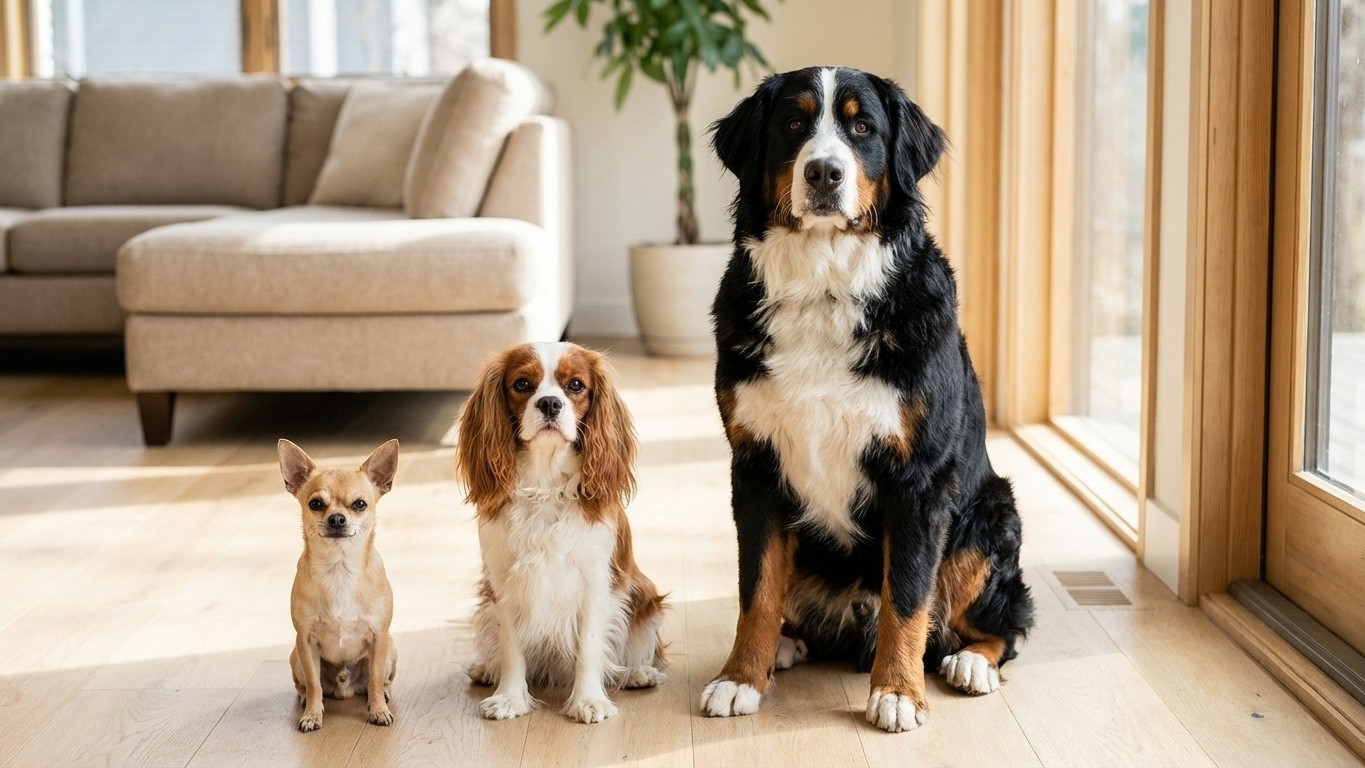
Size matters. Not as a value judgement, but as a practical reality that shapes every single day of life with a dog. The food bills, the sofa space, the walking routine, the vet costs, the way your children or elderly relatives interact with your pet, all of it flows from this one fundamental characteristic. Choosing the wrong size of dog for your lifestyle is one of the most common adoption mistakes made in the UK, and it’s almost always avoidable with a little research upfront.
This dog breeds guide by size chart covers the full spectrum, from the tiny Chihuahua nestled in a handbag to the towering Irish Wolfhound barely fitting through a standard doorway. You’ll find a comparative overview of breeds by size category, honest assessments of who each category suits, and the questions most people forget to ask before they fall in love with a puppy photo. Think of it as your starting point before diving into the detailed guides for each size group, including our comprehensive small dog breeds guide, our medium dog breeds guide, our large dog breeds guide, and our giant dog breeds guide.
Why a Dog’s Size Shapes Your Entire Life Together
The Practical Impact on Daily Life and Living Arrangements
A Cavalier King Charles Spaniel and a Bernese Mountain Dog are both affectionate, family-friendly breeds. But the Cavalier fits comfortably in a one-bedroom flat in Bristol, while the Bernese needs significantly more room, more food, and frankly, a larger car boot. Size isn’t just about physical space, it cascades into everything from the type of lead and harness you buy to whether you can realistically carry your dog to the vet if it’s injured.
Flat-dwellers often assume that only small dogs are suitable for apartment living, but this oversimplifies things considerably. Some giant breeds are surprisingly calm indoors and manage well in a flat provided they get sufficient outdoor exercise. Conversely, a Jack Russell Terrier, small enough to sleep in a shoebox, can be an absolute hurricane of energy that would drive a sedentary owner to distraction. Size gives you a starting framework, but it must always be read alongside temperament and energy level.
Consider also the human context of your household. A boisterous Labrador can accidentally bowl over a toddler or an elderly grandparent without any ill intent. A tiny Chihuahua, on the other hand, can be easily hurt by rough handling from young children. The physical scale of a dog relative to the people sharing its home is a welfare issue for both parties.
Exercise Needs, Energy and the Hidden Costs of Getting It Wrong
The correlation between size and exercise requirements is real but imperfect. Large and giant breeds often need substantial daily exercise to maintain a healthy weight and joint health, but some of the most demanding dogs in terms of daily activity are medium-sized working breeds like Border Collies or Springer Spaniels. Small terrier breeds were originally bred to hunt and have energy reserves that would exhaust many owners twice their age.
Budget is the other lens through which size matters enormously. Food costs scale with body weight in a fairly linear way. A giant breed can easily consume three to four times the daily calories of a small dog. Add in the cost of larger crates, beds, leads, grooming equipment, and veterinary treatments (anaesthesia dosing, for example, is weight-dependent), and the monthly outgoings of owning a Saint Bernard versus a Miniature Dachshund diverge dramatically.
Comparative Overview: Dog Breeds by Size, Weight and Key Traits
The Comparison Table
The table below gives a snapshot of representative breeds across all four size categories. It’s a quick-reference tool rather than an exhaustive list, each category has detailed guides linked throughout this article for those who want to go deeper.
| Size Category | Weight Range | Example Breeds | Average Lifespan | Exercise Needs | Suited To |
|---|---|---|---|---|---|
| Small (up to 10 kg) | 1–10 kg | Chihuahua, Pug, Shih Tzu, Cavalier KCS, Miniature Dachshund | 12–16 years | Low to moderate | Flats, smaller homes, older owners |
| Medium (10–25 kg) | 10–25 kg | Beagle, Cocker Spaniel, Border Collie, Whippet, Bulldog | 10–14 years | Moderate to high | Active families, suburban homes with gardens |
| Large (25–45 kg) | 25–45 kg | Labrador, Golden Retriever, German Shepherd, Weimaraner | 9–13 years | High | Houses with gardens, active owners |
| Giant (45 kg+) | 45–90+ kg | Great Dane, Saint Bernard, Irish Wolfhound, Newfoundland | 6–10 years | Moderate to high | Spacious homes, experienced owners |
How to Use This Table
The lifespan figures are averages based on breed health data and should be treated as general guidance rather than guarantees. Exercise needs reflect daily requirements for a healthy adult dog, puppies and seniors have different needs. “Suited to” describes the most common compatible living situations, not hard rules. A Labrador can thrive in a flat if its exercise needs are consistently met; a Chihuahua can live in a large house without any issue whatsoever.
Small Dog Breeds (Up to 10 kg)
Popular Examples and What Makes Them Tick
The Chihuahua holds the record as the world’s smallest recognised dog breed, with some individuals weighing under 1.5 kg. Despite their pocket-sized frame, they have enormous personalities, bold, fiercely loyal to their person, and sometimes bafflingly unaware of their own size when confronting larger dogs. The Cavalier King Charles Spaniel sits at the larger end of this category and is one of the UK’s most loved small breeds, prized for its gentle temperament and adaptability.
Pugs, French Bulldogs (typically falling just within or just above this range), Shih Tzus, and Miniature Dachshunds are all consistently popular in British households. Each has quite different energy levels and grooming needs, the Shih Tzu’s coat demands regular professional grooming, while the Pug’s main requirement is that you keep an eye on those skin folds and monitor its breathing given the brachycephalic (flat-faced) structure.
Who Small Dogs Actually Suit
Small breeds genuinely excel in urban environments. Lower exercise requirements (though never zero, every dog needs daily walks) make them manageable for people with limited mobility or very busy schedules. They’re economical to feed and easy to transport. For older owners or those living alone, the companionship offered by a small, affectionate dog like a Cavalier can be genuinely life-enhancing.
The flip side is real and worth stating plainly. Small dogs are often harder to train because owners inadvertently let them get away with behaviours they’d never accept from a larger dog, leading to that unfortunately common phenomenon of the snappy, over-excited small dog that rules the household. They can also be fragile around young children who haven’t yet learned to handle animals gently. The small dog breeds guide covers these nuances in much greater depth, including which small breeds are genuinely family-friendly and which do better in quieter homes.
Medium Dog Breeds (10–25 kg)
The Versatile Middle Ground
There’s a reason the Cocker Spaniel has been one of the UK’s most popular breeds for decades. Medium-sized dogs offer a kind of sweet spot, robust enough to join you on proper country walks, small enough to fit in a normal-sized car, and varied enough in temperament that there’s almost certainly a medium breed to match any personality type. The Beagle’s cheerful curiosity, the Whippet’s elegant calm at home combined with explosive speed outdoors, the Border Collie’s almost unsettling intelligence — all fall within this weight band.
The medium dog breeds guide explores this category in detail, but the key point here is that “medium” doesn’t mean “easy”. A Border Collie needs a job to do. A Springer Spaniel will go absolutely feral without sufficient mental and physical stimulation. Medium breeds suit active people, families with children old enough to engage properly with a dog, and anyone who can commit to two solid walks a day.
The Ideal Owner Profile
Suburban families with a modest garden, active individuals who run or hike regularly, and households where someone is home for a good portion of the day, these are the contexts where medium breeds typically flourish. The caveat, worth repeating: always look at the individual breed’s specific energy and grooming requirements, not just the weight category.
Large Dog Breeds (25–45 kg)
Big Hearts, Big Needs
The Labrador Retriever has held the title of the UK’s most popular breed for many years, which tells you something about the public’s appetite for large, good-natured dogs. Golden Retrievers, German Shepherds, and Weimaraners round out the upper end of this category. These are dogs that will fill your home, literally and emotionally. They lean on you, they greet visitors with full-body enthusiasm, and they tend to assume that the sofa is communal property.
Large breeds demand genuine commitment to daily exercise. A German Shepherd that doesn’t receive adequate physical and mental stimulation can become destructive and anxious, that’s not a character flaw, it’s a welfare issue born of unmet needs. For a thorough breakdown of costs, space requirements, and breed-specific traits, the large dog breeds guide goes into considerably more detail.
Space, Food and Healthcare Realities
A house with a garden is strongly advisable for most large breeds, though not always mandatory. Food costs become meaningful at this size, a 30 kg Labrador with an enthusiastic appetite can get through kibble at a rate that genuinely surprises first-time large-dog owners. Hip and elbow dysplasia are health concerns to be aware of in several large breeds, which means that pet insurance isn’t a luxury but a sensible financial safeguard. Always discuss health screening for breed-specific conditions with your vet before choosing a large breed puppy.
Giant Dog Breeds (45 kg+): What You Need to Know Before Adopting
The Gentle Giants and Their Particular Quirks
Owning a Great Dane or a Saint Bernard is a genuinely different experience from owning any other size of dog. These animals are physically imposing in a way that can startle even dog lovers who aren’t used to them, an Irish Wolfhound at full height can look a person in the eye while standing on all fours. Yet the temperament of most giant breeds is calm, almost contemplative. They’re not generally frenetic animals; they tend toward a measured, dignified demeanour that makes them surprisingly manageable indoors, provided their exercise needs are met.
The Newfoundland is famously good with children, the Saint Bernard iconic for its patient nature, the Great Dane often described as a dog that doesn’t quite know it’s not a lapdog. If you’re seriously considering a giant breed, the giant dog breeds guide covers everything from feeding costs to travel logistics with a dog that may outweigh a significant proportion of the UK population.
Lifespan, Health and the Financial Reality
This is the hard part. Giant breeds have significantly shorter average lifespans than small breeds, some Great Danes live only six to eight years. The heartbreak of that is real and should be honestly considered before adopting. They’re also prone to conditions including bloat (gastric dilatation volvulus), which is a veterinary emergency, as well as heart conditions and joint problems. Veterinary costs scale with body weight for many treatments and medications. Pet insurance for a giant breed will cost more than for a small dog, and food bills can run to several hundred pounds annually. These aren’t reasons not to own a giant breed — they’re reasons to go in with eyes wide open.
How to Choose the Right Dog Size for Your Household
The Questions That Actually Matter
Start with the honest version of your life, not the aspirational one. How much time do you genuinely have for walks each day, not the ideal week, but the average Tuesday in November when it’s raining sideways? Do you have stairs, and might an elderly or arthritic large dog struggle with them in future years? Is your garden securely fenced? Can your car accommodate a large crate?
Children under five generally do better with breeds known for patience and gentleness regardless of size. Allergies are a separate consideration, some low-shedding breeds across all size categories are described as more suitable for allergy sufferers, though no dog is truly hypoallergenic. Mobility limitations in owners tend to favour smaller or medium breeds with moderate exercise needs.
Connecting Size to the Bigger Picture
Size is your entry point, not your destination. Once you’ve narrowed down a size category that makes practical sense for your home and routine, the deeper work begins: temperament, trainability, grooming requirements, health predispositions, and how the breed typically interacts with other animals. The dog breeds guide serves as the umbrella resource connecting all these threads, designed to help you move from “I want a dog” to “I want this specific breed for these specific reasons.”
FAQ: Dog Breeds by Size
How much does a dog cost depending on its size?
The purchase price of a puppy doesn’t reliably correlate with size, a Chihuahua from a reputable breeder can cost as much as a Labrador. Ongoing costs, however, do scale upward with size. Food, medications, anaesthesia for procedures, boarding, and specialist equipment all cost more for larger dogs. Giant breeds represent the highest ongoing monthly expenditure of any category.
Do small dogs really live longer than large dogs?
The evidence strongly suggests yes, though the biological reasons aren’t entirely understood. Larger body size in dogs appears to correlate with faster cellular ageing and a higher incidence of certain cancers. While individual variation is wide and lifestyle factors matter enormously, a Chihuahua living to 16 is unremarkable, while a Great Dane reaching 10 would be exceptional. This lifespan difference is a real consideration, especially for families with children who will bond deeply with a dog and eventually face loss.
Can a large dog really be happy in a flat?
With sufficient daily exercise, and we mean genuine, substantial exercise, not just a quick lap of the block — some large breeds adapt to flat living better than their size might suggest. Greyhounds, for example, are large and surprisingly low-energy indoors. The challenge is consistency: a large dog in a flat that doesn’t get proper exercise will become a problem, physically and behaviourally. It’s a commitment that requires honest self-assessment. Your vet can also advise on whether a specific breed’s health profile makes flat living viable long-term.
Further Reading and Next Steps
Each size category covered briefly here has its own dedicated deep-dive guide. If small breeds are where your interest lies, the small dog breeds guide covers temperament profiles, health considerations, and the honest trade-offs of life with a compact canine companion. The medium dog breeds guide explores the versatile middle ground in detail, while the large dog breeds guide addresses the real costs and spatial commitments of larger breeds. For those genuinely curious about life with a colossal dog, the giant dog breeds guide is essential reading before making any decision.
The right dog for you isn’t the biggest, the smallest, or the most Instagram-worthy, it’s the one whose needs and personality genuinely fit the life you actually lead. Take the time to get that match right, and you’re setting the foundation for one of the most rewarding relationships a person can have.