
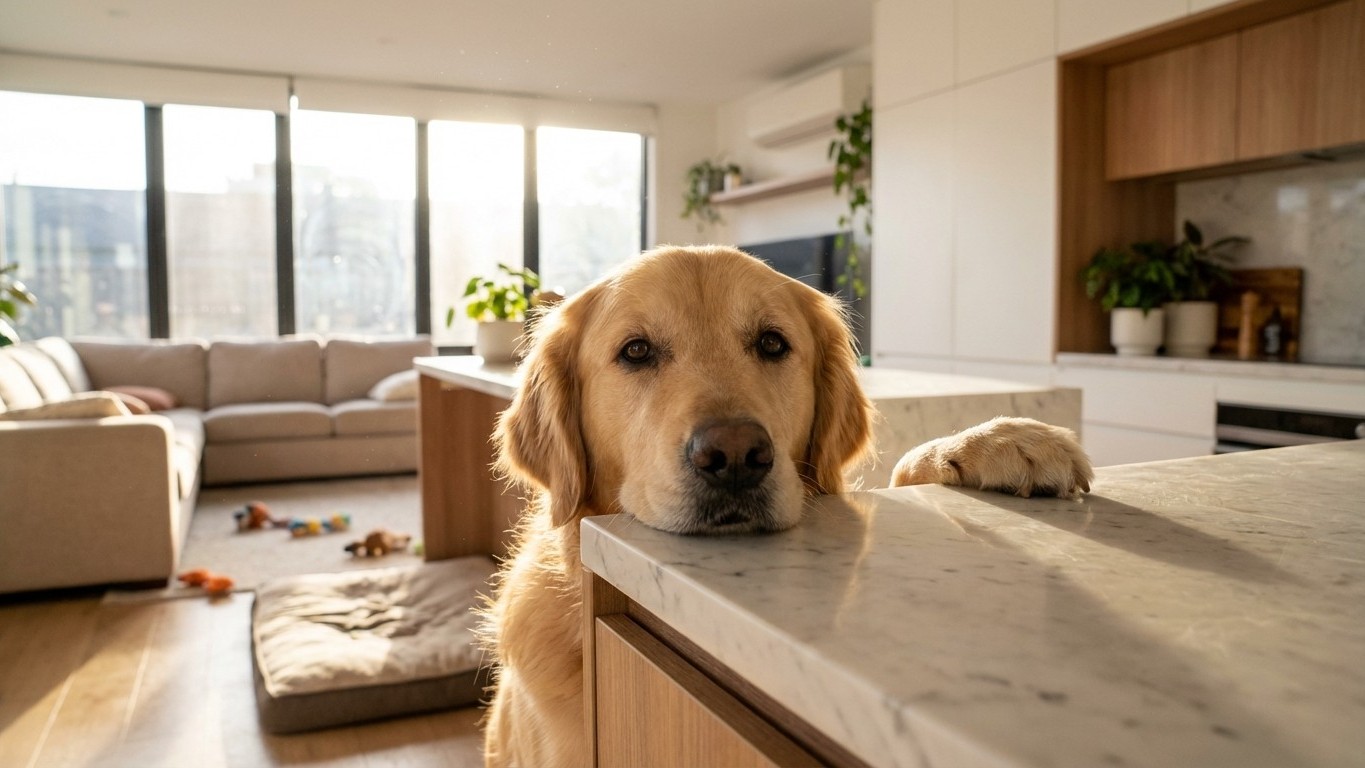
Big dogs ask a lot. More food, more space, more exercise, more vet bills, and more love returned in equal measure. If you’re weighing up whether a large breed fits your life, this guide gives you the honest picture: what these dogs genuinely need, what they actually cost, and which breeds suit which households. No glossing over the difficult bits.
What counts as a large dog breed?
Weight and size: the objective markers
The line between “medium” and “large” shifts depending on who you ask, but most vets and breed registries draw it at around 25–30 kg (55–65 lbs). Dogs above that threshold are typically classed as large, while anything over 45 kg edges into giant territory. Height is a secondary marker, most large breeds stand between 55 cm and 70 cm at the shoulder. These aren’t just numbers for classification; they directly shape every practical decision, from the size of your car boot to the cost of an anaesthetic.
Iconic large breeds worth knowing
The roster of large breeds covers an enormous range of temperaments and purposes. Golden Retrievers and Labrador Retrievers remain perennially popular family dogs, built for retrieving game but equally enthusiastic about retrieving tennis balls in a suburban garden. German Shepherds and Belgian Malinois represent the working and herding world, highly intelligent and intensely energetic. Weimaraners and Dalmatians were bred for endurance, and they’ll remind you of that fact every single day. Then there are the gentler giants: Standard Poodles (frequently underestimated), Bernese Mountain Dogs, and Rhodesian Ridgebacks, each with distinct needs and personalities. For a broader overview of where large breeds fit in the canine size spectrum, the small dog breeds guide comparing all sizes from tiny to enormous is worth a read before committing.
Lifestyles that suit large dogs
Do you really need a house with a garden?
The garden question comes up constantly, and the honest answer is: it helps, but it isn’t mandatory. A garden provides convenient toilet access and a safe space to decompress, but it doesn’t replace structured exercise. A large dog with a garden who gets two fifteen-minute potter-arounds per day will be far less satisfied than a flat-dwelling dog who gets two proper hour-long walks. Space indoors matters more than most people assume, a Labrador sprawled across a small studio flat leaves very little room for the humans.
Apartment living: realistic or a stretch?
Some large breeds adapt reasonably well to flat life, provided the exercise commitment is non-negotiable. Greyhounds, despite their racing history, are famously low-energy indoors and often suit apartment living surprisingly well. Labrador Retrievers can manage flats if well-exercised. Breeds with high arousal levels, Huskies, Malinois, working-line German Shepherds, genuinely struggle in confined spaces without significant outdoor stimulation. Lifts, stairs, and neighbours below are practical considerations too: a large dog bounding down a corridor at 6 a.m. makes enemies quickly. If you’re comparing options across sizes, the medium dog breeds guide offers a useful counterpoint for those uncertain whether going large is the right call.
Physical and mental exercise needs
How much exercise, and what kind?
Most large breeds need a minimum of 60–90 minutes of active exercise daily, split across two or three outings. That’s a baseline, not a ceiling. For working breeds, German Shepherds, Weimaraners, Vizslas, that figure rises to two hours or more of genuinely vigorous activity. “Active exercise” means more than a slow plod around the block; it includes off-lead running where safely possible, fetch, swimming, or structured play. Mental stimulation runs alongside physical exercise: training sessions, puzzle feeders, scent work, and varied environments all matter. A tired large dog is a well-behaved large dog.
What happens when stimulation is lacking
Under-exercised large dogs don’t simply become lethargic, they become destructive, anxious, or both. Chewed furniture, excessive barking, door-scratching, and hyperactivity around guests are common signs. In more serious cases, chronic under-stimulation contributes to compulsive behaviours and reactivity on the lead. These aren’t character flaws; they’re communication. The dog is telling you the arrangement isn’t working. Addressing it through training and exercise is always preferable to surrendering the dog — but prevention is far easier than cure, which is why being honest with yourself before getting a large breed matters so much.
The real cost of owning a large dog
Food: quantities and what to budget
Food is the most immediately obvious ongoing cost, and one of the most underestimated. A large dog eating quality dry kibble will typically consume between 400 g and 600 g per day, depending on breed, age, and activity level. At current UK prices for a decent mid-range complete food, that translates to roughly £60–£100 per month, or £720–£1,200 annually. Raw feeding or premium wet food pushes that figure considerably higher. Working-breed owners sometimes spend £150 or more monthly on food alone. Cheap food isn’t a genuine saving when it contributes to poor coat condition, loose stools, and long-term health problems.
Vet costs and joint health
Large and giant breeds carry elevated risk for certain health conditions, and this shapes vet bills significantly. Hip and elbow dysplasia are common in breeds including Labradors, Golden Retrievers, and German Shepherds. Bloat (gastric dilatation-volvulus) is a life-threatening emergency that affects deep-chested breeds like Great Danes, Weimaraners, and Standard Poodles, surgery when it occurs can cost £3,000–£6,000. Orthopaedic consultations, joint supplements, physiotherapy, and prescription joint-support diets add up over a dog’s lifetime. Routine costs (annual boosters, flea and worm treatments, dental care) are also proportionally higher than for small breeds simply because the doses and product quantities are larger.
Insurance, equipment, and housing impact
Pet insurance for a large breed in the UK varies widely by breed and insurer, but lifetime policies for a Labrador or German Shepherd typically run £50–£100 per month, and claims history pushes premiums up. Equipment costs more at scale: a large crate, a robust harness, a properly sized bed (a decent orthopaedic dog bed for a large breed costs £60–£150), and leads rated for the weight. Some rental properties exclude large dogs entirely, a housing reality that affects thousands of owners each year. Factoring all costs together, a realistic annual budget for a large dog in the UK ranges from approximately £2,500 to £4,500, with higher-end estimates for working breeds or those with ongoing health conditions.
Large dogs in daily family life
With children and other animals
Large dogs and children can make wonderful companions : Golden Retrievers and Labradors have long, well-earned reputations as family dogs. The key caveat is supervision: a large dog knocking over a small child mid-enthusiastic greeting isn’t aggression, but it can cause injury. Teaching both children and dogs appropriate interaction is the real work, and it pays off enormously. With other animals, early socialisation largely determines outcomes. Most large breeds can live peacefully with cats and smaller dogs when introduced carefully and young.
Trainability and social aptitude
Large breeds generally respond well to positive reinforcement training, and many, Retrievers, Standard Poodles, German Shepherds, rank among the most trainable dogs in existence. That intelligence is a gift, but it also means boredom hits hard. A bored clever dog is an inventive one. Starting basic obedience early, keeping sessions short and rewarding, and building in regular mental challenges keeps large dogs engaged. Socialisation during puppyhood, covering a wide range of people, dogs, environments, and sounds, is genuinely one of the best investments an owner can make. For guidance on matching breed traits to your lifestyle across all sizes, the dog breeds guide lays out a practical framework worth reading.
Five popular large breeds and their profiles
A quick comparative look at five commonly chosen breeds gives a sense of how much variation exists within the large category:
- Labrador Retriever: High energy when young, calms with age. Excellent with families. Prone to hip dysplasia and obesity. Annual cost: £2,500–£3,500.
- German Shepherd: Highly intelligent, loyal, protective. Needs rigorous exercise and mental work. Joint health is a priority. Annual cost: £3,000–£4,500.
- Golden Retriever: Gentle, sociable, easy to train. Heart disease and cancer risk increases with age. Annual cost: £2,500–£3,500.
- Weimaraner: Extremely high-energy, strong hunting instinct. Not ideal for first-time owners. Annual cost: £2,800–£4,000.
- Bernese Mountain Dog: Calm, affectionate, good with families. Shorter lifespan than many large breeds (7–9 years average). Annual cost: £3,000–£4,500.
Large breed vs. giant breed: where the line actually falls
Giant breeds, think Great Danes, Irish Wolfhounds, Saint Bernards, Leonbergers — sit in a category of their own beyond “large”. The practical differences aren’t just aesthetic. Giant breeds typically have shorter lifespans (6–9 years), higher food costs, and greater anaesthetic and surgical risks due to sheer body mass. Medication doses, flea treatments, and even worming tablets are sold at higher price points. Vet consultations that involve sedation or anaesthesia carry elevated risk for giant breeds, and this is worth discussing explicitly with a vet before committing. The emotional weight of a shorter lifespan is real too, a factor that many prospective owners underestimate until they’re living it.
Frequently asked questions
How much daily exercise does a large dog need? Most large breeds require 60–90 minutes of active exercise per day, split across two or more outings. Working breeds and high-drive dogs often need two hours or more of vigorous activity.
Can a large dog live in a flat? Some can, particularly lower-energy breeds like Greyhounds or well-exercised Labradors, but it demands a serious commitment to daily outdoor exercise. High-energy working breeds generally struggle in small spaces regardless of how much exercise they receive.
What does it really cost to keep a large dog annually? Budget realistically between £2,500 and £4,500 per year, covering food, routine vet care, insurance, and equipment. Unexpected health issues can push this considerably higher. Many owners are surprised, check out the small dog breeds guide for a side-by-side comparison of what different size dogs cost over their lifetimes.
Is a large dog the right choice for you?
The people who thrive with large dogs tend to share a few traits: they enjoy being active outdoors in all weathers, they have flexible schedules or work from home, they’re comfortable with dog hair on absolutely everything, and they’ve thought seriously about the financial commitment before the puppy arrives. Large dogs reward attentive, active ownership with extraordinary loyalty and companionship. The question isn’t really whether large dogs are good or bad, they’re both, entirely depending on the fit. If you’re still weighing your options across the full size spectrum, the dog breeds guide helps you map your lifestyle against breed characteristics honestly, without the romantic filter that tends to cloud first-dog decisions.
Whatever size you choose, please consult a vet before bringing any dog home to discuss breed-specific health screening, vaccination schedules, and dietary needs for that particular animal’s life stage. Getting that groundwork right from the start makes everything that follows considerably easier.