
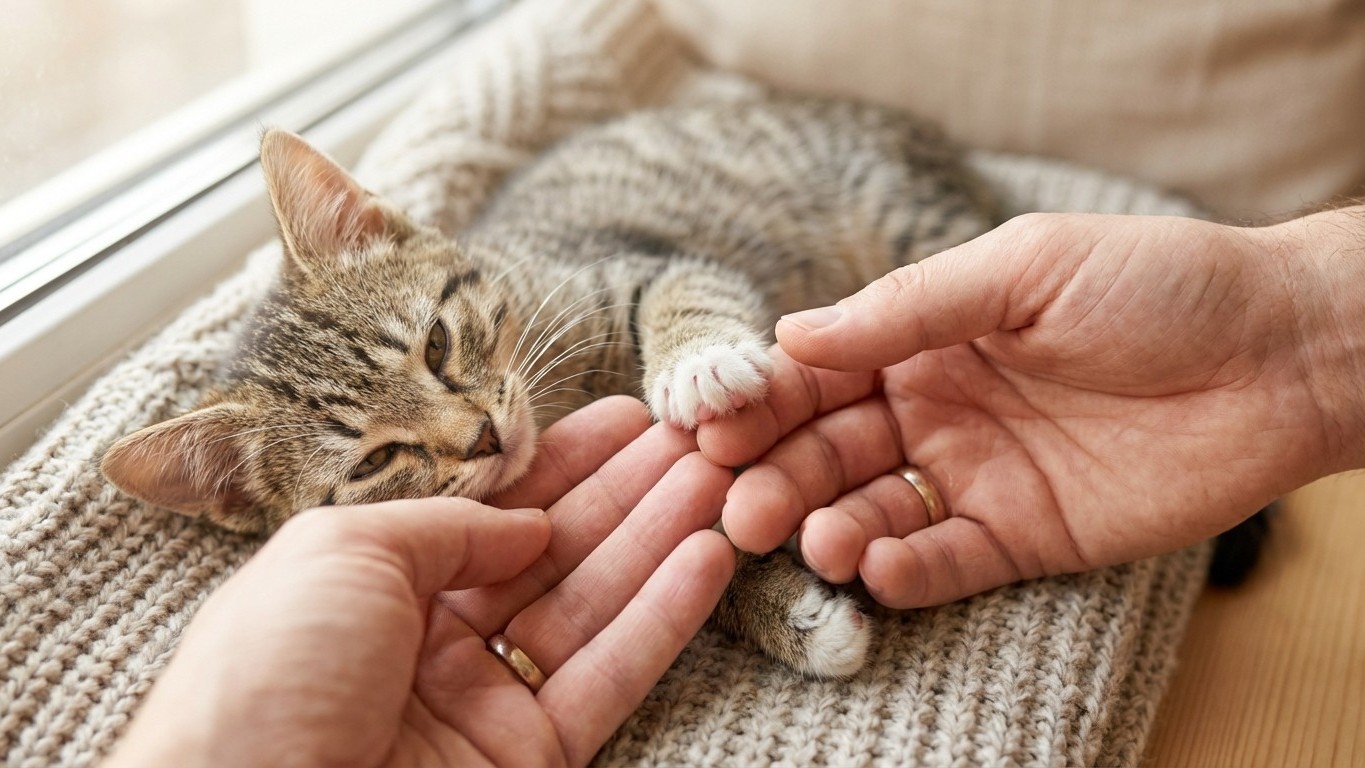
Spring is kitten season. Rescue centres across the UK fill up, litters are born in garden sheds and under hedges, and thousands of households suddenly find themselves with a tiny, wide-eyed bundle of fur to care for. Everyone worries about the obvious things, warmth, feeding, the litter tray. But there is one gesture, quiet and deceptively simple, that many new owners only discover months too late: deliberate, gentle touch in that very first week. Done right, it shapes who your cat becomes for the next fifteen years.
Key takeaways
- There’s a nine-week window where everything changes—and most new owners don’t even know it exists
- Five minutes of daily handling by multiple people can rewire a kitten’s entire personality for life
- The one thing vets see owners overlook repeatedly, and why it costs them hundreds in stress during future vet visits
The window that closes faster than you think
A kitten’s journey to becoming well-socialised with humans begins as early as two weeks old, with the critical socialisation period waning at about nine weeks of age. That is not a very long time. Spring kittens born in April are, behaviourally speaking, a different animal by midsummer. According to behavioural research, the quality of socialisation directly determines a cat’s personality and adaptability in adulthood. Think about that for a moment, the cat who refuses to be picked up by visitors, who bolts under the bed at the sound of the hoover, who scratches anyone who dares touch their paws? Those behaviours are often not personality quirks. They are the footprint left by a missed window.
Early studies evaluating the effect of kitten handling on subsequent behaviour toward people showed that handling by multiple people for as few as 5 minutes a day can have lifelong benefits, especially if done prior to 7 weeks of age. Five minutes. Less time than it takes to make a cup of tea. The maddening part is that since most kittens are not brought home until 7–8 weeks, their primary and critical socialisation period will often be completed before meeting you, which is why it’s so important to find a breeder or rescue that understands the importance of early handling.
The gesture itself: what it actually looks like
The “gesture” is not complicated. During the critical period, kittens need to be held every day, handled gently, petted, groomed, and introduced to new items and experiences. This time is also critical for becoming desensitised to sounds within the home, car rides and carriers, and the handling of sensitive areas like ears, mouth, eyes, and paw pads. That last detail is the one Most People Overlook. Most new owners stroke their kittens along the back and call it done. The real work, the work that pays dividends at every vet visit for the rest of the cat’s life — is touching the paws, gently opening the mouth, running a finger around the ears. Boring to describe, transformative in practice.
It is important to remember that exposure is not the same as socialisation. Having a screaming four-year-old yanking on a kitten’s tail could cause the cat to be afraid of children for life. However, meeting several young children who are calm and handle the kitten appropriately can lead to a cat who adores kids. Quality, beats quantity every single time. A kitten gently held by three calm people has been socialised. A kitten passed around a noisy party has been stressed. The distinction matters enormously.
There is also the slow blink, the most charming entry point for any nervous new owner. Unlike humans, cats do not have a physiological need to blink; eyes closed in the wild means they are vulnerable to other predators. If you slow blink at a cat, you are telling them “I trust you.” When they slow blink back or close their eyes in your presence, they are telling you they trust you too. Starting with this gesture in week one, before any handling, costs nothing and signals safety to a creature who is, biologically speaking, both predator and prey.
Sounds, textures, and the world beyond your lap
Socialisation is about far more than human touch. Introducing new textures by letting kittens play on carpeting, tile, wood, and blankets helps enormously, as does exposing them to household noises such as blenders, doorbells, banging pots, and washing machines, but muffling loud or harsh noises at first, by covering an appliance with a towel or making the noise from an adjacent room, keeps it positive. The logic here is simple: a kitten who has heard the washing machine spin cycle at three weeks old is unlikely to flee in terror from it at three years old.
Begin playing sounds at very low volume and increase the volume only if your kitten appears relaxed and comfortable. Watch their body language honestly. Signs of relaxation include a soft, neutral body, narrowed soft eyes with small pupils, a loose low or softly swishing tail, and calmly moving away, sitting, or lying down in the presence of something new. If you are seeing any of these, you are doing it right. Freezing, wide pupils, a puffed tail, stop, give it a day, try again at lower intensity.
One practical tip that surprises many people: exposing your kitten to different textures of food can help avoid picky behaviour later. Spring kittens who experience only one brand and one texture of wet food during their early weeks can become notoriously fussy eaters. Offering a gentle rotation early on is not indulgence, it is insurance.
When you bring a spring kitten home at eight weeks
If you are adopting a kitten rather than raising one from birth, the socialisation window has not necessarily slammed shut, but you do need to move thoughtfully. When you first bring your kitten home, keep them in a confined, kitten-proofed area for a few days to help them settle. This private area should include all basic necessities: kitten food, water, a bed, some toys, and a litter box. Resist the urge to introduce them to the whole house on day one. The world is enormous to something the size of a slipper.
After bringing kittens inside, give them an initial two-day adjustment period before trying to socialise them too much, the change of scenery can be stressful. When you do start spending time with them, begin by moving slowly and speaking softly, and keep loud TV or music down. Then, once they are settled, start the daily handling sessions described above. Recommendations for socialisation are for 15 to 40 minutes of interaction with the kitten each day, broken into shorter sessions rather than one long stretch.
A common mistake is using hands as toys during play. It seems harmless, a tiny kitten gnawing your finger is objectively adorable. Never use your hands or feet as “toys” when playing with your kitten. Although it can be cute when your kitten pounces at your toes or plays with your fingers, this can become a habit that your kitten will bring into adulthood. A wand toy creates the same connection without teaching the kitten that human skin is a legitimate target.
Finally, and this applies to every health concern that arises, please consult your vet early and often. Your vet can guide you through the vaccination schedule, flag any developmental concerns, and often advise on local kitten socialisation classes, which give young cats exposure to other animals and unfamiliar people in a controlled setting. The first week is yours to shape. The years that follow belong to both of you.
Sources : chewy.com | completecatguide.com