
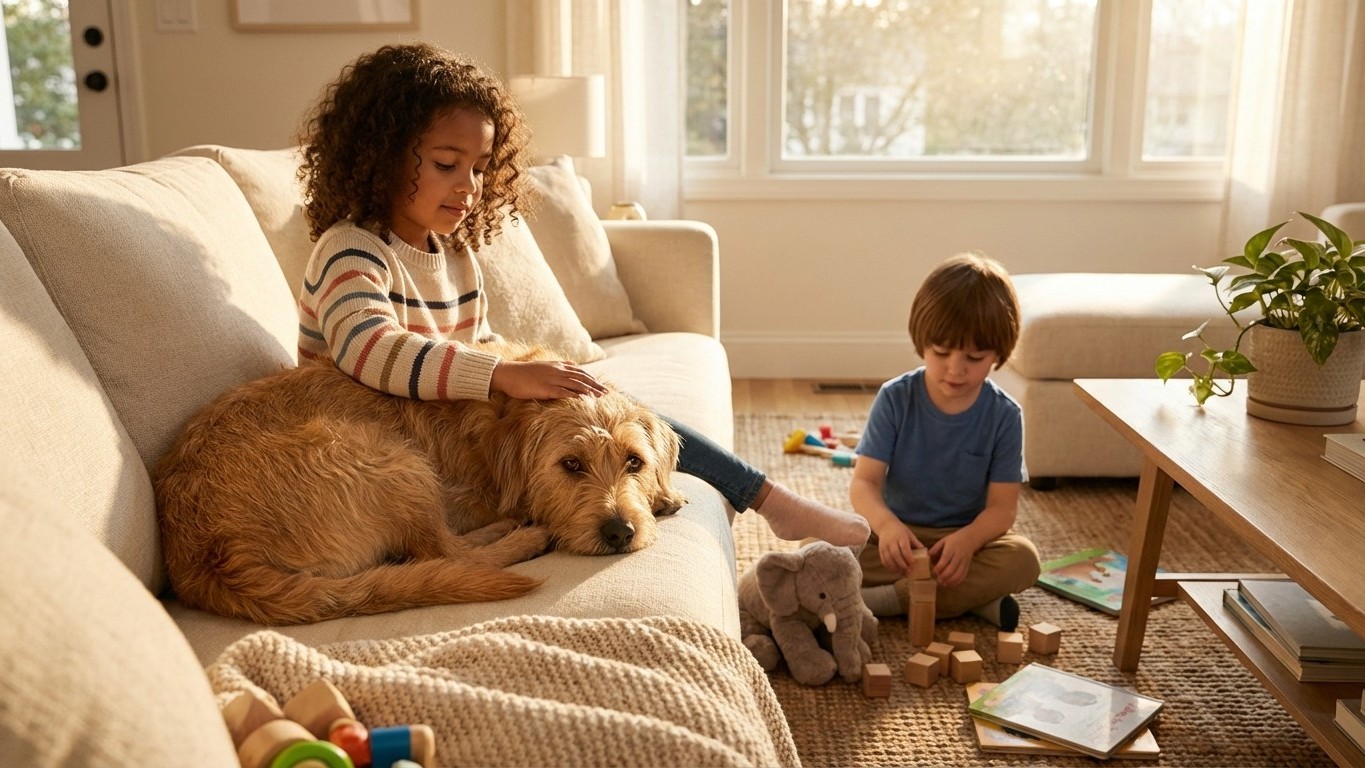
Bringing a dog into a family home is one of those decisions that can genuinely transform daily life, for better or for worse. The right dog becomes a beloved companion who teaches children empathy, patience, and responsibility. The wrong match, however well-intentioned, can create stress for everyone, including the dog. So before falling for a pair of soulful eyes at a rescue centre or a litter of puppies, it’s worth understanding what actually makes a breed suited to family life, and what that means in practice, with real children, real noise, and the beautiful chaos of an ordinary Tuesday morning.
Why choosing the right breed matters more than people think
Safety and cohabitation with children
Dogs and children are a classic combination, but it’s worth being honest: not every breed is equally well-suited to life with young people. Children move unpredictably, squeal at high pitches, tug at ears, and occasionally toddle directly into a sleeping dog’s personal space. A dog with a low tolerance for this kind of interaction, or one bred for guarding or high-intensity working tasks, can find family life genuinely stressful. Stress in dogs rarely stays invisible for long.
The good news is that many breeds have been developed over generations with traits that align beautifully with family life: a stable temperament, a high threshold for handling, and a natural inclination to engage gently with people of all ages. These traits aren’t just pleasant to have. They are the foundation of safe cohabitation.
Temperament and patience: the real differentiators
Two dogs of the same breed can behave differently depending on their individual history and socialisation. But breed-level temperament tendencies are real and well-documented. A Labrador Retriever has been selectively bred for softness of mouth and cooperation with humans. A Border Collie has been bred to work independently, respond intensely to movement, and herd, instincts that can translate into nipping at running children if the dog isn’t given appropriate outlets. Neither breed is “bad”. They’re just different, and understanding that difference before you commit can spare everyone a great deal of difficulty.
What actually makes a dog family friendly
Temperament: tolerance, gentleness, emotional stability
A family friendly dog is, above all, a predictable one. Families need a dog whose reactions they can read and anticipate. Emotional stability, meaning a dog that doesn’t swing between extreme excitement and anxiety, matters enormously in a household with children. Look for breeds described as “biddable” (willing to cooperate with their humans), those with a reputation for being gentle and tolerant, and those with a low tendency toward resource guarding, which is when a dog becomes protective over food, toys, or space in ways that can lead to snapping.
Patience with children and handling everyday surprises
A toddler who trips and falls directly onto a sleeping dog is not a hypothetical. It happens. A dog with genuine patience, one that has a high threshold before feeling threatened or overwhelmed, will respond by moving away or tolerating the contact. This patience is partly temperament, partly socialisation, and partly the dog’s overall wellbeing. A dog that is tired, in pain, or chronically understimulated has a much lower tolerance for disruption. This is why overall care matters just as much as breed selection.
Reactivity to noise, chaos, and unexpected handling
Family homes are loud. Birthday parties, arguments over the remote control, the smoke alarm going off because someone burned the toast again. Dogs that are highly sensitive to noise or sudden movement can find this environment chronically stressful. Breeds that have been developed to work in noisy environments, or those known for calm temperaments around activity, tend to adapt much more easily. The Cavalier King Charles Spaniel, for instance, is famous for its ability to simply curl up beside a rowdy family gathering and sleep through most of it.
Predictability and the role of proper socialisation
No breed guarantee comes without socialisation. A puppy from the most gentle-natured breed in the world still needs positive early experiences with children, strangers, different environments, and varying sounds to develop into a confident, settled adult. Poorly socialised dogs, regardless of breed, can become anxious or reactive over time. If you’re adopting rather than buying from a breeder, asking about a dog’s history with children and how they respond to handling is not just sensible, it’s necessary.
The best family friendly breeds: portraits and comparisons
A practical comparison of popular family breeds
Rather than a rigid table, think of family friendly breeds along a spectrum. On one end, you have high-energy, sociable, robust dogs that thrive in active families with older children who can match their pace. On the other, you have gentle, lower-energy companions that suit calmer households or families with very young children. Here’s a snapshot of where some of the most recommended breeds sit:
- Golden Retriever: large, high energy, famously gentle and patient, very trainable, loves children actively
- Labrador Retriever: similar to the Golden, slightly more boisterous, equally affectionate, excellent with children of all ages
- Cavalier King Charles Spaniel: small, calm, gentle, very adaptable to quieter family life or flats, excellent with toddlers
- Beagle: medium-sized, curious, sociable, good with children, though can be stubborn and needs mental stimulation
- Staffordshire Bull Terrier: despite its reputation, the “Staffie” has long been nicknamed the “nanny dog” in the UK, with enormous affection for children when well-socialised
Detailed breed portraits
The Golden Retriever is almost the textbook family dog, and there’s a reason for that. Originally bred as a gundog, it has a soft mouth, a strong desire to please, and an almost inexhaustible patience with being dressed in hats by five-year-olds. They do need significant daily exercise and can be boisterous as young dogs, so they work best in families with enough outdoor space and energy to match.
The Labrador Retriever shares many of the Golden’s qualities and consistently ranks among the UK’s most popular breeds. Labs are famously food-motivated (to put it charitably), which makes training relatively straightforward. They are also robust enough to handle rough-and-tumble play with older children without becoming anxious. The downside is their adolescent phase, which can be prolonged and enthusiastic, meaning consistent training from an early age pays real dividends.
The Cavalier King Charles Spaniel is the quiet gem on this list. Gentle, affectionate, and instinctively calm, they are ideal for families in smaller homes or those with babies and very young children who need a dog that won’t knock anyone over. They do have health considerations, and any prospective owner should research these carefully and choose a responsible breeder. Always, always consult a vet about breed-specific health screening before committing.
The Beagle brings curiosity and sociability in abundance. They love company and tend to be friendly with both children and other pets. The challenge is their independence of mind and their nose, which can lead them into trouble. Families who can provide consistent, positive training and a securely fenced garden will find them wonderful companions.
Underrated breeds that deserve a second look
The Staffordshire Bull Terrier is perhaps the most misunderstood breed in Britain. In practice, well-bred and well-socialised Staffies are exceptionally affectionate with children, robust enough for active play, and deeply loyal. Many rescue organisations have Staffies available for adoption, and they often make superb family pets for homes that understand their need for exercise, companionship, and consistent training.
The Boxer is another breed that surprises people. They’re exuberant and clownish, which children adore, and their patience with being pestered is genuinely impressive. For active families with space, they’re a wonderful choice. The Newfoundland, meanwhile, is a gentle giant with a reputation for calmness and patience with children that borders on legendary, though the grooming commitment is considerable.
For more context on comparing breeds across different lifestyle criteria, the dog breeds guide offers a thorough breakdown by mode of life that complements this family-specific view.
Making it work: practical advice for families with dogs
Educating both the dog and the children
The most stable, patient dog in the world still benefits from a household where children have been taught how to interact with animals respectfully. This means no pulling tails, no disturbing a dog while it’s eating, no approaching an unfamiliar dog without asking the owner first. These aren’t just politeness rules. They’re safety rules, and teaching them early is one of the most effective things a parent can do to prevent incidents.
On the dog’s side, basic obedience training, sit, stay, leave it, go to your bed, gives the dog clear communication tools and gives the family a way to manage challenging moments calmly. A dog that has a “go to your bed” cue can be given a peaceful retreat during chaotic moments, which benefits everyone. If you’re starting from scratch with a new dog, a dog breeds guide for beginners can help you understand what to expect from the training process at different life stages.
Space, routines, and daily life logistics
Dogs thrive on routine, and so do children. Aligning feeding times, walk schedules, and rest periods with the family’s daily rhythm reduces anxiety for the dog and makes care feel manageable rather than chaotic. Every dog needs a space of its own, a crate, a bed in a quiet corner, somewhere it can retreat and rest undisturbed. This isn’t luxury. It’s a welfare need, and teaching children to respect this space prevents the build-up of stress that can lead to reactive behaviour over time.
Preventing accidents and managing risky moments
Even the most gentle dog should never be left entirely unsupervised with a very young child. This isn’t a reflection on the dog’s character. It’s simply responsible management. The moments most likely to result in an incident are those involving food, sleep (a dog that is startled awake), pain (a dog that is unwell or injured), and resource guarding. Being aware of these situations and actively managing them, by separating dog and child during mealtimes, for instance, removes most of the risk before it materialises.
Your questions answered
Which breed should I choose if I have a baby or very young children?
For families with babies and toddlers, the priority is a calm, low-reactivity dog with a gentle nature and a small-to-medium build that won’t accidentally knock a child over. The Cavalier King Charles Spaniel and the Bichon Frise are often recommended in this context. Breeds with very high prey drives or extremely boisterous play styles can be more challenging in this setting, even if they’re fundamentally good-natured. A conversation with a reputable breeder or a qualified dog behaviourist can help you think through the specific dynamics of your household.
What precautions should a first-time dog-owning family take?
Research before you commit, ideally using resources like this how to choose a dog breed guide that walks through criteria methodically. Budget realistically, not just for purchase price but for food, insurance, vet bills, training classes, and grooming. Sign up for puppy classes as early as possible. And be honest with yourselves about your lifestyle, how much exercise you can genuinely commit to, and whether your home suits the size and energy level of the dog you’re considering.
Can you adopt a rescue dog into a family with children?
Absolutely, and many families do this successfully. Good rescue organisations assess dogs carefully and will be honest about which dogs are suitable for homes with children. Some rescues specifically foster dogs in family settings to evaluate their behaviour. The key is transparency on both sides: be clear about your household when you apply, and ask detailed questions about the dog’s history, behaviour around children, and any known triggers. A dog from a rescue that has been assessed as child-friendly and has some basic training can be an excellent family addition.
Going further: other guides to help you choose
If you’re still in the early stages of deciding which dog fits your family, a broader perspective on lifestyle compatibility is enormously helpful. The dog breeds guide for beginners covers the full range of lifestyle considerations from energy levels and living space to compatibility with other pets. For those who want a step-by-step methodology, the how to choose a dog breed guide breaks the decision into seven clear criteria that are easy to work through as a family.
Beyond the general guides, consider exploring resources specifically covering low-shedding and hypoallergenic breeds (if allergies are a concern in your household), breeds suited to flat or apartment living, and breeds known for being quieter, which can be a genuine consideration if you live in close proximity to neighbours. Each of these angles adds another layer to the decision, and the more information you gather before the dog arrives, the smoother that arrival tends to be.
The question of which breed is “best” for families doesn’t have a single answer, of course. What it has is a set of criteria, patience, predictability, gentleness, and the willingness of the whole family to meet the dog halfway, that, when taken seriously, make the difference between a dog that’s simply in the house and one that is genuinely woven into the fabric of your family life. That’s the version worth working towards.