
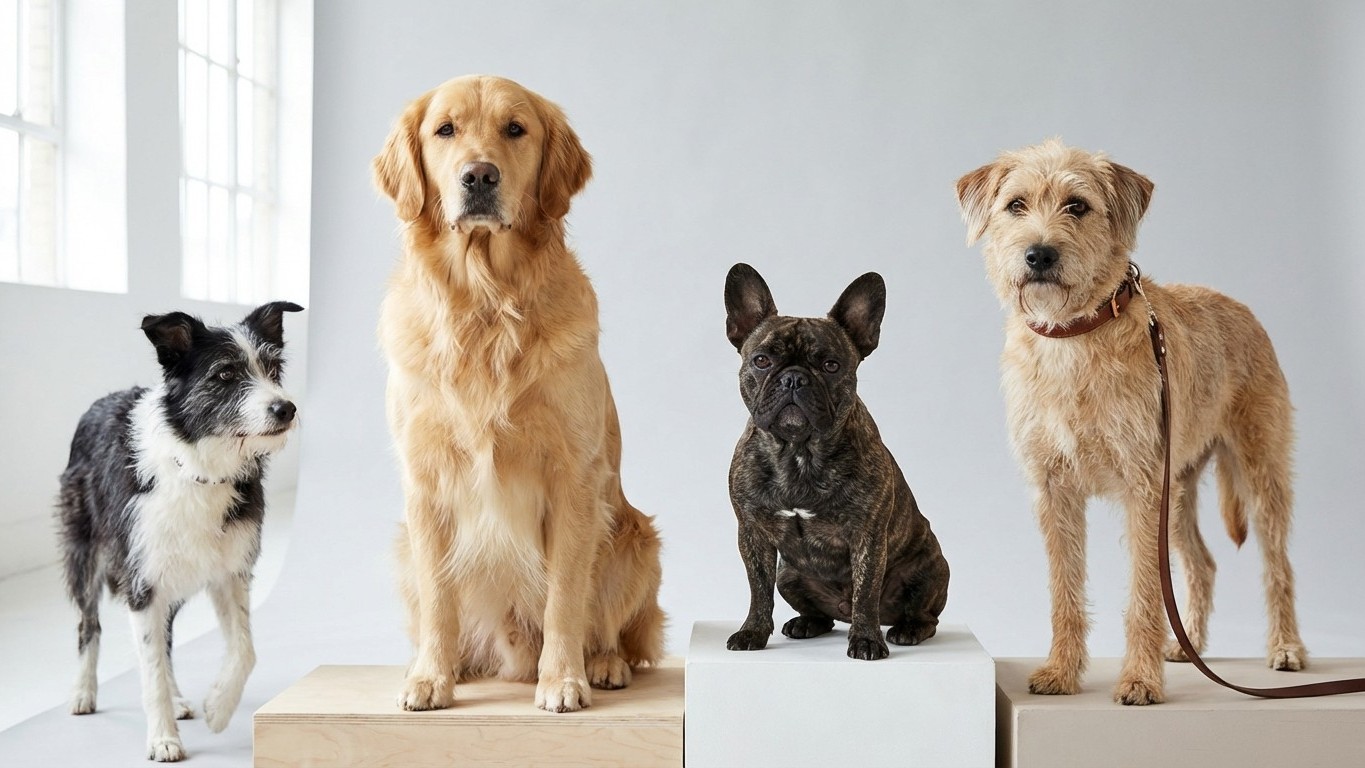
Choosing a dog is one of the most consequential decisions a pet lover can make, yet thousands of families across the UK do it backwards every year. They fall for a pair of soulful eyes at a rescue centre, or get swept up by a breed they’ve seen on television, only to discover six months later that their gorgeous new companion is systematically dismantling the sofa, terrorising the cat, or needs three hours of daily exercise that nobody actually has time for. The mismatch between breed and lifestyle is, quietly, one of the leading reasons dogs end up surrendered to shelters. This guide exists to stop that from happening to you.
What follows is a proper framework for thinking through your choice, not a romanticised list of pretty breeds. You’ll find honest assessments of what different types of dogs actually demand, practical comparisons across key criteria, and direct links to specialist guides where you can go deeper on health, dog breeds temperament guide, coat care (including our hypoallergenic dog breeds guide for allergy sufferers), and size. For comprehensive breed information specific to the UK, our dog breeds guide UK provides detailed profiles tailored to British households. If you’re new to dog ownership, our dog breeds guide for beginners offers essential insights to help you make an informed choice. Consider this your starting point and your compass.
Why the Breed Choice Matters More Than People Realise
The Impact on Both Dog and Owner
A Border Collie kept in a one-bedroom flat by a couple who work full-time isn’t just an inconvenient pet. That dog is genuinely suffering. Border Collies were bred over centuries to work sheep for eight to ten hours a day, processing complex information, making independent decisions, covering vast distances. These are classic examples of working breeds, and understanding their specific needs is crucial – our working dog breeds guide explores these requirements in detail. Strip all of that away and you don’t get a relaxed companion, you get an animal with nowhere to put its considerable intelligence and energy, which often manifests as obsessive behaviour, destructive habits, or anxiety. The dog isn’t being difficult. It’s doing exactly what its genetics are telling it to do, in an environment that makes that impossible.
The reverse is equally true. Rehome a gentle, low-energy Basset Hound with an enthusiastic runner who wants a jogging partner, and you’ll have a frustrated owner and a perplexed dog who cannot understand why anyone would voluntarily move that fast. Good breed matching isn’t just about owner convenience, it’s a welfare issue for the animal. This is particularly crucial for families, which is why consulting a best dog breeds guide for families with children can help ensure the right match for your household’s specific needs. For those specifically interested in compact companions, our small dog breeds guide offers detailed information on breeds suited to smaller living spaces.
The financial dimension also deserves honesty. Large breeds cost more to feed, insure, and treat at the vet. Certain breeds are prone to expensive hereditary conditions that can significantly impact both the dog’s quality of life and your budget – our comprehensive dog breeds health guide covers these breed-specific health concerns in detail. Breeds with high grooming needs require regular professional appointments. A dog that seems affordable to acquire can represent a wildly different long-term financial commitment depending on its breed.
Common Mistakes to Avoid
The “cute puppy” trap is probably the most common. Chow Chow puppies are extraordinarily adorable, fluffy little bear cubs that attract attention everywhere they go. Adult Chow Chows are independent, often aloof, and can be territorial, they’re not the sociable, playful companions many first-time owners expect. Breed characteristics are set before a dog is born, not after it comes home.
Another frequent error is taking lifestyle snapshots rather than long-term projections. You might be young, active, and living in a house with a garden right now. But will you still have that garden in five years? Are children on the horizon? A dog chosen for your current circumstances needs to be capable of adapting to foreseeable changes. Dogs live anywhere from 8 to 16 years depending on breed, that’s a lot of life stages to consider.
Perhaps the most underestimated mistake is ignoring the experience gap. Some breeds are genuinely unsuitable for first-time owners, not because they’re dangerous, but because they require a level of consistent, confident handling that most novices haven’t yet developed. An experienced dog owner can often manage a challenging breed beautifully. A first-timer with the same breed may struggle significantly. Our dog breeds guide for beginners goes into this in more detail if you’re starting from scratch.
Understanding the Major Dog Breed Groups
Official Classifications: FCI, KC, and AKC
Breed classifications exist for a reason beyond bureaucratic tidiness. The Fédération Cynologique Internationale (FCI), the Kennel Club (KC) here in the UK, and the American Kennel Club (AKC) in the United States all group breeds according to their original working function. That historical purpose is the single most reliable predictor of a breed’s instincts and temperament, more reliable, in many cases, than individual assessments of specific dogs.
The FCI system divides breeds into ten groups, ranging from sheepdogs and cattle dogs through to companion and toy dogs. The KC uses seven groups. The categories differ slightly, but the underlying logic is the same: dogs were selectively bred over generations to excel at specific tasks, and those traits don’t disappear just because the job is no longer needed.
What Each Group Tends to Bring
Herding breeds (Sheepdogs, Collies, German Shepherds, Belgian Malinois) are typically high-intelligence, high-energy dogs that need a job or a structured outlet. They thrive with training, can be exceptional family dogs in active households, but will create their own “work” (often destructive) if not given sufficient mental stimulation.
Sporting and gundog breeds (Labradors, Golden Retrievers, Spaniels, Vizslas) were bred to work alongside hunters all day, which means they’re often sociable, eager to please, and built for stamina. Many of these breeds make wonderful family pets precisely because their working role required them to be biddable and good-natured around people. They still need significant daily exercise, though.
Terriers are a group that often surprises new owners. Small in stature, enormous in personality, terriers were bred to hunt and kill vermin, which means many have a strong prey drive, can be feisty with other dogs, and possess a determination that can read as stubbornness during training. They’re entertaining, robust little characters, but they rarely fit the “easy” category.
Hound breeds split broadly into sighthounds (Greyhounds, Whippets, Salukis) and scent hounds (Beagles, Bloodhounds, Bassets). Sighthounds are often surprisingly calm at home, thriving on short but intense bursts of exercise. Scent hounds, with their nose-to-ground focus, can be almost impossibly distracted outdoors and have a strong instinct to follow a scent wherever it leads, reliable recall is a genuine challenge.
Toy and companion breeds (Cavalier King Charles Spaniels, French Bulldogs, Maltese) were developed explicitly for human company. They tend to be people-oriented, adaptable to smaller spaces, and less physically demanding, though some have significant health concerns associated with their conformation. Working and utility breeds (Boxers, Dalmatians, Bulldogs, Chow Chows) cover a broad spectrum and need to be assessed individually.
Matching Your Life to the Right Breed Profile
Families with Children
The idea that any dog is automatically good with children is one of the most persistent myths in pet ownership. Breed matters enormously here, but so does individual temperament, early socialisation, and the way children are taught to interact with the dog. That said, certain breeds have strong track records in family settings.
Golden Retrievers and Labrador Retrievers consistently rank highly for family compatibility, their patience, sociability, and relatively forgiving nature make them well-suited to the chaos of family life. Staffordshire Bull Terriers, often unfairly maligned, are known in the UK as “nanny dogs” historically, and well-bred, well-socialised Staffies can be wonderfully affectionate family companions. Beagles bring robust cheerfulness that suits children well, though their scent-driven independence requires secure outdoor spaces.
Breeds that tend to be less suited to households with young children include those with strong guarding instincts (some Akitas, Rottweilers handled without appropriate experience), dogs with very low tolerance for unpredictable movement or noise, and any breed with known pain-related aggression triggers, which is worth exploring via our dog breeds health guide.
Seniors and Older Adults
An older adult considering a dog deserves honest advice, not romanticised encouragement. The right dog can be transformative for wellbeing, providing companionship, routine, and gentle motivation to get outside. The wrong breed can become a physical and financial burden.
Smaller to medium breeds with moderate exercise needs are generally the most practical : Cavalier King Charles Spaniels, Shih Tzus, Miniature Schnauzers, and smaller Poodle variants all tend to fit this profile. Greyhounds are surprisingly excellent companions for older adults: calm indoors, gentle in temperament, and content with a couple of shorter walks daily. Breeds to approach with caution include anything with significant pulling strength on the lead, very high energy demands, or complex training requirements.
Rehoming an adult rescue dog, rather than taking on a puppy, can be particularly sensible for older owners. The chaotic energy of puppyhood (sleep deprivation, house training, the chewing phase) is a consideration that shouldn’t be underestimated.
Active People and Sport-Oriented Owners
If you genuinely run, cycle, hike, or spend significant time outdoors, and you want a dog that participates in all of it, your options open up considerably. Vizslas, Weimaraners, Border Collies, Siberian Huskies, and Belgian Malinois are all breeds that can keep pace with high-output owners, and often need that level of activity to be truly happy.
The trap here runs in the opposite direction: assuming that because you’re active, any energetic breed will work. A Husky kept with even a very active owner who doesn’t understand the breed’s specific characteristics (strong pack instincts, tendency to roam, vocality) can still be a challenging match. Research the breed’s specific traits thoroughly via the dog breeds temperament guide, not just its exercise requirements.
Apartment Living vs Houses with Gardens
Apartment living doesn’t automatically disqualify high-energy breeds, provided the owner compensates with consistent outdoor exercise. But it does narrow the practical field considerably. Size becomes relevant, not just for space, but for the reality of navigating lifts, stairs, and shared spaces. Breeds that vocalise frequently (Beagles, Huskies, many terriers) can create real problems in flats with thin walls and close neighbours.
Some of the most apartment-suitable breeds include French Bulldogs, Cavalier King Charles Spaniels, Greyhounds, Pugs, and smaller Poodle variants. Our small dog breeds guide explores size-based considerations in much more depth, including practical comparisons that go beyond what you’ll find here.
A garden changes the calculation significantly, but it’s not a substitute for active exercise. Letting a dog “use the garden” doesn’t replace walks, dogs need varied environments, social encounters, and genuine exercise, not just access to a patch of lawn.
Cohabitation with Other Pets
Introducing a dog into a home with cats, small animals, or existing dogs requires careful breed selection. Sighthounds with a strong prey drive can be dangerous around small animals unless raised with them from puppyhood, and even then the instinct can resurface. Terriers, with their heritage of small-animal hunting, similarly need careful management around rabbits, guinea pigs, or cats.
Breeds that tend to coexist more peacefully with other animals include Golden Retrievers, Labrador Retrievers, Cavalier King Charles Spaniels, and many Poodle variants. Multi-dog households benefit from understanding same-sex dynamics and breed-specific social tendencies, some breeds are naturally more dog-social than others.
The Key Criteria You Need to Evaluate
Temperament: Energy, Trainability, and Sociability
Temperament is the most important single criterion, and it’s more complex than “friendly” or “calm.” A dog’s energy level affects daily life practically, how much exercise is needed, whether the dog can settle when you need it to, whether boredom becomes a problem. Trainability affects everything from basic safety (reliable recall, lead manners) to how easily the dog integrates into different social situations. Sociability determines whether your dog can accompany you to outdoor cafes, greet visitors, or coexist with strangers in public spaces.
These three dimensions don’t always align predictably. A Border Terrier might be highly trainable but also very high energy. A Basset Hound might be easy-going and low-energy but famously stubborn about recall. Understanding how these traits combine within a specific breed is where the dog breeds temperament guide becomes genuinely useful.
Size, Weight, and the Practical Realities
Size affects more than just the space a dog takes up. A larger dog costs more to feed, requires higher doses of medication and flea/tick treatment (which affects vet bills), needs a larger crate, a bigger bed, and often a more robust lead and harness. Transport becomes a consideration, can your car accommodate the dog safely? Some rental properties have weight limits for pets. Insurance premiums often scale with size.
Giant breeds (Great Danes, Saint Bernards, Newfoundlands) typically have shorter lifespans than small breeds, which is a genuinely difficult trade-off that prospective owners rarely factor in at the outset. Falling in love with a Bernese Mountain Dog knowing it may only live eight to ten years is a different emotional proposition than committing to a Miniature Dachshund who might be with you for fifteen or sixteen years.
Health Predispositions and Longevity
Every breed carries certain health tendencies, and some are more significant than others. Brachycephalic breeds (French Bulldogs, Pugs, Bulldogs) face well-documented respiratory challenges linked to their flat-faced conformation. Large and giant breeds are disproportionately affected by joint conditions like hip and elbow dysplasia. Cavalier King Charles Spaniels have a high prevalence of a serious heart condition called Mitral Valve Disease. This isn’t a reason to avoid these breeds entirely, but it is a reason to go in with full awareness and appropriate insurance.
Reputable breeders conduct health screenings specific to their breed and will provide documentation. Rescue centres, for mixed breeds in particular, often cannot predict specific health trajectories, though mixed heritage can sometimes confer broader genetic resilience. The dog breeds health guide covers these predispositions in detail, including what questions to ask breeders and what health tests to look for. If you have concerns about a specific breed’s health profile, always discuss them with a vet before committing.
Coat Care and Grooming Needs
The dog with the gorgeous flowing coat that catches your eye in a café may represent a significant ongoing commitment in professional grooming fees and daily brushing time. Double-coated breeds like German Shepherds, Huskies, and Golden Retrievers shed heavily, particularly during seasonal coat changes, this is worth considering if anyone in the household has sensitivities to pet hair or if you simply don’t want dog fur as a permanent fixture in your home. Single-coated breeds that need regular clipping, such as Poodles and their variants, Bichon Frises, and many Schnauzers, don’t shed heavily but do require professional grooming every six to eight weeks.
Short-coated breeds like Beagles, Boxers, and Dalmatians are often marketed as low-maintenance, and they are in terms of grooming, but some short-coated breeds are actually quite heavy shedders. Our hypoallergenic dog breeds guide explores the full spectrum of coat types and their maintenance realities, which is particularly relevant if allergies are a factor.
Hypoallergenic Breeds: What the Term Actually Means
Here’s something that surprises many people: there is no such thing as a truly hypoallergenic dog. All dogs produce the proteins that trigger allergic reactions in sensitive people, primarily through their skin dander, saliva, and urine rather than their fur directly. What varies between breeds is how much of these allergens they shed into the environment.
Breeds marketed as hypoallergenic : Poodles, Labradoodles, Portuguese Water Dogs, Soft Coated Wheaten Terriers — typically produce fewer airborne allergens because they shed less dander. Many allergy sufferers do find they react less severely to these breeds. But individual responses vary, and anyone with significant dog allergies should spend time with the specific breed (and ideally multiple dogs of that breed) before committing. No reputable source can guarantee zero reaction.
A Step-by-Step Framework for Finding Your Breed
Honest Self-Assessment Before You Start Looking
Before you browse a single breed profile, answer these questions honestly, writing your answers down if that helps:
- How much time can you genuinely dedicate to exercise daily, on your worst, most tired, most weather-awful days?
- What is your actual living space, and is it likely to change in the next ten years?
- What is your realistic budget for food, vet care, insurance, and grooming annually?
- How experienced are you with dog training and handling?
- Does anyone in the household have allergies, limited mobility, or a fear of dogs?
The gap between your aspirational self and your realistic self is where poor breed choices live. The friend who enthusiastically commits to two-hour daily walks often finds that commitment quietly eroding by month three. Choose a breed that works for realistic-you, not aspirational-you.
Comparative Breed Profiles by Life Situation
Rather than an exhaustive alphabetical breed list, the table below maps common life situations to breed categories and specific examples. Think of it as a starting framework, not a definitive prescription.
| Life Situation | Ideal Characteristics | Breed Examples |
|---|---|---|
| Active individual / sporty couple | High energy, resilient, trainable | Vizsla, Border Collie, Weimaraner, Dalmatian |
| Family with young children | Patient, sociable, robust | Labrador Retriever, Golden Retriever, Staffordshire Bull Terrier, Beagle |
| Senior / older adult | Moderate energy, manageable size, gentle | Cavalier King Charles Spaniel, Greyhound, Shih Tzu, Miniature Schnauzer |
| Apartment dweller, limited outdoor time | Adaptable, quiet, low to moderate exercise | French Bulldog, Cavalier, Greyhound, Pug (with health caveats) |
| Allergy sufferer | Low-shedding, minimal dander | Poodle, Miniature Schnauzer, Portuguese Water Dog, Soft Coated Wheaten Terrier |
| Multi-pet household (cats) | Low prey drive, sociable | Golden Retriever, Cavalier, Maltese, Labrador Retriever |
| First-time owner, limited experience | Forgiving, trainable, good-natured | Labrador Retriever, Golden Retriever, Bichon Frise, Poodle (Standard) |
The Head vs Heart Problem in Choosing a Breed
When Appearance Misleads
The Siberian Husky sits at the top of nearly every “most beautiful dog breeds” list. Dramatic colouring, striking eyes, wolf-like build. The reality of living with a Husky is substantially more demanding than the aesthetic suggests: these are working dogs bred to run enormous distances in harsh conditions, they are vocal (the famous “Husky howl” is not always charming at 5am), they have a strong prey drive, and their independent nature makes them genuinely challenging to train reliably off-lead. Husky rescues across the UK are full of dogs surrendered by owners who fell in love with the look and didn’t fully research the breed.
The same pattern repeats with Chow Chows, Belgian Malinois (exploding in popularity partly due to their film appearances), and Alaskan Malamutes. Beautiful, impressive animals, and genuinely rewarding for the right owner. But the “right owner” requires specific experience and circumstances that not everyone has.
A useful rule: if you’re primarily drawn to a breed for its appearance, treat that as a starting point for research, not a reason to acquire the dog. Look hard at the working history of the breed, read forum discussions from actual owners (not just breeders), and try to spend time with adult examples of the breed, not just puppies.
Thinking in Decades, Not Months
A puppy is irresistible. That’s just a biological fact, the rounded features, the clumsy paws, the dependence, all of it triggers caregiving instincts in humans that are almost impossible to override. Which is why it’s worth doing all your serious thinking before you’re in the same room as an eight-week-old puppy.
The commitment you’re making stretches across years of your life that will look different from today. Puppies require an intensity of time and attention that surprises most first-time owners. Adolescent dogs (typically between six months and two years) go through a phase that tests even experienced owners. Adult dogs settle into themselves and become the companions you imagined, but only if the foundation has been properly built. Older dogs require their own form of commitment as health needs increase.
None of this is a reason not to get a dog. Dogs are extraordinary companions and the benefits to human wellbeing are well-established. But it is a reason to choose your breed with your eyes fully open.
Frequently Asked Questions
How do I choose the breed best suited to my daily life?
Start with an honest audit of your lifestyle, not the lifestyle you aspire to. Consider daily exercise time realistically, your living space, your budget (including vet care, food, and grooming), your experience with dogs, and any household members with special needs or sensitivities. Match these factors to breed characteristics rather than appearance. Use resources like this guide and our specialist sub-guides to cross-reference your shortlisted breeds across multiple criteria before making any decision.
Which breeds suit families with children, or older adults?
For families with children, Labrador Retrievers, Golden Retrievers, Staffordshire Bull Terriers, and Beagles consistently perform well, combining patience, robustness, and sociability. For older adults or seniors, calmer, more manageable breeds tend to work best : Cavalier King Charles Spaniels, Greyhounds, and Shih Tzus are frequently recommended, as are adult rescue dogs who’ve moved past the demanding puppy phase.
Which breeds work in apartments?
Apartment-suitable breeds are generally defined by moderate exercise needs, adaptability to limited space, and low-to-moderate vocalisation. French Bulldogs, Cavalier King Charles Spaniels, Greyhounds, and various Poodle variants tend to adapt well to flat living. The size of the breed matters less than you might think, a well-exercised larger dog can be calmer indoors than a small terrier with high energy and a vocal streak.
Are hypoallergenic breeds genuinely allergy-friendly?
No dog is completely hypoallergenic, but some breeds produce significantly fewer airborne allergens than others. Poodles, Bichon Frises, Portuguese Water Dogs, and Miniature Schnauzers are among the breeds most frequently recommended for allergy sufferers. Individual responses vary, so spending time with the specific breed before adopting is strongly advisable. Always consult your GP or an allergist alongside your research if allergies are a serious concern.
What are the most important criteria to check before adopting a pedigree dog?
Prioritise temperament match, energy level compatibility, health predispositions (and the screening documentation that reputable breeders provide), coat maintenance requirements, size relative to your space and budget, and breed-specific needs around socialisation and training. Visit the breeder or rescue centre, ask detailed questions, and meet the parents where possible. Never buy from sources that cannot demonstrate proper health screening or won’t let you visit in person.
Going Deeper: Your Next Steps
This guide has covered the landscape, the principles, the frameworks, the key questions. But breed choice is a decision that deserves more than a single article, however comprehensive. Each of the major criteria we’ve explored here has its own specialist guide within this series, built to give you the granular information you need.
If you’re at the very beginning of your journey, the dog breeds guide for beginners walks through the full lifestyle-matching process in more detail, with additional guidance on where to source a dog responsibly and what to expect in the first weeks at home.
Size is often underestimated as a factor, the small dog breeds guide covers the full spectrum from toy breeds through to giant varieties, with a comparative table that makes the practical differences concrete and easy to navigate.
For a detailed breakdown of how energy levels, sociability, and trainability vary across breeds, the dog breeds temperament guide provides exactly the kind of nuanced analysis that helps you move from “I like the sound of this breed” to “I understand what living with this breed actually involves.”
Coat care is a commitment that runs every single week of your dog’s life. The hypoallergenic dog breeds guide covers shedding levels, grooming requirements, and which breeds are most suitable for allergy-prone households, with specific advice on what low-allergen really means in practice.
Finally, health is the factor most people underestimate until a large vet bill Arrives. The dog breeds health guide maps the most common breed-specific conditions, typical lifespans, and the health tests responsible breeders should be conducting, essential reading before you commit to any pedigree breed.
The ideal dog for you is out there. It might not look exactly like the dog you first imagined, but it will be the one that actually fits your life, and that match, when it works, is one of the genuinely good things about being human.