
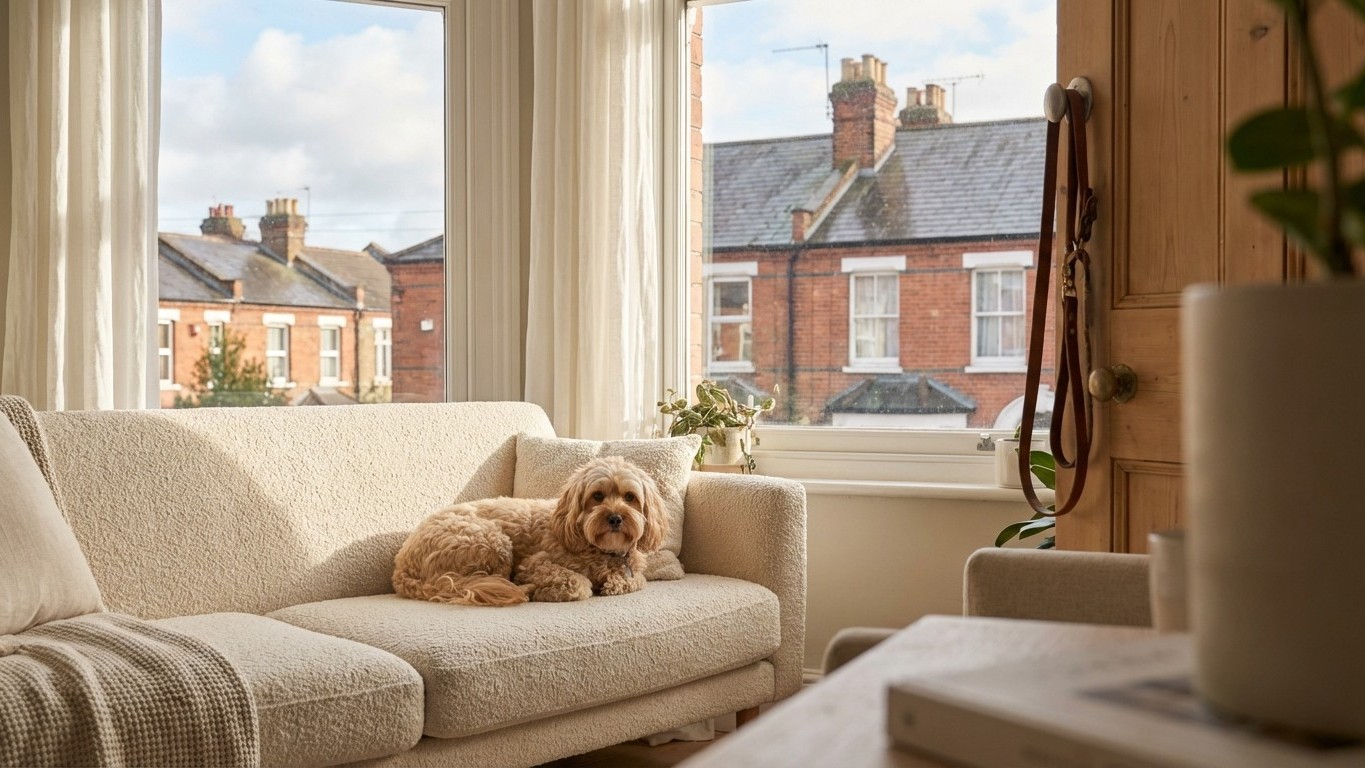
Sharing your flat with a dog in the UK is one of life’s quiet joys, morning walks before the office, a warm body on the sofa on a Sunday afternoon, the simple comfort of not coming home to an empty space. But choosing the wrong breed for a first-floor flat in Manchester or a conversion in South London can unravel that picture entirely. Thin walls, shared hallways, and landlords who scrutinise pet clauses make the choice of breed far more consequential here than it would be in a detached house with a garden.
Why the breed you choose matters more in a British flat than anywhere else
The specific pressures of UK flat living
British housing stock is, to put it generously, compact. Victorian terraces converted into flats, purpose-built 1960s blocks, new-build apartments with walls you could practically hear your neighbour breathing through, the acoustic reality of UK flat living is that your dog’s behaviour becomes, very quickly, everyone’s business. A dog that barks for two hours when left alone doesn’t just affect you; it affects the retired couple below, the shift worker next door, and eventually your tenancy agreement.
Space is the other pressure. Most UK flats offer between 40 and 70 square metres of living area, often without direct garden access. You’re relying on communal outdoor spaces, nearby parks, and strict walking routines. A dog with sky-high energy levels and no outlet will redecorate your walls in ways no deposit covers.
Regulations and what landlords actually expect
The legal picture has shifted. Since the 2021 model tenancy agreement update, social housing landlords in England can no longer impose blanket no-pets policies, tenants can request to keep pets, and refusal must be in writing with reasonable justification. Private landlords, however, still retain considerable discretion, and many still say no by default or charge higher deposits where pets are concerned.
Even where pets are permitted, leasehold flats often have head lease restrictions that override tenancy agreements. Always check both documents. Some blocks have specific rules about dog size (often capped at a vague “medium” without further definition), noise complaints processes, and requirements to keep dogs on leads in communal areas. Knowing this before you adopt a dog, not after, saves enormous heartache. For a fuller picture of breed-specific legislation and housing rules, the dog breeds guide UK is a useful starting point.
What to actually look for in a flat-friendly breed
Size: the myth and the reality
Small dogs are better for flats, right? Not necessarily. A Jack Russell Terrier weighs under six kilograms and will still bark at the postman, destroy cushions, and demand more exercise than many owners expect. Meanwhile, a Greyhound, which can stand 75cm at the shoulder, is famously happy sleeping for 18 hours a day and rarely makes a sound. Size is a proxy for suitability, but it’s a poor one used alone.
What size does affect is the practical logistics: a smaller dog is easier to carry in a lift, takes up less floor space, and generates less noise simply by moving around. These are genuine advantages in a flat. But they’re secondary to temperament.
Energy levels and indoor temperament
The question to ask isn’t “how big is this dog?” but “what does this dog do when it’s not being walked?” A calm, low-energy dog that settles easily indoors is your friend. A working breed that needs a task or a high-drive dog that paces when under-stimulated is, in a flat context, a welfare problem waiting to happen, for the dog as much as for you.
Breeds that were developed to work all day, Border Collies, Huskies, German Shepherds in some lines, can become destructive or vocally stressed when their needs aren’t met. That’s not a character flaw; it’s genetics doing exactly what it was designed to do. Choosing a breed whose natural resting state is compatible with flat life is genuinely kinder to the animal.
Barking: the deal-breaker no one talks about enough
If there is one factor that leads to dogs being rehomed from flats in the UK, it’s barking. Separation anxiety, territorial alerting, frustration barking, each has different triggers and different solutions, but all of them carry the same consequence in an apartment block: a formal noise complaint, potentially followed by pressure to rehome. Some breeds are simply more predisposed to vocalisation than others. Beagles, for instance, were bred to bay loudly on a trail; that instinct doesn’t switch off in a Hackney one-bed. Basenjis, conversely, are often called “barkless” (they yodel rather than bark, which is a sentence that deserves to exist).
Social compatibility with neighbours, children, and other animals
Flat living means shared lifts, communal gardens, and chance encounters in corridors. A dog that is consistently calm around strangers, comfortable with the unpredictability of children, and non-reactive towards other animals will make your daily life significantly easier. Socialisation from puppyhood matters enormously here, but breed predispositions for friendliness and low reactivity give you a better starting point.
The best dog breeds for UK flat living
These eight breeds consistently come up in conversations with urban dog owners, and for good reason. They represent a range of sizes and personalities, but all share the qualities that matter most in a flat: relatively low vocalisation, manageable energy indoors, and genuine adaptability to smaller spaces.
- Cavalier King Charles Spaniel — gentle, quiet, and happy with moderate exercise; the quintessential British flat dog, though prone to health issues that need monitoring
- French Bulldog — low energy, rarely barks, suits indoor living well; brachycephalic concerns mean you should only source from health-tested lines
- Greyhound / Whippet — the flat-living surprise package: low-energy indoors, minimal barking, elegantly calm; needs a daily sprint but settles beautifully afterwards
- Shih Tzu — bred as an indoor companion, genuinely content in small spaces, friendly with strangers
- Basenji — unique vocalisation pattern (low barking), independent, clean habits; best for experienced owners
- Bichon Frisé — cheerful, low-shedding, sociable with neighbours and other animals
- Pug — affectionate, low-energy, generally quiet; like French Bulldogs, health screening is non-negotiable given brachycephalic concerns
- Maltese — tiny, low-exercise needs, bonds closely with owners; can be prone to separation anxiety if not trained early
A brief note on the Greyhound, because it surprises people every time: rescue Greyhounds are among the most rehomed dogs in the UK, many coming from racing backgrounds. They’re usually house-trained, calm, and deeply appreciative of a warm sofa. For flat-dwellers willing to do a little training, adopting a retired racer is one of the most rewarding things you can do. The most popular dog breeds in the UK guide offers broader context on why certain breeds have surged in popularity for exactly these urban-living reasons.
Breeds that genuinely struggle in flats, and what to consider instead
Border Collies, Dalmatians, Siberian Huskies, and Weimaraners are routinely among the dogs surrendered to rescue centres by well-meaning urban adopters who underestimated the commitment involved. These are not bad breeds, they’re working breeds, or high-drive breeds, whose needs are genuinely difficult to meet in a flat environment regardless of how much you love them.
Beagles and Dachshunds, though popular and relatively small, both have strong vocalisation tendencies rooted in their scent-hound heritage. That’s not a reason to dismiss them outright, but it’s a reason to go in with open eyes, and robust separation anxiety training from day one.
If you’re drawn to a breed that seems like a stretch for flat living, honest conversations with breed-specific rescues (who know individual dogs’ personalities far better than any generalisation) are invaluable. You might find a mellow, middle-aged Beagle who barely whimpers. You might not. Know what you’re signing up for.
For a broader look at matching breeds to your actual lifestyle rather than an idealised version of it, the dog breeds guide covers this honestly and without the marketing gloss that sometimes colours breed profiles.
Making flat life genuinely work for a dog
Good routines are non-negotiable. Dogs in flats thrive on predictability: set walk times, a consistent feeding schedule, and structured alone-time training that builds their confidence gradually. Crate training, done properly and positively, gives a dog its own defined space within a small home, not as containment, but as a den they choose to use.
Physical enrichment matters as much as outdoor exercise. Puzzle feeders, scent games played in the hallway, training sessions that tire the brain, these reduce the pent-up energy that leads to barking and destruction. A twenty-minute sniff walk where a dog is allowed to investigate every lamppost and bin bag is more exhausting, neurologically, than a brisk thirty-minute trot on the lead.
If you’re renting, document your landlord’s written permission for the dog before you bring one home. Keep copies. Introduce yourself to immediate neighbours before the dog arrives, it’s a small social investment that pays dividends when the puppy has a noisy fortnight adjusting to its new home. And always, always consult a vet before adopting a breed with known health issues, particularly brachycephalic breeds. What looks like a lifestyle choice is also a welfare responsibility.
The dog breeds guide UK goes deeper on the particularities of choosing a breed specifically within the British context, climate, exercise infrastructure, and the cultural expectations around dog ownership that shape daily life here in ways that aren’t always obvious until you’re living them.
The real question isn’t which breed fits your flat. It’s which breed fits the life you actually live, in the city you actually live in, with the neighbours, routines, and square footage you actually have. Get that right, and the flat becomes irrelevant, it’s just home.