
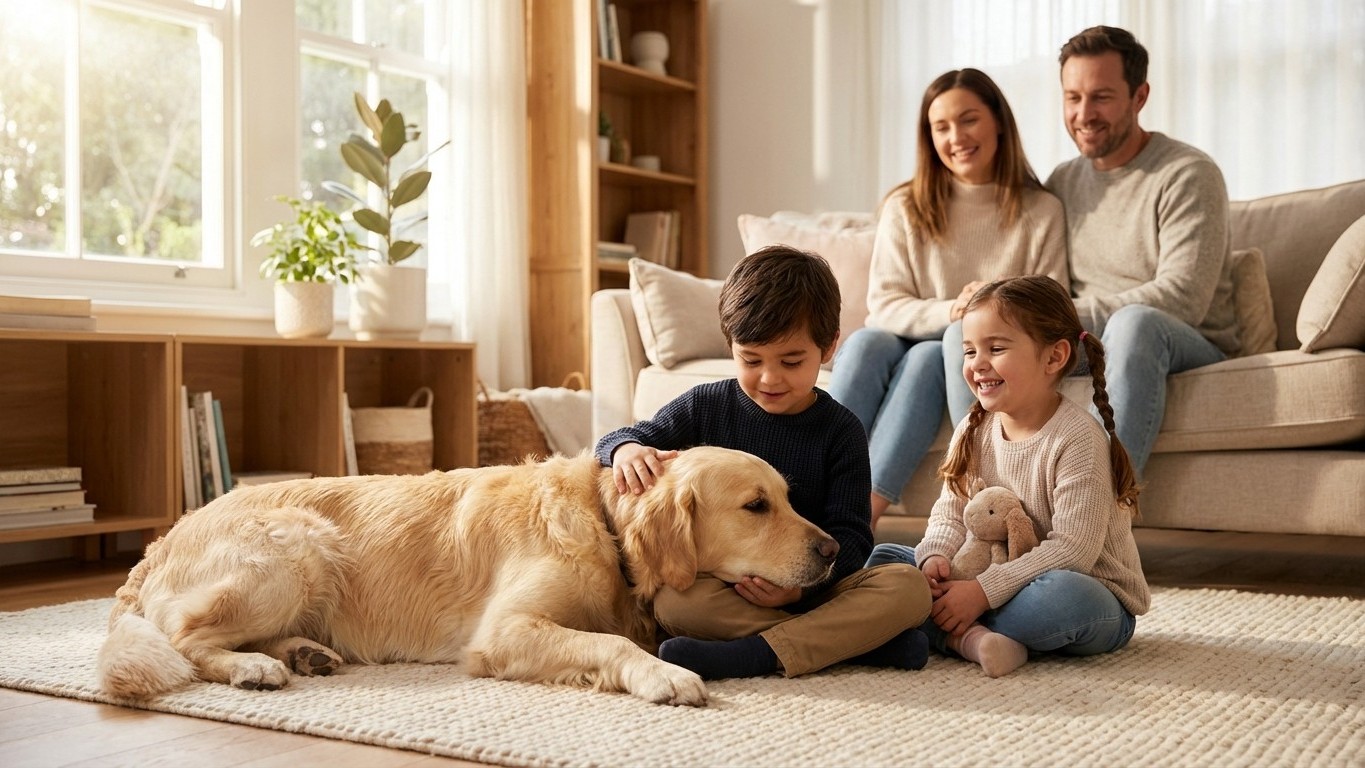
Choosing a dog when you have children at home is one of the most consequential decisions a family can make, and getting it wrong affects everyone, the kids, the dog, and your sanity at 7am on a school day. The good news is that certain breeds genuinely thrive alongside children, bringing patience, resilience and genuine affection into the home. The less obvious news is that “good with kids” means something far more specific than most people realise.
This best dog breeds guide for families with children cuts through the noise to give you a practical, honest framework: what to look for in a family breed, which dogs consistently deliver, and how to set the whole relationship up for success from day one.
Why Breed Choice Actually Matters for Families
There’s a popular argument that any dog can be good with children if it’s raised well. And while training and socialisation absolutely matter, genetics shape temperament in ways that no amount of positive reinforcement can fully override. A breed selected over centuries for guarding instincts will react differently to a toddler’s sudden shriek than one bred to retrieve game gently in a hunter’s hand. That’s not prejudice against any particular dog. It’s just honest biology.
The risk calculation here runs in both directions. A poorly matched breed can mean a stressed, overwhelmed dog who eventually snaps after months of tail-pulling and unexpected cuddles. That stress is a welfare issue for the dog, but it’s also a genuine safety concern for your children. Bite incidents involving children in the UK are overwhelmingly linked to situations where the dog’s warning signals were missed, not recognised, or where the dog had no comfortable retreat from persistent handling. Conversely, the right breed, well integrated, can become the emotional anchor of a child’s entire childhood. Research consistently shows that growing up with a dog builds empathy, responsibility and emotional resilience in children. The bond is worth pursuing. It just needs to be pursued thoughtfully.
The Criteria That Separate a Great Family Dog from a Risky Mismatch
Temperament: Patience, Gentleness and Genuine Tolerance
The single most important quality in a family dog isn’t obedience or size. It’s what behaviourists call “bite threshold”, essentially how much provocation a dog can absorb before reacting. High-threshold breeds tolerate the chaos of family life with remarkable equanimity. They can handle a four-year-old tripping over them, a teenager stealing their spot on the sofa, and a baby screaming three feet from their ear, all in the same afternoon, without their mood shifting dangerously. Patience is partly learned but mostly inherited. When researching a breed, look specifically at temperament standards written by the breed’s official UK club, not just marketing descriptions from breeders.
Energy Levels and Exercise Needs
High-energy breeds with children can be wonderful, but the maths has to work. A Border Collie in a family with young children who can’t walk two miles a day is a recipe for a dog who herds the kids obsessively, destroys furniture, and generally becomes unmanageable. Families with older children who love outdoor life might find that energy a perfect fit. Younger families with babies and toddlers often do better with breeds that have moderate exercise needs, something that thrives on a good daily walk rather than a training session and a five-mile run.
Size, Robustness and Physical Interaction
This is where conventional wisdom gets it backwards. Many people assume small dogs are safer around young children. Often, the opposite is true. Tiny breeds like Chihuahuas or Toy Pomeranians are physically fragile and can respond defensively when accidentally hurt by a clumsy toddler. Medium to large breeds, counterintuitively, tend to handle rough handling with more physical and emotional resilience, provided their temperament is sound. A Labrador who gets sat on by a three-year-old typically just wanders off. A small terrier in the same situation may feel cornered and react.
Grooming, Shedding and the Reality of Family Life
No one wants to spend Sunday afternoons elbow-deep in dog hair when there are sports fixtures, homework battles and a roast to organise. Shedding is worth factoring in honestly. Heavy shedders like German Shepherds require significant hoovering commitment. If allergies are a concern in your household, lower-shedding breeds such as Poodles and Poodle crosses become relevant, though no dog is genuinely hypoallergenic since the allergen is carried in skin cells and saliva, not just fur.
Health and Longevity in a Family Context
Dogs with serious health problems create emotional and financial stress that impacts the whole family. Flat-faced breeds (Bulldogs, Pugs) often struggle with breathing issues that require ongoing vet care. Giant breeds tend to have shorter lifespans, which means children may face bereavement quite young. This isn’t a reason to avoid these breeds entirely, but it’s worth weighing up honestly. Always ask a vet for guidance on breed-specific health concerns before committing, and look for breeders who health-test their breeding stock.
Breeds That Consistently Shine in Family Settings
Labrador Retriever: The Reliable Classic
There’s a reason Labradors have sat at the top of UK Kennel Club registration charts for decades. They combine high bite thresholds, genuine enthusiasm for people of all ages, and an almost supernatural tolerance for chaos. They’re robust enough to weather the physical attentions of young children, smart enough to train relatively easily, and motivated enough by food and praise to make teaching household rules straightforward. Their exercise needs are real (a bored Labrador will eat your kitchen) but manageable with two decent walks per day. The main downside is shedding, which is considerable.
Golden Retriever: Softness and Adaptability
If Labradors are the sensible choice, Golden Retrievers are the romantic one. They have an almost theatrical gentleness, a breed-wide reputation for patience, and a soft mouth inherited from their retrieving heritage. Goldens tend to be sensitive souls, meaning they respond poorly to harsh training and thrive in calm, affectionate households. Families who shout a lot or run a chaotic home may find a Golden becomes anxious. In the right setting, though, few breeds bond with children more deeply.
Cavalier King Charles Spaniel: Small Dog, Big Heart
Among the smaller breeds, the Cavalier stands apart. Unlike many toy breeds, Cavaliers were specifically developed as companion dogs and show a genuine, settled warmth around children. They’re portable enough for flats or smaller homes, and their exercise needs are modest. The caveat here is health: Cavaliers have well-documented breed-specific health issues including heart conditions and neurological problems. Anyone considering this breed should research these seriously, seek health-tested breeding lines, and build a relationship with a vet early. The breed is a joy; the commitment needs to go in with eyes open.
Beagle: Sturdy, Playful and Sociable
Beagles are an interesting choice that families sometimes overlook. They’re physically robust, genuinely playful, and pack-oriented in a way that makes them naturally social with a household full of people. They also have a stubborn streak and a nose that functions essentially as a second brain, which means they require patience during training and secure, fenced gardens. For active families who can channel that energy, a Beagle fits beautifully.
Poodle: The Underrated All-Rounder
Standard Poodles in particular are the most intelligent dogs on the planet, and that intelligence makes them highly trainable and adaptable. Their low-shedding coat makes them a practical option for families with mild allergies. They’re playful without being boisterous, affectionate without being clingy, and they tend to have good physical and emotional resilience. The haircuts may look fussy, but the dogs themselves are anything but precious.
Staffordshire Bull Terrier: The Misunderstood Softy
Staffies carry an undeserved reputation that doesn’t survive contact with the actual dogs. They were historically nicknamed “nanny dogs” in Britain for their affection and protectiveness towards children, and that temperament remains. They’re physically sturdy, warmly affectionate, and typically excellent with the children they know. Early socialisation matters, as it does for any breed, and their strength means training shouldn’t be neglected. But as a family dog in a committed household, a well-bred and well-raised Staffie is genuinely hard to beat.
A Quick Word on Other Options
Families with very specific lifestyles might look beyond these headline breeds. Flat-dwelling families with older children might consider a Whippet, surprisingly calm indoors and delightfully quick outside. Families with older kids who want a working dog experience might find a Flat-Coated Retriever thrilling. For those navigating the question of dogs and cats in the same household, the dog breeds guide good with cats offers a more targeted look at breeds that manage multi-pet households well.
Practical Steps for Bringing a Dog into a Family Home
Preparing Children and Setting the Rules
Before the dog arrives, children need clear, specific instruction, not vague ideas about “being kind.” Teach them never to approach a dog eating or sleeping, to avoid hugging around the neck (which many dogs find threatening), and to let the dog come to them rather than rushing towards it. Role-play these scenarios with younger children. Make it a game. The rules need to feel normal by the time the dog walks through the door.
The Adaptation Phase: Patience and Vigilance
The first few weeks are when most problems take root. A new dog is processing an entirely new environment, new people, new smells and new sounds all at once. Keep initial interactions calm and brief. Give the dog a safe retreat (a crate, a bed in a quiet corner) that children are not allowed to enter. Supervision during interactions is non-negotiable for young children, no matter how lovely the breed. Even the most patient dog can be pushed too far if a toddler repeatedly tries to climb on it unsupervised.
Common Questions and Mistakes Worth Avoiding
One question that comes up constantly is whether a dog chosen for its gentle reputation can ever still bite a child. Honestly, yes. Any dog can bite under sufficient stress or pain. That’s not a reason for fear; it’s a reason for respect and ongoing supervision. The mistake families make most often isn’t choosing the wrong breed, it’s assuming that a good breed means zero vigilance is needed.
Another frequent error is underestimating the exercise commitment. Families often research breeds thoroughly pre-dog and then find life with a baby or a demanding job leaves the dog under-walked for months. Under-exercised dogs develop behavioural problems that then get attributed to the breed. The breed usually isn’t the problem.
If you’re still in the research phase and want a broader view of how lifestyle factors should shape your choice, the dog breeds guide covers the full picture across different living situations and owner profiles.
Explore Further: Guides for Specific Family Situations
Different families have different constraints, and a good breed choice for one household can be a poor fit for another. If your family includes a grandparent or older adult who will share the dog’s care, the dog breeds guide for seniors addresses the specific needs of calmer routines and manageable sizes. For households where a dog needs to coexist peacefully with existing cats, the dedicated dog breeds guide good with cats walks through both breed selection and introduction strategies in detail.
Comparing the Top Family Breeds at a Glance
Every family’s circumstances are different, so no single breed tops the list for everyone. That said, here’s a quick comparison of the breeds covered above across the criteria that matter most in family life:
- Labrador Retriever: High energy, very robust, excellent patience, heavy shedder, easy to train
- Golden Retriever: Moderate-high energy, gentle and sensitive, low aggression threshold, moderate-heavy shedder
- Cavalier King Charles Spaniel: Low-moderate energy, adaptable to smaller homes, significant health caveats, minimal shedding
- Beagle: Moderate-high energy, sturdy, scent-driven, requires secure garden, moderate shedding
- Poodle (Standard): High energy, very intelligent, low shedding, excellent trainability
- Staffordshire Bull Terrier: Moderate energy, physically robust, very affectionate, low grooming needs
The breed that fits your family best is ultimately the one whose needs align with your real daily life, not your ideal version of it. Honest self-assessment about time, space, activity levels and budget matters as much as breed temperament charts. And if you’re still weighing up the bigger picture of which dog suits your whole household profile, the best dog breeds guide for families with children covers the full range of household configurations, from young families to multi-pet homes to households with older adults, in one place.
The dog you bring home won’t be perfect. Neither will your children around the dog. The relationship that develops between them, through the learning and the mishaps and the years of accumulated trust, is the thing that makes it all worthwhile.